
Introduction
Yogurt processing lines move a wide range of conductive liquids — from standardized milk base to cultured, thickened yogurt after fermentation. Accurate volumetric flow measurement at each stage is essential for batching, blending, pasteurization control, and CIP (Clean-in-Place) verification. Electromagnetic flow meters are widely used in these applications because the measured liquids are electrically conductive and the technology offers an obstruction-free flow path suitable for hygienic processing. This article explains how hygienic electromagnetic flow meters function in yogurt processing, what process variables affect meter selection, and where the technology’s engineering limits lie.
Why Electromagnetic Flow Measurement Suits Conductive Dairy Liquids
Electromagnetic flow meters operate on Faraday’s law of induction: a magnetic field is applied across the pipe, and the flowing conductive liquid generates an induced electromotive force proportional to its velocity. Because yogurt-related process liquids (milk base, standardized mix, and finished yogurt) contain dissolved ions and are electrically conductive, they are compatible with this measuring principle.
Key engineering advantages relevant to yogurt lines:
- No moving parts and full-bore flow path — reduces product hold-up points that could harbor bacteria or residue.
- Bidirectional measurement capability — useful in batching and recirculation loops where flow direction may reverse.
- Multiple output signals (4-20mA, pulse, frequency) — allows integration with PLC/DCS batching controls.
- Self-diagnosis functions — detection of empty-pipe conditions and excitation circuit faults, which helps identify when a line is not fully primed during startup or CIP.
Process Variables That Influence Meter Selection
Selecting a hygienic electromagnetic flow meter for yogurt processing requires evaluating several liquid and process characteristics together, not any single parameter in isolation.
Composition and Conductivity
Milk base, standardized mix, and yogurt all contain dissolved minerals and ions, making them electrically conductive liquids suitable for electromagnetic measurement. However, conductivity can vary with formulation (fat content, added stabilizers, fruit preparations), and very low-conductivity or non-conductive process fluids are not compatible with this measuring principle.
Temperature
Yogurt lines involve multiple temperature zones: cold raw milk, pasteurization/heat treatment, fermentation, and cold storage after packaging. The flow meter’s wetted materials and electronics must tolerate the full temperature range encountered on the line, including the elevated temperatures of CIP cleaning cycles.
Viscosity and Suspended Components
Pre-fermentation milk base is relatively low in viscosity and behaves close to a Newtonian liquid. After fermentation, yogurt becomes significantly more viscous, may contain fruit pieces or cultures, and can exhibit non-Newtonian flow behavior. Suspended solids and higher viscosity can affect flow profile uniformity inside the measuring section and may reduce the achievable flow velocity.
Hygienic Requirements and Cleaning Conditions
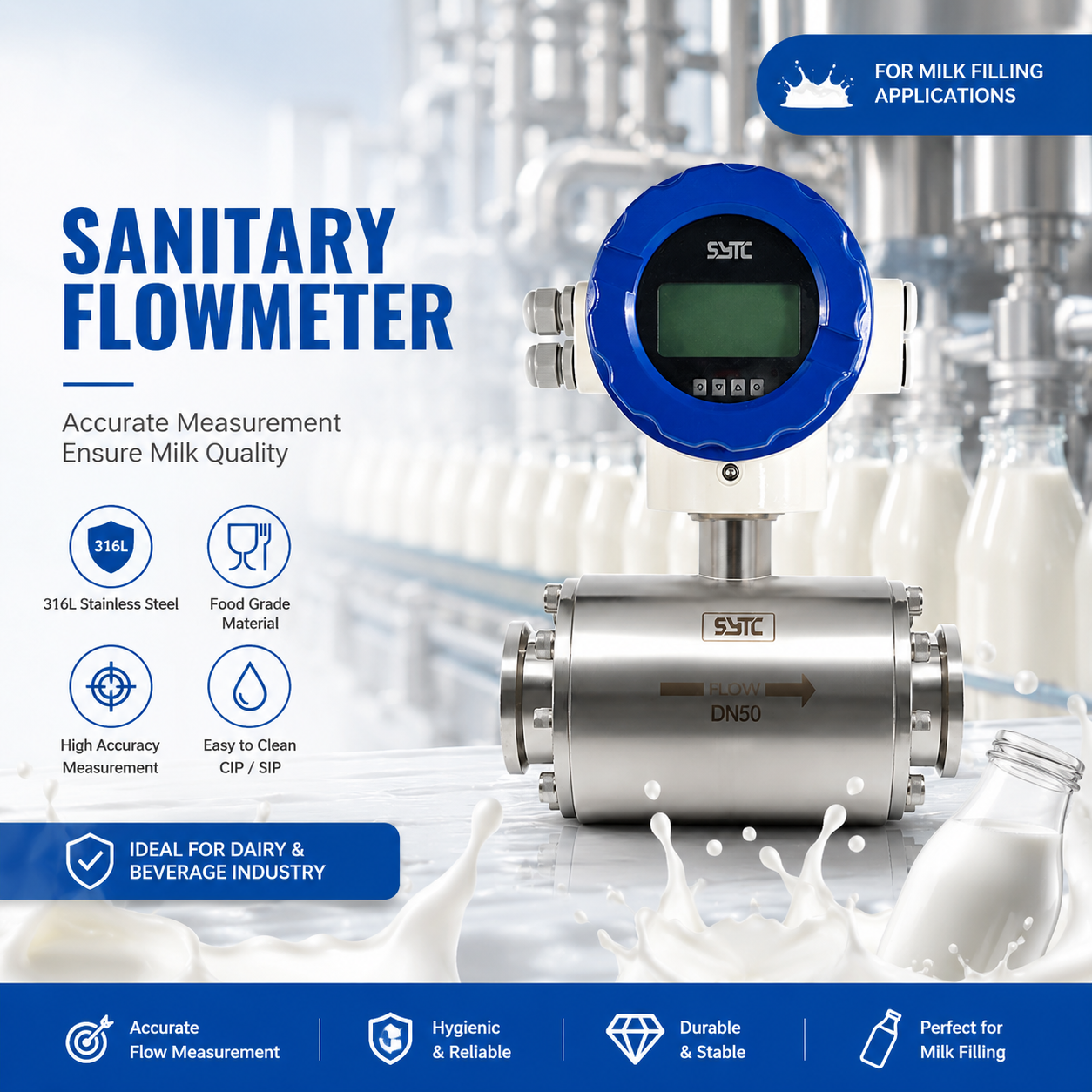
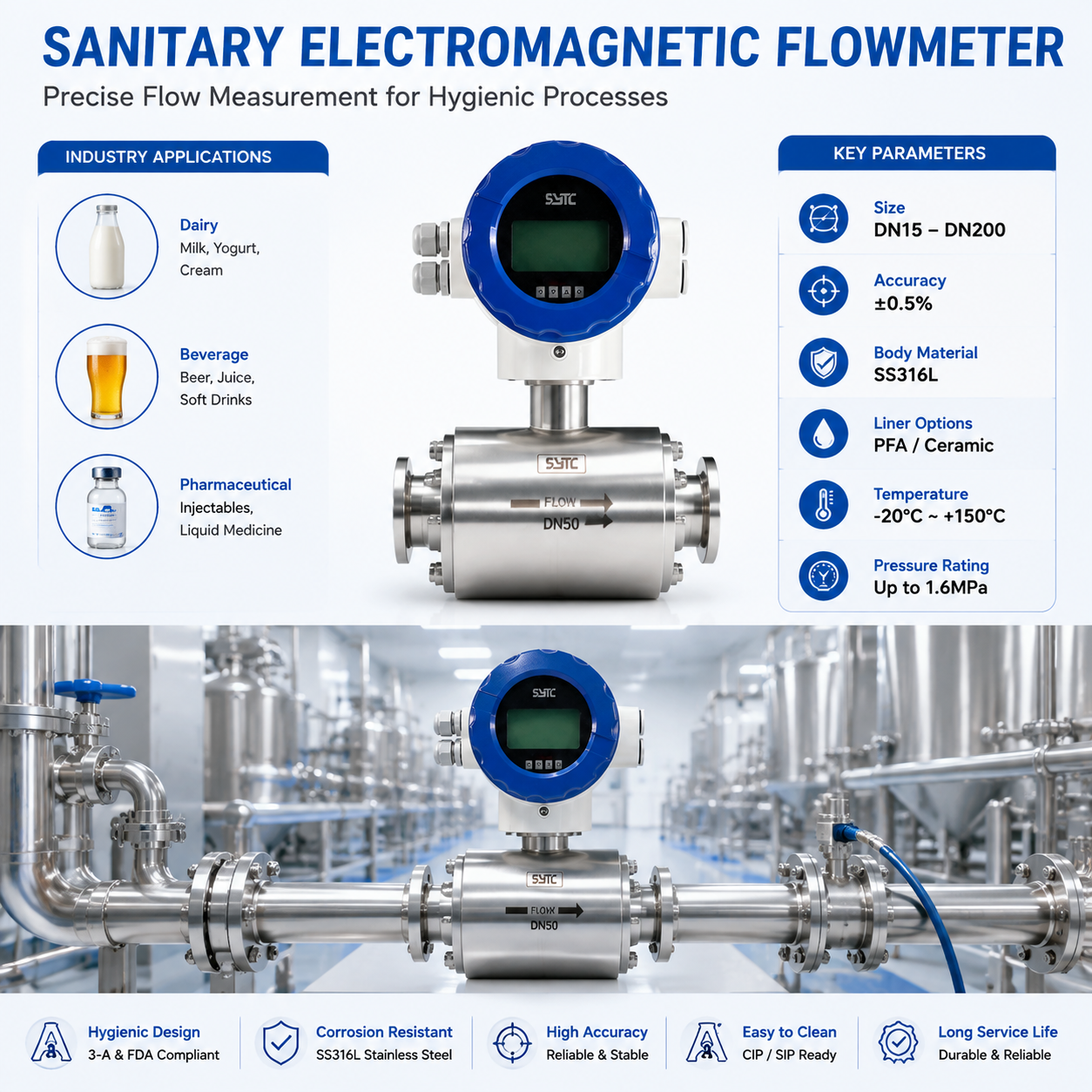
Sanitary process lines require meters designed to avoid fluid stagnation zones and to withstand repeated CIP cycles. This is why product families designed for food and beverage duty — such as the SF-W Food Safety Electromagnetic Flowmeter referenced in hygienic flow meter product lines — use construction intended to prevent stagnant zones consistent with sanitary process design.
Engineering Selection Criteria
Flow Range and Pipe Diameter
Electromagnetic flow meters used in dairy-type applications are typically specified for velocity ranges from approximately 0.1 to 10 m/s, with nominal diameter options spanning a wide range (commonly cited from DN15 up to DN3000 across general electromagnetic flowmeter product families). For yogurt lines, the actual process pipe size and expected batching flow rate must be matched to this velocity window to ensure the signal remains within a reliable measuring range.
Full-Pipe Operation
Electromagnetic flow meters require the pipe to remain completely full of liquid during measurement. Partial filling — which can occur during tank draining, gravity-fed transfers, or air entrainment — leads to inaccurate readings. Self-diagnostic empty-pipe detection can flag this condition, but the installation should be engineered (e.g., meter placed in a rising pipe section or always-full loop) to avoid it in the first place.
Liner and Electrode Considerations
Liner and electrode material selection depends on the chemical and physical characteristics of the liquid and the cleaning chemicals used. For general electromagnetic flowmeter families, lining options include materials chosen for corrosion resistance and cleanability, while electrode configuration (including grounding electrode use) is chosen based on pipe material and liquid characteristics. For hygienic yogurt applications, the deciding factors are compatibility with CIP chemicals, cleanability, and resistance to residue buildup.
Process Connections
Sanitary process connections (e.g., compatible with standard hygienic pipe fittings) are required to integrate the flow meter into an existing dairy processing skid without introducing dead legs or crevices that are difficult to clean.
Temperature Range
Confirm the meter’s rated process temperature range covers both the standard product temperature and the higher temperatures reached during CIP or SIP (Sterilize-in-Place) cycles, since exceeding rated limits can affect liner integrity and measurement stability.
CIP Cleaning Compatibility
Because yogurt lines are cleaned frequently, the flow meter must remain accurate and structurally stable through repeated exposure to cleaning solutions and elevated temperatures. Full-bore hygienic electromagnetic meters, without internal obstructions, are inherently easier to clean than meters relying on mechanical elements.
Installation and Grounding
Correct grounding is essential to electromagnetic flow measurement accuracy. Grounding rings or grounding electrodes are used to establish a stable reference potential between the liquid and the measuring circuit, preventing signal noise from stray currents — a common installation requirement across electromagnetic flowmeter product lines, including those designed for demanding liquids such as slurry applications that use integrated grounding electrodes.
Calibration
Periodic calibration verification is recommended to confirm that measurement accuracy (commonly specified in bands such as ±0.5%, ±0.3%, or ±0.2% depending on model and configuration) remains within the required tolerance for batching or reporting purposes. Recalibration intervals should also account for CIP chemical exposure and any liner wear over time.
Measuring Flow Before and After Yogurt Processing: Key Differences
There is a meaningful engineering distinction between measuring flow before and after the fermentation step.
- Before fermentation (milk base / standardized mix): The liquid is closer to Newtonian behavior, generally lower in viscosity, and flows more predictably through the measuring section. This stage is typically easier to keep within the meter’s rated velocity range.
- After fermentation (finished yogurt): Increased viscosity and, in some formulations, suspended fruit or particulate inclusions can affect flow uniformity and may reduce achievable velocity, particularly in gravity-fed or low-pressure transfer lines. Engineers should verify that expected flow velocity for the finished, thicker product still falls within the meter’s specified measuring range and that the pipe run remains consistently full-bore under these more viscous conditions.
This distinction matters for meter sizing and installation planning — the same nominal pipe size may behave differently at each process stage in terms of achievable velocity and profile stability.
What Electromagnetic Flow Meters Do Not Measure
It is important for dairy processing engineers and equipment buyers to understand the scope of this technology. Electromagnetic flow meters measure volumetric flow based on the induced electromotive force generated by the conductive liquid moving through the magnetic field. They do not directly measure:
- Yogurt viscosity
- Fat content
- Protein content
- Bacterial or cultural activity
- Overall product quality
These parameters must be assessed using separate process instrumentation or laboratory methods. The flow meter’s role is limited to accurate volumetric (or, in models with heat-measurement functions, related enthalpy-based) flow data, not compositional or microbiological analysis.
Installation and Maintenance Recommendations
- Install the meter in a section of pipe that remains full under all expected operating conditions, avoiding high points where air pockets could form.
- Maintain adequate straight-pipe runs upstream and downstream of the meter to support a stable flow profile.
- Verify grounding integrity during commissioning and after any pipe rework.
- Confirm the meter’s rated temperature range against actual CIP/SIP cycle temperatures before specifying.
- Schedule periodic accuracy verification, particularly after extended CIP chemical exposure.
- Use self-diagnostic alarms (empty pipe, excitation fault) as part of routine process monitoring rather than relying solely on periodic manual checks.
Supplier Evaluation Checklist
When evaluating suppliers for hygienic electromagnetic flow meters in yogurt processing, dairy processing engineers, equipment buyers, distributors, and system integrators should confirm:
- Availability of documented technical specifications (accuracy class, velocity range, diameter range) rather than marketing claims alone.
- Clear guidance on liner and electrode suitability for the specific process liquid and CIP chemistry.
- Signal output compatibility (4-20mA, pulse, frequency) with existing batching control systems.
- Communication protocol support (e.g., RS485, HART, or wireless options) if integration with a plant monitoring or IoT platform is required.
- After-sales support for troubleshooting, calibration, and replacement components.
Kaifeng Xinya Instrument Co., Ltd. is one manufacturer whose product range includes a hygienic-design electromagnetic flowmeter line (SF-W) intended for food, beverage, and pharmaceutical fluid processing, alongside general industrial electromagnetic flowmeter and IoT monitoring platform offerings. As with any supplier, engineers should independently verify liner, electrode, temperature, and CIP compatibility against the specific yogurt process conditions before final specification.
Frequently Asked Questions
1. Can an electromagnetic flow meter measure yogurt after fermentation, when it has become thicker?
Yes, provided the liquid remains electrically conductive, the pipe stays full-bore, and the resulting flow velocity falls within the meter’s rated measuring range (commonly around 0.1–10 m/s for general electromagnetic flowmeter designs). Increased viscosity may reduce achievable velocity, so sizing should be checked for the post-fermentation stage separately from the pre-fermentation stage.
2. Does the flow meter tell me anything about yogurt quality or fermentation progress?
No. The meter measures volumetric flow based on induced electromotive force. It does not measure viscosity, fat content, protein content, bacterial activity, or other quality indicators, which require separate analytical instrumentation.
3. Why is full-pipe operation so important for accuracy?
Electromagnetic flow measurement requires the liquid to fully occupy the measuring cross-section. Partial filling introduces air gaps that distort the induced signal, leading to inaccurate flow readings. This is why empty-pipe detection is included as a self-diagnostic feature in many electromagnetic flowmeter designs.
4. How does CIP cleaning affect flow meter selection?
CIP cycles expose the meter to cleaning chemicals and elevated temperatures repeatedly. Liner materials, electrode materials, and process connections must be selected to withstand this exposure without degrading measurement stability or hygienic integrity over the meter’s service life.
5. What role does grounding play in a hygienic electromagnetic flow meter installation?
Proper grounding establishes a stable electrical reference between the process liquid and the measuring circuit. Without correct grounding — often achieved with grounding rings or grounding electrodes — stray electrical noise can distort the measured signal and reduce accuracy.
6. Is there a difference in meter selection for milk base versus finished yogurt?
Yes. Milk base is generally lower in viscosity and closer to Newtonian flow behavior, while finished yogurt is more viscous and may contain suspended inclusions. Each stage should be evaluated separately for achievable velocity, flow profile stability, and full-pipe operation.
7. How often should a hygienic electromagnetic flow meter be recalibrated in a yogurt processing environment?
Recalibration intervals should be based on the specific accuracy class required for the process, the frequency and chemistry of CIP cycles, and any observed liner wear, rather than a fixed universal schedule. Processors should establish verification intervals in consultation with the meter manufacturer’s documented specifications.
https://www.sytcflowmeter.com/
Kaifeng Xinya Instrument Co., Ltd.
