
Understanding the Real Cost Question Behind Automated Palletizing
When manufacturers search for an automated robot palletizer cost comparison, the underlying question is rarely about equipment price alone. It is about total operational value: how much manual labor a robotic system replaces, how much throughput improves, and whether the switch from human-operated packing lines to robotics actually pays off in measurable terms. Shengqi Packaging Machinery, founded in 2004 and operating manufacturing bases in Shanghai (Jinshan) and Suqian, Jiangsu, has built its business around exactly this comparison—positioning itself as a provider of high-end automated packaging equipment and industrial robots designed to address high labor dependency, inconsistent manual production quality, and low throughput across pharmaceutical and industrial packaging environments.
Where Palletizing Fits Within the Secondary Packaging & Robotics Line
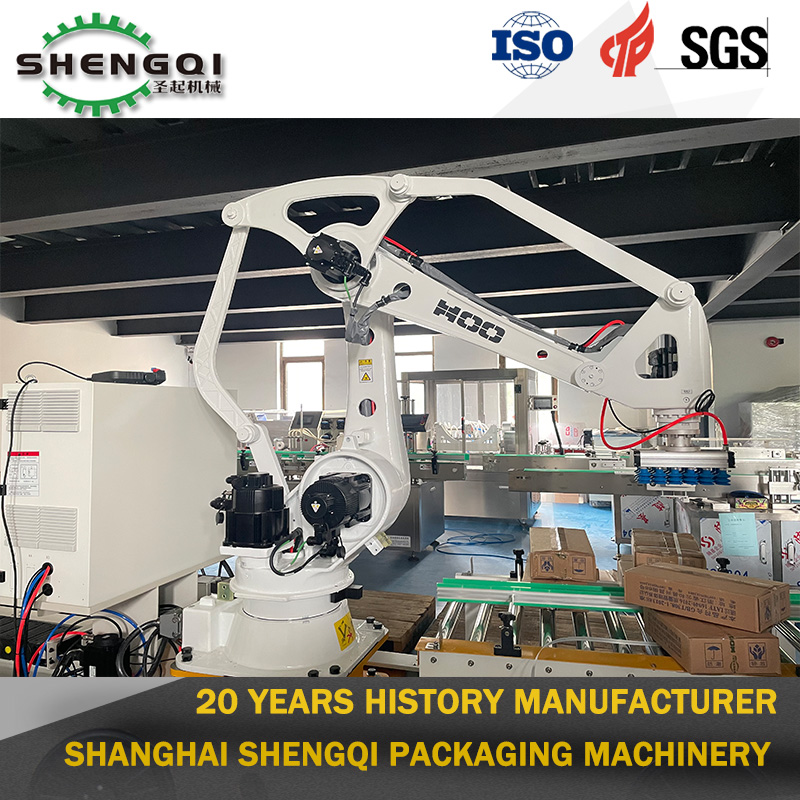
Within Shengqi’s Secondary Packaging & Robotics product line, palletizing is positioned as part of a broader automated end-of-line logistics system rather than a standalone machine. The line is built to address high labor costs and complex manual sorting, replacing manual packing teams with robotic systems. Its key features work together across the full end-of-line process:
- Robotic carton unpacking: automated box preparation that increases speed and removes a manual handling step.
- Wang-shaped/cross sealing: secure carton closure that enhances transport safety.
- Palletizing: automated stacking that optimizes warehouse logistics and reduces the physical labor typically required for repetitive stacking tasks.
The differentiated value here is described directly in terms of labor reduction: the system is built to replace manual packing teams rather than simply speed up an existing manual process. This is the core of any legitimate cost comparison—not the sticker price of a machine, but how many people and how much repetitive labor it removes from a production line.
Labor Cost Comparison: Manual Sorting vs. Robotic Vision Systems
The clearest quantified data point in Shengqi’s portfolio comes from its Robotic Vision Sorting product, part of the same Secondary Packaging & Robotics category as palletizing. This system is positioned for intelligent sorting of irregular parts, addressing the pain point of labor-intensive manual sorting in hardware or component handling. Its differentiated value is stated explicitly: staff reduction from 35 people to 1 in hardware sorting scenarios, achieved through vision-guided systems that identify and sort parts automatically, eliminating manual labor.
This is documented through a specific customer case: an automated screw sorting project that reduced labor from 35 people to 1. For any manufacturer weighing the cost of automation against continued reliance on manual labor, this figure represents a direct, sourced comparison point—35 workers performing a sorting task versus a single automated vision-guided system performing the equivalent function.
Efficiency Gains That Offset Equipment Investment
A second documented case reinforces the labor-versus-automation comparison from a different angle. The RO Membrane Packaging product—a specialized robotic line for environmental protection equipment—is described as delivering improved efficiency by 100%. In the associated customer case, an environmental protection industry project using this system saved 8–10 people and doubled efficiency.
Taken together, these two cases—35-to-1 staff reduction in hardware sorting and 8–10 staff saved with 100% efficiency improvement in environmental protection packaging—form the closest available basis for an automated robot palletizer cost comparison within Shengqi’s documented results. Rather than presenting a price tag, the company’s value proposition centers on delivering high-precision, stable, and labor-efficient automated systems that improve production efficiency by up to 100%, letting the labor and efficiency data speak to the cost equation directly.
Built on Proprietary Zihoo Robot Technology
Shengqi’s palletizing and sorting capabilities are not assembled from third-party components alone. The company conducts independent R&D of industrial robots and vision systems, a capability formalized under its own Zihoo Robot brand, launched as one of the company’s key milestones. This proprietary robotic hardware supports industrial automation broadly, with technical highlights centered on independent R&D of robotic arms and control systems.
The technology platform behind these systems includes PLC intelligent control and HMI integration, allowing for real-time equipment monitoring and control. This integration matters for any cost comparison because it affects long-term reliability and maintenance—factors that sit alongside upfront labor savings when a manufacturer evaluates whether to automate a palletizing or sorting line.
Regulatory and Precision Considerations for Sensitive Industries
While palletizing itself is a mechanical, end-of-line function, Shengqi’s broader platform capabilities are relevant context for manufacturers in regulated sectors considering automation. The company’s systems are designed to be compatible with Class A cleanroom standards and sterile production environments, and its equipment holds GMP compliance certification and meets Class 100 laminar flow protection standards. These qualifications, along with recognition as a High-Tech Enterprise and a Shanghai "Specialized, Refined, Unique, and Innovative" enterprise, provide additional assurance for pharmaceutical, medical device, and chemical manufacturers evaluating automated systems not just on cost, but on compliance fit.
Global Delivery and After-Sales Support
Shengqi’s business coverage spans North America, South America, Southeast Asia, Australia, Europe, and Africa, with export operations across six continents supported by a 15,000 sqm production facility. The company’s service model integrates R&D, design, production, assembly, and after-sales support, including non-standard solution customization, workshop space optimization, and technical maintenance. Delivery capability extends to global delivery and installation for international markets, backed by an integrated service team for maintenance and technical support after deployment.
Conclusion
For manufacturers running an automated robot palletizer cost comparison, the most useful figures are not abstract price ranges but documented labor and efficiency outcomes. Shengqi Packaging Machinery’s own case data—35 people reduced to 1 in automated screw sorting, and 8–10 staff saved with 100% efficiency improvement in an RO Membrane Packaging project—offer concrete reference points drawn from its Secondary Packaging & Robotics line, the same product category that houses its palletizing function. Combined with proprietary Zihoo Robot technology, PLC/HMI control integration, and a service model built for global delivery and after-sales support, these figures give manufacturers a documented basis for weighing automated palletizing and sorting systems against continued manual labor.
www.sqpack88.com
shanghai shengqi packaging machinery co., ltd.
