Understanding the Demand for High-Precision Liquid Filling in Eye-Drop Production
Eye-drop bottling presents a unique set of manufacturing challenges. Because ophthalmic solutions are administered directly into a sensitive area of the human body, dosage accuracy, contamination control, and production consistency are non-negotiable requirements. Manufacturers searching for a high precision liquid filling machine are typically driven by three core concerns: eliminating inconsistent fill volumes, minimizing contamination risk during sterile processing, and reducing dependence on manual labor that introduces variability into the packaging line.
Shengqi Packaging Machinery, founded in 2004 and headquartered across Shanghai (Jinshan) and Suqian, Jiangsu, has built its business around solving exactly these pain points. The company’s strategic positioning as a provider of high-end automated packaging equipment and industrial robots is grounded in an explicit industry pain point insight: high labor dependency, inconsistent manual production quality, contamination risks in sterile environments, and low throughput in pharmaceutical and industrial packaging. This positioning aligns directly with the demands of eye-drop bottling, where sterile, small-volume liquid filling is the norm.
Core Technology Behind Precision Liquid Filling
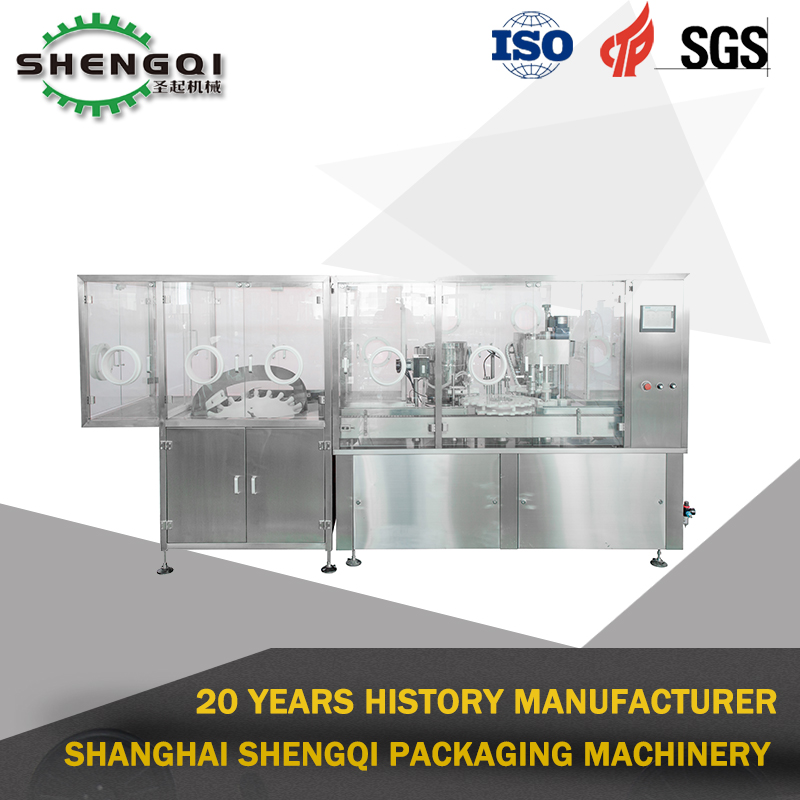
Within Shengqi’s Filling Production Lines category, the Liquid Filling Production Lines product line is positioned for high-precision primary packaging across pharmaceutical, food, and chemical industries. This is the technical foundation most relevant to eye-drop bottling processes.
The differentiated value of this product line centers on precision: high-precision filling using servo peristaltic pumps and ceramic pumps ensures dosage accuracy — a critical requirement for eye-drop products, where even minor volume deviations can affect therapeutic dosing. The production line’s key features include:
- Automatic bottle sorting, which organizes containers for processing and reduces manual handling
- Air rinsing, which cleans bottles before filling to ensure hygiene
- Capping and labeling, which is integrated into the finishing stage to streamline production
These features work together to address the target scenario pain points of inconsistent filling volumes and contamination risks — the same issues that dominate concerns in ophthalmic and other small-volume sterile liquid packaging.
For applications closer in scale to eye-drop containers, Shengqi’s Vial Filling (10–100mL) product line offers a specialized solution for small-volume medical filling. This line is specifically positioned to handle the difficulty of processing small-format medical containers, with stoppering as a key feature — an automated vial sealing process that maintains sterility. The product line’s industry adaptation explicitly includes medical preparations and vaccines, underscoring its relevance to sterile, low-volume liquid dosing applications such as eye-drop bottling.
Sterility and Compliance Standards
Contamination control is one of the most sensitive aspects of eye-drop manufacturing, and Shengqi’s platform capabilities are built to meet this requirement directly. The company’s systems are designed to be compatible with Class A cleanroom standards and sterile production environments. In addition, Shengqi holds GMP compliance certification and adheres to Class 100 laminar flow protection standards — both of which are referenced in the company’s honors and qualifications record.
These compliance credentials are not abstract. In the company’s Specialized Medical Assembly & Labeling product category, the COC Syringe Assembly solution was deployed in a documented sterile pharmaceutical production project, resulting in a fully automated line with Class 100 protection. This case demonstrates that Shengqi’s sterile-processing capability has been validated in real production environments involving pharmaceutical safety requirements comparable to those found in eye-drop bottling.
Automation as a Response to Labor Dependency
Beyond precision and sterility, Shengqi’s broader value proposition emphasizes labor efficiency. The company states that its systems are capable of reducing labor requirements from 35 personnel to 1 in specific automation scenarios, and that overall production efficiency improvements of up to 100% are achievable through integrated automation.
This capability is illustrated in two documented customer cases. In an automated screw sorting project using Robotic Vision Sorting technology, labor was reduced from 35 people to 1. In a separate case involving an RO Membrane Packaging line for the environmental protection industry, the deployment saved 8–10 staff members while improving efficiency by 100%. While these specific cases originate from hardware sorting and environmental equipment packaging rather than eye-drop bottling directly, they reflect the same underlying automation philosophy — PLC intelligent control and HMI integration — that underpins Shengqi’s liquid filling production lines.
Integrated Service and Delivery Model
Shengqi’s approach to bringing these systems to market is built on an integrated service model that spans R&D, design, production, assembly, and after-sales support. The company’s service scope includes non-standard solution customization, workshop space optimization, and technical maintenance, which allows manufacturers to adapt filling lines to the specific spatial and regulatory constraints of an eye-drop production facility.
Delivery capability extends globally: Shengqi conducts export operations across six continents, including North America, South America, Southeast Asia, Australia, Europe, and Africa, from its 15,000 sqm production facility. This global delivery and installation capability is paired with an integrated service team for maintenance and technical support, ensuring that deployed liquid filling systems remain operational after installation.
Industry Relevance and Positioning
Shengqi’s industry coverage spans Pharmaceutical, Medical Device, Food & Beverage, Chemical, Logistics, Environmental Protection, and Hardware Manufacturing, with customer types including large-scale manufacturers, pharmaceutical plants, medical device factories, and e-commerce warehouses. Within the pharmaceutical and medical device segments, the combination of the Liquid Filling Production Lines, Vial Filling (10–100mL), and Saline Solution Filling and Disinfectant Filling product lines demonstrates a breadth of experience in liquid packaging applications that share technical DNA with eye-drop bottling: small-volume dosing, sterility assurance, and dust- or contamination-free handling.
Conclusion
For manufacturers evaluating a high-precision liquid filling machine for eye-drop bottling, the core requirements are dosage accuracy, sterile processing compliance, and reduced reliance on manual labor. Shengqi Packaging Machinery’s Liquid Filling Production Lines and Vial Filling (10–100mL) systems are engineered around servo peristaltic and ceramic pump technology for precision dosing, supported by GMP compliance certification, Class 100 laminar flow standards, and Class A cleanroom compatibility for sterility assurance. Backed by documented automation case studies showing measurable labor reduction and efficiency gains, along with a global delivery and after-sales support structure, Shengqi presents a technically grounded option for manufacturers seeking automated, compliant, and precise liquid filling solutions applicable to eye-drop and similar small-volume sterile packaging processes.
www.sqpack88.com
shanghai shengqi packaging machinery co., ltd.
