Buyers researching automated disinfectant filling line cost quickly discover that price alone tells an incomplete story. The real question is what value a filling system delivers relative to its investment—how much labor it eliminates, how consistently it fills product, and how well it meets sterile or high-speed chemical packaging standards. Understanding these factors provides a clearer framework for evaluating cost than simply comparing sticker prices.
Understanding the Cost Factors Behind Automated Disinfectant Filling Lines
Disinfectant filling is a specialized category within liquid packaging, requiring equipment capable of handling chemical liquids at speed while maintaining dosage accuracy. According to available industry documentation, disinfectant filling lines are positioned for high-speed chemical liquid packaging and are adapted for both the chemical and healthcare industries. This dual adaptation matters because it signals that the equipment must satisfy two overlapping demands: throughput for commercial-scale chemical production, and the hygiene expectations associated with healthcare-adjacent products.
Cost, in this context, is shaped less by the container itself and more by the underlying filling technology, the level of automation integrated into the line, and the degree of customization required for a specific production environment.
What Drives the Investment in a Disinfectant Filling System
Precision Filling Technology and Its Role in Cost Efficiency
High-precision filling relies on servo peristaltic and ceramic pump technology to ensure dosage accuracy. These pump systems are engineered to reduce inconsistent filling volumes, a common pain point in liquid packaging operations. When filling volumes are inconsistent, material waste increases and rework becomes necessary—both of which add hidden costs over the lifecycle of production. By investing in precision pump technology upfront, manufacturers can reduce these recurring losses, which is an important consideration when evaluating total cost rather than upfront price alone.
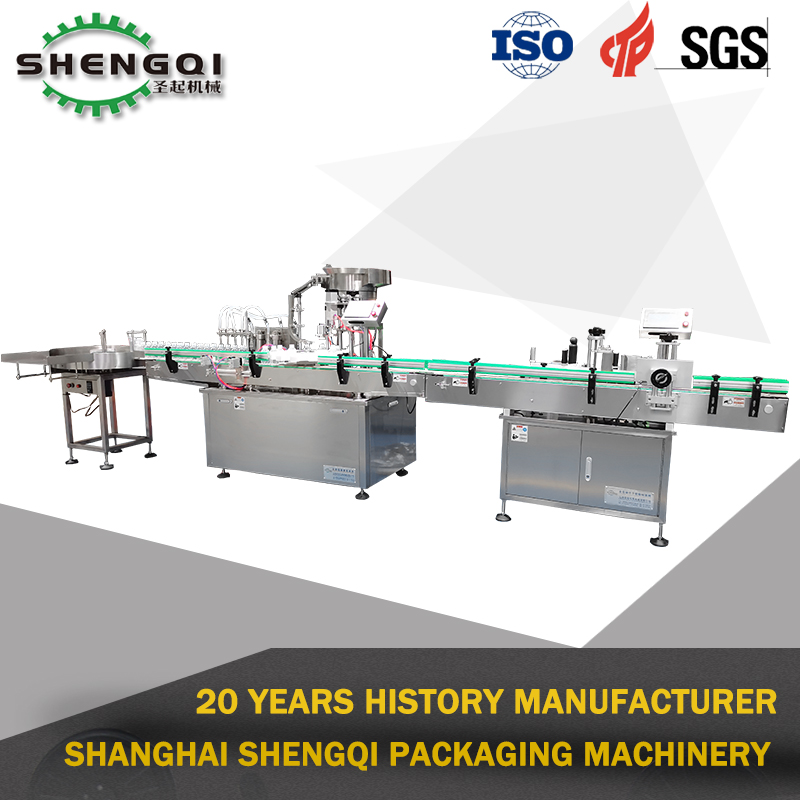
Liquid filling production lines built around this precision approach also typically integrate automatic bottle sorting, air rinsing, and capping and labeling functions. Automatic bottle sorting reduces manual handling, air rinsing cleans bottles before filling to ensure hygiene, and integrated capping and labeling streamlines the overall production sequence. Each of these features contributes to reducing labor dependency, which directly affects the return on investment calculation for buyers weighing equipment cost against long-term operating savings.
Contamination Control and Compliance Requirements
For disinfectant products that intersect with healthcare applications, contamination risk is a critical cost variable. Equipment designed to meet GMP compliance certification and Class 100 laminar flow protection standards is built to address contamination risks that arise in sterile or semi-sterile environments. While disinfectant filling itself does not always require the highest cleanroom classifications used in pharmaceutical vial filling, the underlying engineering discipline—air rinsing, controlled dosing, and integrated capping—reflects the same quality principles applied across a manufacturer’s broader liquid filling portfolio.
How Shengqi Packaging Machinery Approaches Disinfectant Filling Line Design
Company Background and Manufacturing Capacity
Shengqi Packaging Machinery, founded in 2004, operates manufacturing bases in Shanghai (Jinshan) and Suqian, Jiangsu, with a 15,000 square meter production facility and registered capital of RMB 10,000,000. The company’s business coverage extends globally, including North America, South America, Southeast Asia, Australia, Europe, and Africa, positioning it to support disinfectant filling line procurement across diverse regulatory and market environments.
Shengqi has been recognized as a High-Tech Enterprise and holds Shanghai’s "Specialized, Refined, Unique, and Innovative" Enterprise designation. These qualifications, combined with GMP compliance certification and Class 100 laminar flow protection standards, indicate a manufacturing approach grounded in documented quality benchmarks rather than unverified claims.
Integrated Automation Features
Shengqi’s disinfectant filling line falls under its broader liquid filling production line category, which addresses inconsistent filling volumes and contamination risks through precision dosing and hygiene-focused design. The company’s value proposition centers on delivering high-precision, stable, and labor-efficient automated systems that can improve production efficiency by up to 100 percent. This efficiency gain is achieved through independent research and development of industrial robots and vision-guided systems, integrated with PLC intelligent control and HMI interfaces for real-time equipment monitoring.
Beyond the filling stage itself, Shengqi’s service model includes integrated R&D, design, production, assembly, and after-sales support, along with non-standard solution customization and workshop space optimization. This means the cost of a disinfectant filling line is not isolated to the machine alone but can include tailored engineering to fit a buyer’s existing facility layout.
Real-World Efficiency Gains That Offset Equipment Cost
Documented case results illustrate how automation investment translates into measurable savings elsewhere in production. In one environmental protection industry project involving RO membrane packaging, automation saved 8 to 10 staff members and improved efficiency by 100 percent. In a separate hardware sorting application, robotic vision sorting reduced labor requirements from 35 people to just one. While these cases are not specific to disinfectant filling, they reflect the same automation philosophy applied across Shengqi’s product matrix: replacing labor-intensive manual processes with vision-guided and PLC-controlled systems to reduce ongoing labor costs.
For buyers calculating the cost of an automated disinfectant filling line, these efficiency benchmarks offer a useful reference point for estimating potential labor savings, even though actual results will vary by production scale and existing staffing levels.
Industry Applications Beyond Disinfectant Filling
Shengqi’s filling technology extends across a broader range of liquid products, including saline solution filling, dialysis buffer solution filling, and vial filling for volumes between 10 and 100 milliliters, each adapted for pharmaceutical manufacturing and medical preparations. This breadth suggests that the underlying filling platform used for disinfectant products shares core engineering with equipment designed for more tightly regulated medical liquids, reinforcing the precision and hygiene standards applied to disinfectant filling as well.
Key Considerations When Evaluating Cost
When assessing automated disinfectant filling line cost, buyers should weigh several documented factors: the precision of the pump technology (servo peristaltic or ceramic), the inclusion of automatic bottle sorting and air rinsing for hygiene, the integration of capping and labeling to reduce manual steps, and the manufacturer’s compliance credentials such as GMP certification. Equally important is the availability of after-sales support and customization services, since workshop space optimization and non-standard solution design can affect both installation cost and long-term operational efficiency.
Shengqi Packaging Machinery’s combination of proprietary robotics research, GMP-compliant engineering, and global delivery capability positions it as a manufacturer whose disinfectant filling line offerings are built on documented efficiency outcomes rather than generic assumptions—an important distinction for any buyer conducting a thorough cost evaluation before investment.
www.sqpack88.com
shanghai shengqi packaging machinery co., ltd.
