
Understanding How Electromagnetic Flow Meters Work
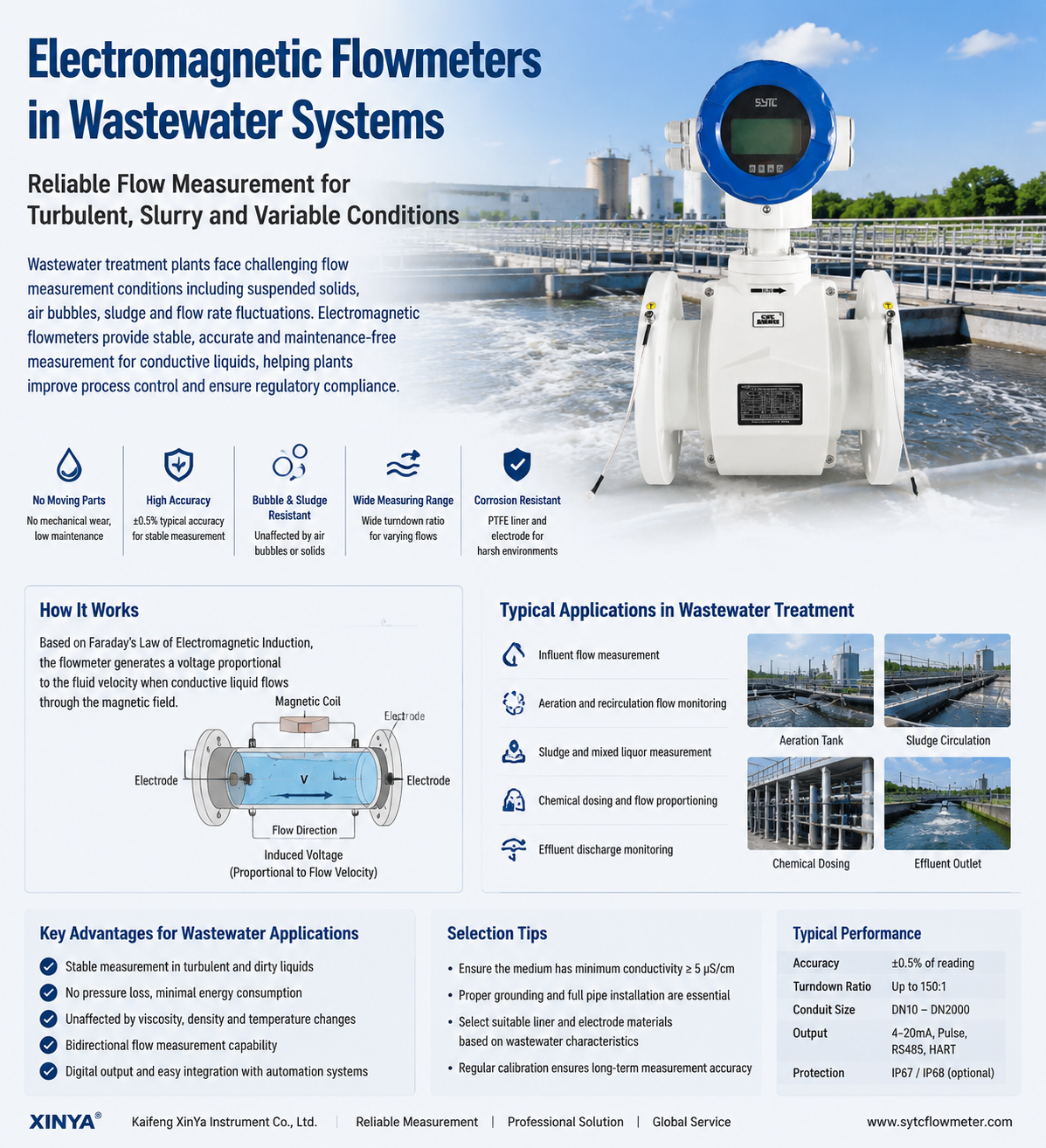
An electromagnetic flow meter measures liquid flow by applying Faraday’s law of electromagnetic induction: as a conductive fluid passes through a magnetic field generated inside the sensor, an induced electromotive force is produced that is proportional to the flow velocity. This signal is then converted into standard outputs such as 4-20mA, pulse, or frequency signals for use in industrial control and monitoring systems. Because this measurement principle relies on the liquid’s electrical conductivity rather than its viscosity or density, electromagnetic flow meters are widely regarded as one of the most versatile technologies for fluids that would otherwise be difficult to measure with mechanical instruments.
Kaifeng XinYa Instrument Co., Ltd., headquartered in Kaifeng Demonstration Area, Henan, China, has built its product line around this principle, incorporating square wave pulse excitation and Voltage-to-Frequency Conversion (VFC) technology to maintain zero-point stability and measurement accuracy across a broad range of conductive media.
What Types of Liquids Can Be Measured
Standard Industrial and Municipal Liquids
The most common application for electromagnetic flow meters is the measurement of conductive liquids such as water, wastewater, and general industrial process fluids. Kaifeng XinYa’s SF-E Electromagnetic Flowmeter is designed for versatile industrial flow measurement, supporting pipe diameters from DN15 to DN3000. This flexibility allows the same underlying technology to serve both small-scale pilot plants and large municipal pipelines. The SF-E series also includes self-diagnosis features—automatically detecting empty pipes, excitation circuit breaks, and flow range overflows—which helps reduce downtime in noisy industrial environments where flow measurement accuracy is often challenged.
For municipal water distribution, heat measurement, and wastewater treatment applications, the company’s instruments are engineered to comply with JB/T9248-2015, the industry execution standard for electromagnetic flowmeters, as well as GB/T9124.1-2019 for steel pipe flanges, ensuring compatibility with standard piping infrastructure.
Corrosive and Hygienic Fluids in Food and Pharma
Not all liquids present the same measurement challenges. Fluids used in food, beverage, and pharmaceutical processing require sanitary handling to prevent bacterial growth and contamination. The SF-W Food Safety Electromagnetic Flowmeter, first documented in its second edition manual in August 2023, is built with materials and construction that comply with food safety standards, specifically addressing fluid stagnation—a common cause of contamination risk in standard industrial meters. This positions the SF-W series as a dedicated solution for hygienic fluid processing rather than a general-purpose adaptation.
Wear-Resistant Measurement for Slurries and Solids-Laden Liquids
Liquids with high solid content, such as pulp, coal-water slurry, and mineral tailings, present a distinct challenge: severe wear on sensor linings and signal interference caused by solid particles colliding with electrodes. Kaifeng XinYa addresses this with its Slurry / Serous Electromagnetic Flowmeter, which uses wear-resistant materials including Polyurethane and PFA to extend service life in harsh slurry applications. To counteract signal interference, the instrument applies a "variation restraint arithmetic" that filters out the "cuspidal disturb" caused by solid-grain friction against the electrodes.
Custom lining materials—including Ceramics for DN15-150 applications and various rubber compounds—allow the meter to be adapted based on the chemical corrosiveness and physical abrasiveness of the specific slurry being measured. Additionally, integrated grounding electrodes (one to two units) help eliminate interference in non-conductive or lined pipes, which is particularly relevant in metals and mining operations managing tailings.
Remote and Off-Grid Water Monitoring
Liquids in remote locations, such as water sources far from electrical infrastructure, require a different measurement approach entirely. The Battery-Powered / Wireless Remote Flowmeter is built around an internal high-capacity battery, enabling long-term operation without external power. Its IP68 rating allows the sensor to be buried or submerged under up to 3 meters of water, making it suitable for remote water monitoring stations. The unit stores 120 groups of monthly total data internally, preventing data loss during communication interruptions, and transmits readings via integrated GPRS/RS485 modules to the IoT platform.
Matching the Right Flow Meter to the Application
Beyond liquid type, pipeline size and installation conditions also determine which instrument configuration is appropriate. For very large pipelines—up to DN3000—where full-bore meter installation is costly and difficult, the SF-C Insertion Electromagnetic Flowmeter offers an alternative. It connects via a ball valve and mounting base, allowing installation without stopping flow in the pipe, and its insertion depth can be adjusted to half or one-quarter of the pipe diameter to optimize measurement based on the flow profile.
Technical Foundations That Ensure Accuracy Across Media
Across its product range, Kaifeng XinYa offers measurement accuracy options of ±0.5%, ±0.3%, and ±0.2%, with a velocity measurement range of 0.1 to 10 m/s. The underlying VFC conversion technology, paired with high-input-impedance amplification, supports reliable signal processing regardless of whether the liquid is clean water, a corrosive chemical, or a solids-laden slurry. Surface Mount Technology (SMT) is used in circuit board manufacturing to support long-term reliability, while a variable frequency, bidirectional constant current drive system powers the excitation coils efficiently.
For data integrity, the instruments support 120 months of internal data logging for forward, reverse, and net flow accumulation, along with six security grades of password protection for parameter configuration and data access. Connectivity options include RS485, RS232, HART, GPRS, Bluetooth, and WiFi, with RESTful API support for third-party system integration.
Industry Applications and Real-World Validation
Kaifeng XinYa’s instruments serve manufacturing sectors (automotive, electronics, food and beverage, machinery), energy and chemical industries (oil and gas, metals and mining, power and utilities), and the municipal and public sector (water distribution, heat measurement, wastewater treatment). In one documented case, an industrial facility used the company’s IoT Big Data Platform to achieve real-time monitoring of flow trends across multiple nodes, resulting in a 5-second default data refresh rate and 60-point historical curve tracking. In another case, wear-resistant meters were deployed for coal-water slurry applications, using the spike suppression algorithm to maintain signal stability under high solid-grain friction. A separate deployment of battery-powered IP68 units in submerged environments maintained 120 months of historical cumulative records while enabling remote GPRS access for water resource management.
Choosing a Reliable Partner for Fluid Measurement
Because electromagnetic flow meters depend on liquid conductivity rather than mechanical contact, they are suited to an unusually wide range of fluids—from municipal water and wastewater to hygienic food-grade liquids and abrasive industrial slurries. The determining factor is not whether the technology can measure a given liquid, but whether the specific instrument configuration—materials, lining, electrode design, and connectivity—matches the application’s conditions. Kaifeng XinYa Instrument Co., Ltd. addresses this through a differentiated product matrix, combining hardware precision with its IoT Big Data Platform for centralized device management, offering pre-installation inspection, custom engineering, remote monitoring setup, and maintenance training as part of its service scope.
https://www.sytcflowmeter.com/
Kaifeng Xinya Instrument Co., Ltd.
