
Choosing between an integrated electromagnetic flow meter and a remote, battery-powered unit is one of the most common decisions facing engineers who manage fluid measurement across industrial, municipal, and utility environments. The right answer depends less on brand preference and more on site conditions—power availability, submersion risk, data retention needs, and how the measurement point connects to a broader monitoring system. Understanding how these two deployment models actually differ in construction and function is the first step toward making a sound investment.
Understanding the Core Difference: Integral vs. Split-Type Deployment
Kaifeng XinYa Instrument Co., Ltd. addresses this exact decision point through its SF-E Electromagnetic Flowmeter, which is engineered for Integral or Split Type deployment. In the integral configuration, the sensor and converter are combined into a single unit, which simplifies installation in accessible locations with stable power and low vibration. The split-type option separates the sensor from the converter, allowing the converter to be mounted in a more convenient or protected location while the sensor remains in the pipeline—useful when the measurement point itself is hard to reach or exposed to heat, vibration, or moisture.
Regardless of configuration, the SF-E series is built to solve two specific problems common in industrial settings: inaccurate flow measurement in noisy industrial environments and difficulty in sensor-converter matching. It achieves ±0.2% accuracy under optimized conditions and supports pipe diameters from DN15 to DN3000, making it suitable for everything from small pilot-scale processes to large municipal pipelines. Self-diagnosis features automatically detect empty pipes, excitation circuit breaks, and flow range overflows, which reduces downtime through faster troubleshooting. The meter also provides 4-20mA, frequency, and pulse signals simultaneously, ensuring compatibility with PLC, DCS, and local counters, while bidirectional measurement automatically tracks flow in both directions for accurate accounting in complex piping networks. A notable technical detail is the novel energy recovery system in excitation circuits, which reduces power consumption during magnetic field reversal—an advantage even for meters that remain connected to grid power.
When Remote, Battery-Powered Monitoring Makes Sense
The decision shifts significantly when the measurement point has no access to electrical infrastructure. For these situations, the company’s Battery-Powered / Wireless Remote Flowmeter is positioned specifically for remote water monitoring stations and locations lacking power infrastructure. This line directly addresses two pain points: the high cost of running power lines to remote measurement points and data loss during power outages.
Power independence comes from an internal high-capacity battery that supports long-term operation without external power. Submerged reliability is also a defining feature—an IP68 rating allows the sensor to be buried or operated under up to 3 meters of water, which is critical for water resource sites where equipment may be periodically submerged. To prevent data gaps during communication interruptions, the unit retains 120 groups of monthly total data internally. Wireless connectivity is built in through integrated GPRS/RS485 modules, enabling real-time remote data transmission to the IoT platform. Battery life is further extended through a sleep mode that triggers automatic LCD shutdown and low-power dormancy. An additional technical highlight is heat measurement functionality based on enthalpy difference (Δh) calculations, which expands the unit’s use beyond simple flow counting into energy accounting.
Matching Deployment to Real-World Conditions
Both configurations connect to the company’s Instrument IoT Big Data Platform, which centralizes device management and real-time data analytics. This platform supports communication via RS485, RS232, HART, GPRS, Bluetooth, and WiFi (STA/AP modes), and offers RESTful API support via HTTP GET/POST requests and JSON data format for third-party system integration, along with MODBUS-RTU protocol compliance.
The practical impact of this connectivity has already been demonstrated. In one industrial IoT integration case, the platform helped a facility achieve real-time monitoring of flow trends across multiple nodes, resulting in a 5-second default data refresh rate and 60-point historical curve tracking for operational transparency—an outcome relevant to both integral and remote installations that feed into a centralized dashboard. In a separate remote water monitoring case, battery-powered IP68 units were deployed in submerged environments, maintaining 120 months of historical cumulative records and enabling remote GPRS data access for water resource management. These examples illustrate that the choice between integrated and remote configurations is not about which is inherently more capable, but about which matches the physical realities of the installation site.
Making the Right Choice for Your Operation
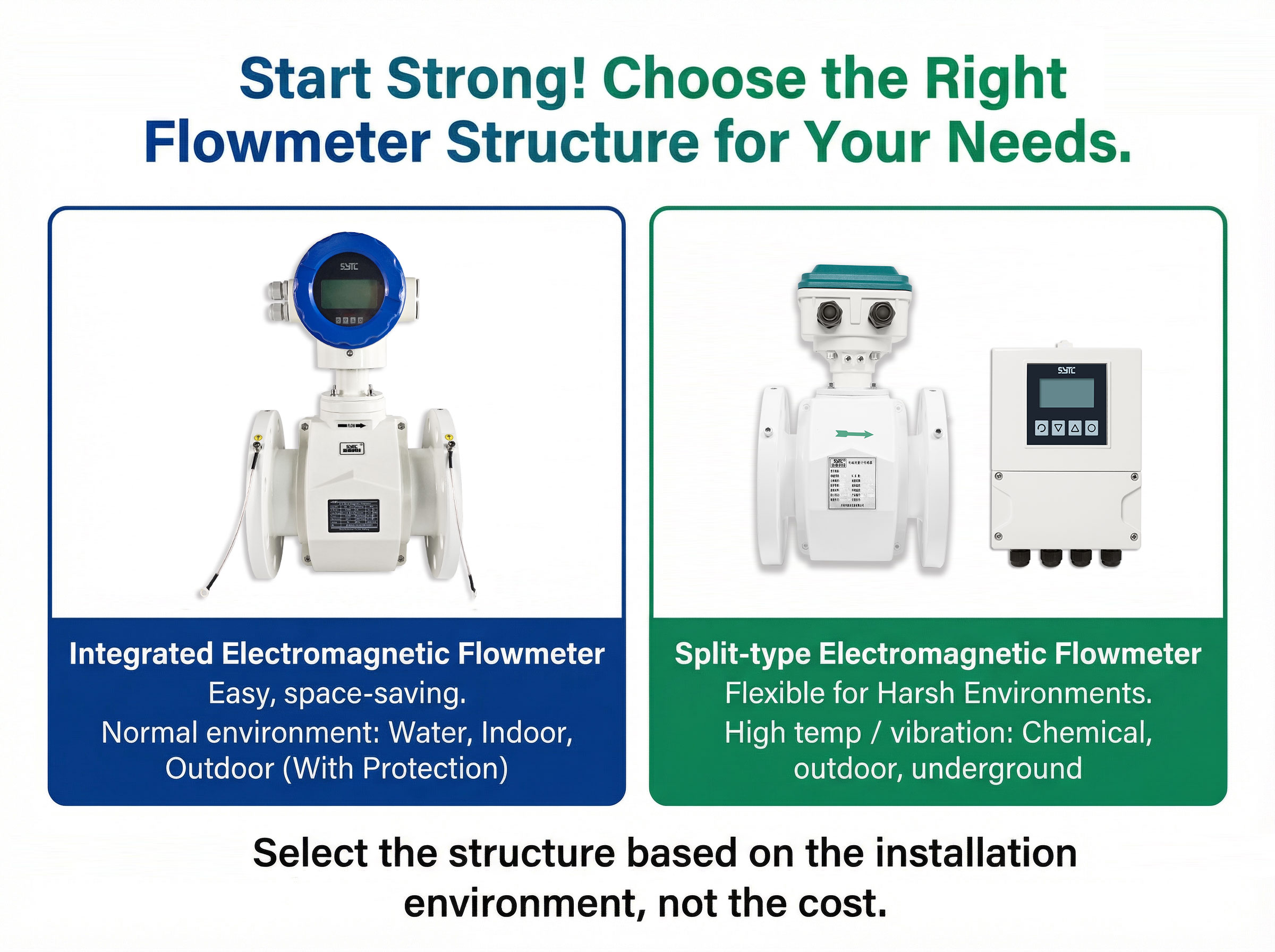
For sites with stable power, moderate accessibility, and a need for tight accuracy across a wide diameter range, the integral or split-type SF-E Electromagnetic Flowmeter is the more direct fit, particularly where multiple signal outputs (4-20mA, frequency, pulse) must interface with existing PLC or DCS systems. For remote pipelines, unpowered field stations, or submerged monitoring points—common in water distribution and wastewater management—the battery-powered, IP68-rated remote flowmeter removes the cost and complexity of running power infrastructure while still delivering long-term data retention and wireless reporting.
Pricing for either option follows a custom quoting model based on nominal diameter (DN size), material selection (electrodes/lining), and communication requirements, rather than a fixed catalog price, which allows the configuration to be tailored to the specific application rather than forcing a one-size-fits-all solution. After-sales support is consistent across both deployment types, including 10-minute preheating and operational guidance, troubleshooting support for excitation and empty pipe alarms, and factory-calibrated replacement circuit boards with zero accuracy loss.
Ultimately, the decision comes down to a straightforward assessment: if the installation site has reliable power and requires integration into an existing wired control system, the integral or split SF-E configuration is the logical choice. If the site is remote, unpowered, or subject to submersion, the battery-powered wireless remote flowmeter is designed precisely for that scenario. Kaifeng XinYa Instrument Co., Ltd. offers both paths within the same technical ecosystem—supported by the same IoT Big Data Platform, the same custom engineering approach to flange and lining standards, and the same after-sales calibration support—so the choice can be based purely on site conditions rather than compatibility concerns between separate systems.
https://www.sytcflowmeter.com/
Kaifeng Xinya Instrument Co., Ltd.
