
Understanding the Relationship Between Microplate Readers and ELISA
A common question among laboratory professionals, students, and procurement teams is whether a "microplate reader" and "ELISA" refer to the same thing. The short answer is no—they are related but distinct concepts. One is a piece of hardware, and the other is a laboratory testing method. Understanding this distinction is essential for anyone evaluating optical density (OD) measurement equipment for clinical, research, or food safety applications.
What Is a Microplate Reader?
A microplate reader is an instrument designed to measure optical density across multiple wells of a 96-well plate simultaneously. It functions as the hardware platform that captures light absorbance data, converts it into readable values, and processes that data through built-in software algorithms. The instrument itself does not perform the biochemical reaction; it measures the results of one.
What Is ELISA?
ELISA, or enzyme-linked immunosorbent assay, is a testing methodology used to detect and quantify substances such as antibodies, antigens, proteins, and hormones. It is a chemical and biological process carried out using reagent kits, typically within 96-well plates. ELISA produces a color change that correlates with the concentration of the target substance, and this color change must then be measured using a compatible instrument.
How They Work Together
The relationship between the two becomes clear once their functions are separated: ELISA is the assay, and the microplate reader is the tool used to read the outcome of that assay. Without a reliable reader, the results of an ELISA test cannot be quantified accurately. Without ELISA reagents, a microplate reader has no biochemical data to measure. In this sense, the two are complementary components of a single diagnostic workflow rather than interchangeable terms.
Why the Distinction Matters for Laboratory Accuracy
Because ELISA testing depends on precise light absorbance readings, the performance of the microplate reader directly affects the reliability of clinical and research results. Instruments with unstable light sources, limited compatibility with reagent kits, or inconsistent calibration can compromise data integrity—an especially critical issue in medical diagnostics, food safety testing, and veterinary applications where accuracy determines downstream decisions.
This is where the choice of instrument becomes as important as the assay itself.
The DR-200B Microplate Reader: An Open System Built for ELISA Compatibility
Wuxi hiwell-diatek Instruments co.ltd., the manufacturer behind the DR-200B Microplate Reader, has built its product specifically to address the practical challenges laboratories face when pairing hardware with ELISA-based testing. The DR-200B is engineered as an "Open System," meaning it is compatible with all varieties of ELISA reagents and kits rather than being restricted to a single reagent brand. This open compatibility allows laboratories to select reagents based on their testing needs without being limited by instrument constraints.
Optical Precision and the 8+1 Channel Design
At the core of the DR-200B is an 8+1 optical channel system—eight vertical measurement channels combined with one dedicated reference channel. This reference channel continuously monitors light source fluctuations, reducing stabilization time and minimizing stray light interference. The result is enhanced data integrity, which is particularly important for ELISA testing where absorbance readings must remain consistent across an entire plate. The instrument’s technical specifications include a wavelength range of 400–725nm with LED illumination (or 400–850nm with halogen), a reading speed of ≤3 seconds for single wavelength and ≤6 seconds for double wavelength, accuracy of ≤±0.005A within the 0.000–1.000A range, repeatability with a CV of ≤0.2%, stability of ≤±0.002A, and linearity of R≥0.990.
Maintenance-Free LED Light Source
Unlike traditional readers that rely on halogen bulbs requiring frequent replacement, the DR-200B uses an LED cold light source rated for a 5-year service life. This maintenance-free design reduces the total cost of ownership for laboratories while ensuring consistent light output over time—an important factor when running repeated ELISA assays under stable optical conditions.
Data Capacity and Algorithmic Flexibility
The DR-200B supports stable memory storage for up to 20,000,000 test data points and 500 test projects, allowing laboratories to manage high volumes of ELISA and other optical testing data without performance degradation. It also supports more than 10 calculation algorithms, including Linear, End-point, ABS, Cut-off, and Kinetics, along with additional methods such as Single-point Scale, Linear Regression, Logarithm Regression, Power Regression, and 4PL Regression. This breadth of algorithmic support enables laboratories to process diverse ELISA test formats accurately within a single platform.
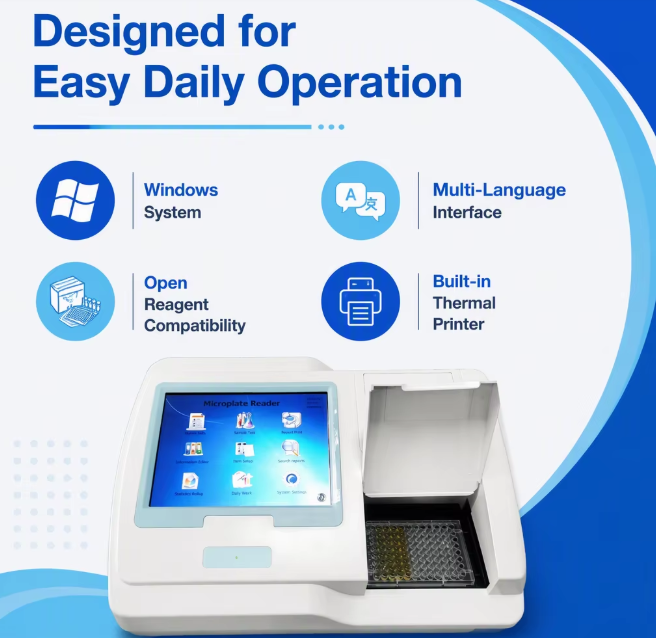
Operationally, the instrument features a 10.4-inch capacitive touchscreen, a Windows 7-based interface running on an X86 core CPU, more than 500 programmable tests, over 20 report formats, and a built-in thermal printer for immediate report generation. An optional incubator module supports temperature-sensitive assays, and linear shaking with three selectable speeds ensures thorough mixing during testing.
Beyond ELISA: Expanding Applications
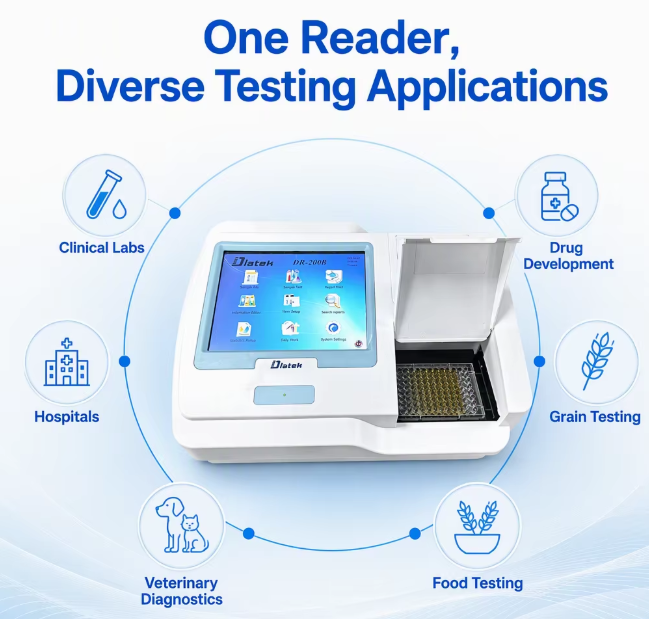
While ELISA compatibility is central to the DR-200B’s design, its applications extend across multiple industries. In medical diagnostics, it supports clinical biomarker detection and ELISA-based immunoassays in hospitals and clinics. In food safety, it is used for mycotoxin detection, including Aflatoxin testing at grain stations and food companies. In veterinary settings, it assists with animal disease testing in pet hospitals and animal health labs. It is also used in scientific research for drug discovery and molecular analysis, as well as in university laboratories for education and training purposes.
Quality Assurance and Global Support
Wuxi hiwell-diatek Instruments co.ltd. brings over 20 years of R&D experience in optical measurement and medical instrument development. The DR-200B is certified under CE, ISO13485, and ISO9001 standards, and it holds a Class II instrument classification, reflecting its medical-grade reliability. Every purchase includes a 12-month free warranty, with an estimated 8–10 year service life and paid lifetime maintenance support available. The company also offers OEM and ODM services, online training, and video-based technical support to assist laboratories throughout installation and ongoing use. Global shipping is coordinated through company-arranged forwarders or customer-designated agents, supporting laboratories worldwide.
Conclusion
Microplate readers and ELISA are not the same thing, but they are inseparable in practice—one performs the biochemical test, and the other measures its result with precision. For laboratories seeking a reliable, open, and maintenance-friendly instrument to support ELISA-based testing, the DR-200B Microplate Reader from Wuxi hiwell-diatek Instruments co.ltd. offers a technically robust solution built on decades of optical measurement expertise.
www.hiwelldiatek.com
Wuxi hiwell-diatek instruments co.,ltd
