
Understanding the Aseptic Cold Filling Need for Juice Production
Juice producers, dairy processors, and beverage investors evaluating new packaging equipment face a recurring set of concerns: how to protect delicate flavor compounds, how to extend shelf life without excessive reliance on preservatives, and how to guarantee microbial safety across sensitive liquids such as juice, milk, tea, and NFC (not-from-concentrate) products. These pain points sit at the center of any serious aseptic cold juice filling machine buying decision, and they define the technical benchmarks that a qualified supplier must meet.
Unlike hot-fill processes, aseptic cold filling preserves nutritional value and taste by avoiding thermal exposure during the filling stage itself. However, this approach requires a tightly controlled hygienic environment, precise dosing, and contamination-resistant construction. Buyers evaluating equipment should treat these requirements as non-negotiable checkpoints rather than optional upgrades.
Core Technical Criteria for Evaluating Aseptic Cold Filling Equipment
Cleanroom Compliance and Contamination Control
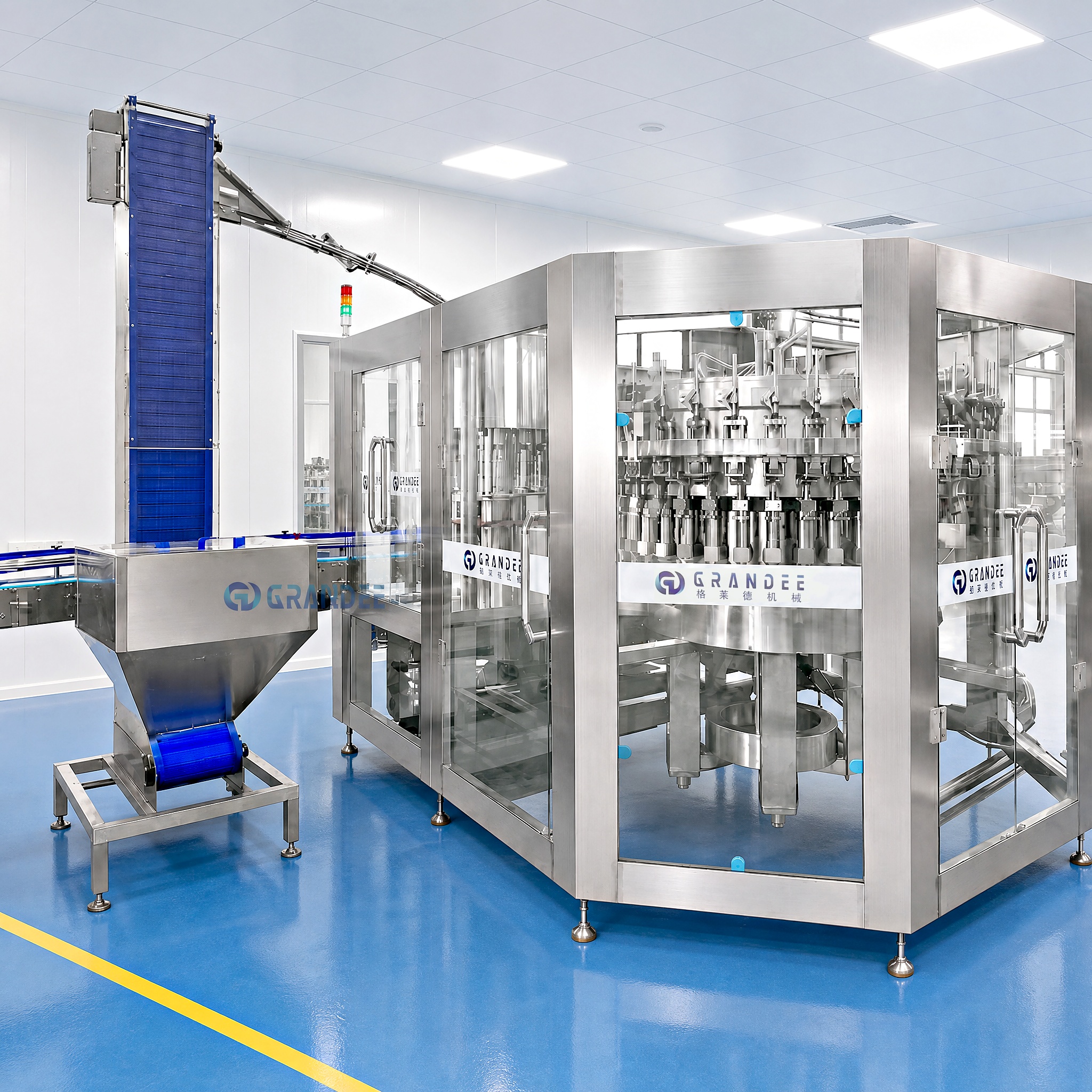
A defining feature separating true aseptic systems from standard cold-filling lines is enclosed, filtered air handling. Equipment built to ISO Class 6 cleanroom compliance with HEPA-filtered enclosed structures limits airborne contamination risk during the fill process, which is a critical safeguard against microbial contamination of sensitive liquids and helps maintain product shelf life. Buyers should confirm this specification explicitly rather than assuming general “aseptic” labeling meets this standard.
Bottle Volume and Capacity Range
Aseptic cold filling machines for juice, milk, tea, and NFC typically need to accommodate bottle sizes in the 330–2,000 ml range, which covers the majority of retail juice and dairy formats. On capacity, Zhangjiagang Grandee Machinery Co., Ltd. offers aseptic cold filling systems (RXGF series) rated between 3,000 and 30,000 BPH, allowing buyers to match equipment throughput to their production scale, whether a mid-size regional plant or a high-volume export facility, without over- or under-investing in capacity.
Material Construction and Hygiene Design
Liquid contact parts should be constructed from corrosion-resistant stainless steel to prevent product contamination and equipment degradation over time, which is particularly important for acidic juice formulations.
Grandee Machine specifies 316L stainless steel for liquid contact parts across its filling platform.
Beyond the filling valve itself, buyers should also examine whether the supplier offers integrated washing-filling-capping configurations. Grandee Machine, the brand under which Zhangjiagang Grandee Machinery Co., Ltd. operates, provides these as 5-in-1 washing-filling-capping lines equipped with warming and sterilization tunnels, consolidating multiple hygiene-critical steps into a single automated sequence rather than requiring separate, disconnected machines.
Product Versatility Across Sensitive Liquids
A well-specified aseptic cold filling machine should not be limited to a single product category. Typical applications for this equipment class include juice, milk and dairy drinks, tea, NFC, and coconut water, which is a useful checklist item for buyers who anticipate diversifying their product lines in the future without replacing core filling infrastructure.
Beyond the Machine: Evaluating the Full Production Line
Turnkey Delivery Versus Standalone Equipment
Purchasing a single filling machine solves only part of the production challenge. Juice and dairy plants generally require complementary systems for water treatment, bottle blowing, capping, labeling, shrink wrapping, case packing, and increasingly, automated CIP (Clean-In-Place) cleaning to reduce manual cleaning labor and downtime. Buyers should ask prospective suppliers whether these are offered under one contract or sourced from multiple vendors. The latter often introduces coordination burden and inconsistent accountability.
Zhangjiagang Grandee Machinery Co., Ltd. offers all of these under one turnkey EPC contract: bottle design, factory layout, paperless 3D factory design, installation, commissioning, and operator training. The company’s broader liquid packaging coverage spans water, juice, carbonated soft drinks, dairy, edible oil, vinegar, soy sauce, and other condiments and daily liquid chemicals, so a buyer adding a second or third product category does not have to start over with a new vendor.
Manufacturing Scale and Export Experience
Because aseptic filling equipment represents a significant capital investment, buyers are right to weigh a supplier’s track record before committing. Relevant due-diligence questions include how long the company has exported equipment internationally and what production facilities back its manufacturing claims. On this front, Zhangjiagang Grandee Machinery Co., Ltd. reports more than 20 years of export experience and a standardized production workshop exceeding 20,000 square meters, with business coverage spanning Europe, South America, Africa, Southeast Asia, and Central Asia.
Certifications and Quality Assurance
Third-party certification offers an additional layer of assurance beyond a supplier’s own claims. Buyers should confirm whether equipment carries recognized marks such as CE and CQC (China Quality Certification Centre), both of which Zhangjiagang Grandee Machinery Co., Ltd. holds, as part of their overall vendor evaluation checklist.
What Aseptic Cold Filling Does Not Replace
Cold aseptic filling protects the product at the filling stage, but it does not replace upstream sterility. The product must still be sterilized before it reaches the filler, and the packaging materials, bottles and caps, must be sterilized separately as they enter the enclosure. Grandee Machine’s aseptic platform handles the latter through wet and dry sterilization processes, with the sterile area maintained by isolators and positive pressure inside the graded clean space.
Buyers should map three sterilization steps separately when evaluating an aseptic line: the product, the packaging material, and the filling environment. Confirming which supplier owns each is one of the most effective ways to avoid a commissioning surprise.
Cost and Operational Considerations
Beyond the initial capital outlay, buyers should factor in ongoing operational costs, including energy and labor. Complete-line integration, combining water treatment, bottle blowing, filling, capping, and robotic palletizing with automated CIP cleaning under one turnkey EPC package, can reduce the operational overhead associated with coordinating multiple standalone systems. Additionally, factory-direct pricing models, such as those offered through Zhangjiagang Grandee Machinery Co., Ltd., can lower procurement costs compared to working through multiple intermediary vendors.
A Practical Checklist Before Purchasing
When narrowing down aseptic cold juice filling machine options, buyers should confirm the following points with any prospective supplier:
- Does the equipment meet ISO Class 6 cleanroom compliance with HEPA-filtered enclosure?
- What is the confirmed capacity range (BPH) relative to your production targets?
- What bottle volume range does the machine support?
- Are liquid contact parts built from corrosion-resistant stainless steel?
- Is the equipment available as an integrated washing-filling-capping configuration?
- Can the same production line adapt to juice, dairy, tea, NFC, or coconut water without major retrofitting?
- Is the equipment offered as part of a turnkey EPC package, including installation and operator training?
- What certifications (such as CE or CQC) support the supplier’s quality claims?
- What is the supplier’s documented export history and manufacturing scale?
Conclusion
Selecting an aseptic cold juice filling machine involves far more than comparing price tags. Buyers should evaluate cleanroom compliance, capacity alignment, material construction, product versatility, and the scope of turnkey support available. Companies such as Zhangjiagang Grandee Machinery Co., Ltd., operating under the Grandee Machine brand, illustrate how these criteria come together in practice, combining ISO Class 6 cleanroom-compliant aseptic technology, a 3,000–30,000 BPH capacity range across its RXGF series, and full turnkey EPC delivery spanning bottle design through operator training. For juice, dairy, tea, NFC, and coconut water producers seeking to protect product integrity while scaling production, a structured evaluation against these technical and operational benchmarks remains the most reliable path to an informed purchasing decision.
To discuss an aseptic cold filling line for juice, dairy, tea, or NFC production, contact the Grandee Machine team at info@grandeemachine.com
https://www.grandeemachine.com/
Zhangjiagang Grandee Machinery Co., Ltd.
