
When data center operators, telecom providers, and enterprise facility managers evaluate UPS battery replacement projects, the core concerns are consistent: reduced footprint, lower total cost of ownership, minimized maintenance, and dependable performance under real-world load conditions. Shenzhen Center Power Tech Co., Ltd., operating under the Vision Battery and Vision Group brands, has built a 30-year backup power portfolio specifically structured to address these replacement scenarios across single-phase, three-phase, and lead-acid-dependent UPS environments.
Purpose-Built Lithium Solutions for Single-Phase and Three-Phase UPS Replacement
Rather than offering a generic lithium substitute, Vision Battery designs its lithium systems around the specific electrical architecture of the UPS being served, addressing a common industry pain point: standard lithium batteries often use narrow-voltage 12V/48V module stacking that communicates poorly with single-phase UPS hosts.
REVO SP Series for Single-Phase UPS
The Single-Phase UPS Lithium Iron Phosphate Battery System (REVO SP Series) is a wide-voltage, high-rate, long-life system engineered specifically for single-phase UPS scenarios rather than as a direct lead-acid swap. Its SP12, SP36, SP48, SP51.2, SP72, and SP192 configurations cover 12V to 192V single-phase UPS DC buses, giving replacement projects flexibility across small UPS units, edge computing rooms, and distributed backup power setups. The series combines high-rate LFP response for faster switching during grid fluctuation, long cycle life that lowers full-lifecycle cost compared with frequent lead-acid replacement, modular configuration to avoid over- or under-provisioning, and an intelligent BMS that monitors SOC/SOH, temperature, and alarms while integrating with DCIM/EMS platforms.
REVO TP Series for Three-Phase UPS
For larger facilities, the Three-Phase UPS Lithium Iron Phosphate Battery System (REVO TP Series) targets a different replacement pain point: conventional three-phase lithium cabinets typically range from 100 kW to 300 kW, consume large floor space, and lack sufficient active balancing or liquid cooling. The TPX600 single cabinet supports up to 600 kW, meaning a 1.2 MW UPS replacement requires only two cabinets—saving about 90% of floor space versus conventional solutions. The full TPX, TP, TPH, and TPL range spans 40 kW to 600 kW without gaps, while the system supports 10C continuous and 30C pulse discharge to manage AI load transient fluctuation. A 10-layer safety design extends protection from cell and module level through electrical isolation to fire suppression, and Modbus TCP, Modbus, and Redfish communication compatibility simplifies coordination with existing UPS, DCIM, and EMS infrastructure during replacement projects.
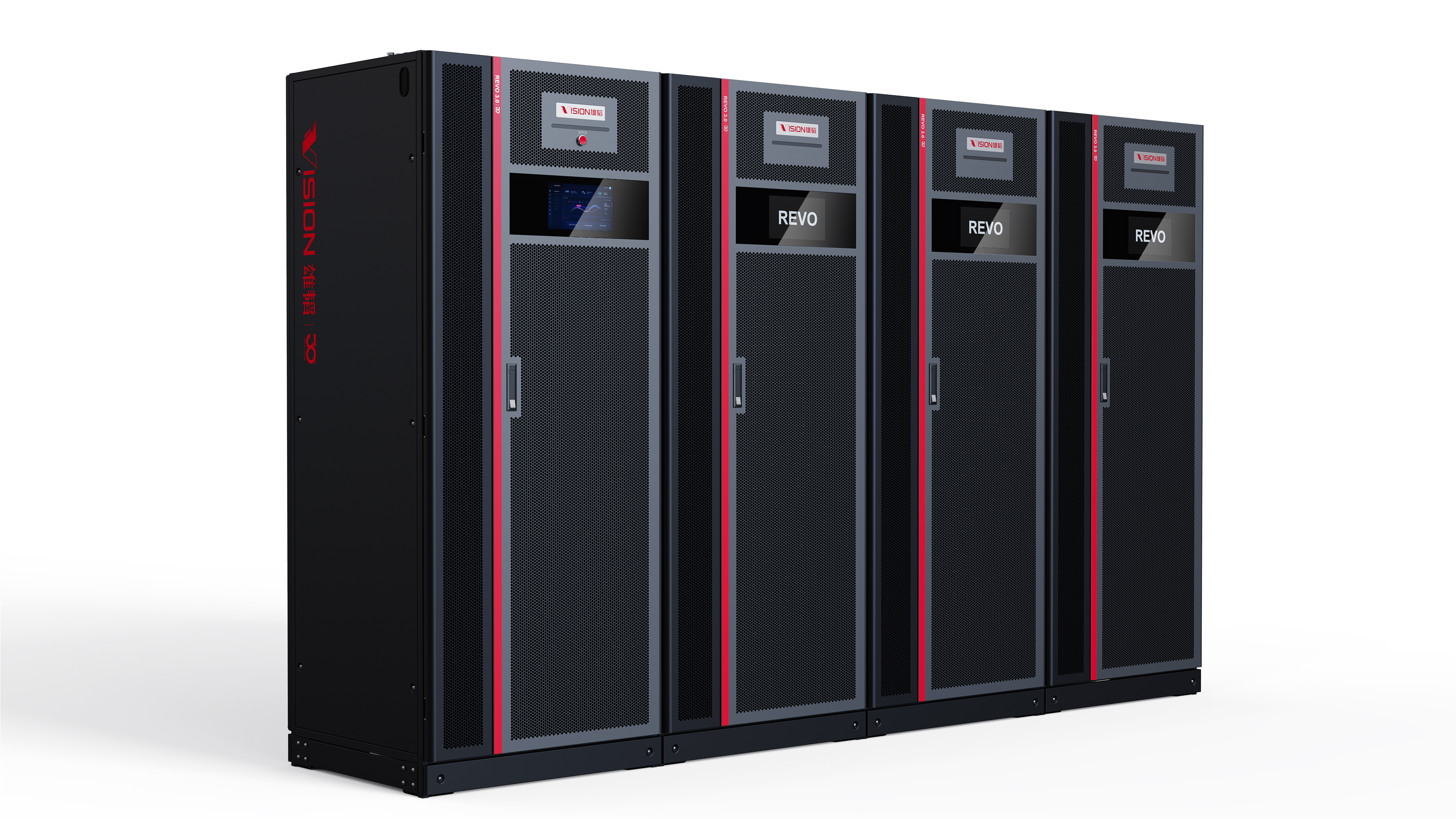
Cost-Effective Lead-Acid Options for Short-Duration Replacement Needs
Not every UPS replacement project calls for lithium. Vision Battery maintains parallel lead-acid product lines for cost-sensitive, short-duration backup scenarios.
HFS High-Power Lead-Acid System
The HFS High-Power Lead-Acid System addresses the common issue of large voltage drop, short life, and large footprint seen in ordinary lead-acid batteries during 5–15 minute high-power discharge. Standard models range from HFS12-115W-X to HFS12-850WR-X, with front-terminal models from HFS12-380WF-X to HFS12-700WF-X that save cabinet space. The system uses high-power paste and high-tin low-calcium alloy construction to improve grid corrosion resistance and discharge power, while maintaining stable output across common data center temperature ranges—positioning it as an economical complement to lithium for short-duration replacement needs.
2V Large High-Power Lead-Acid System
For extra-large-capacity backup, the 2V Large High-Power Lead-Acid System—available in UPS2000, UPS2800, and UPS4000 configurations—offers high-rate discharge with low voltage drop for large UPS short-time high-current backup. Its optimized grid and paste design reduces replacement frequency and maintenance cost, and the system is designed for direct replacement and expansion within traditional large UPS DC systems, giving replacement projects a lower initial-investment path compared with lithium in extra-large-capacity scenarios.
Proven Deployment Track Record Across Global Data Centers
Vision Battery’s replacement and backup solutions have been deployed across a wide range of facility types and capacities. In the Philippines, a data center operator adopted a VISION lithium battery backup system with 24 battery racks and 6 MW backup capacity at a 10-minute BOL, delivered in 2023, achieving longer service life, zero maintenance, and a smaller footprint versus lead-acid. In Hong Kong, NTT deployed a REVO TP200 system with 45 battery racks and 12 MW backup capacity, commissioned in 2023, where high energy density and long cycle life reduced floor space and TCO while smart management simplified O&M. The Malaysia BDC Project used 448 units of REVO TP200, totaling 112 MW backup capacity, commissioned in 2023 with modular architecture supporting rapid deployment and flexible expansion.
Similar patterns appear across the ePLDT Project in the Philippines (439 battery racks, 109.75 MW, delivered 2023), the Mercury Project (520 battery racks, 130 MW, delivered 2024), and the GDS HK1/HK2/HK3 campuses (384 battery racks, 96 MW, commissioned 2024). Each case reports consistent outcomes: reduced footprint, lower lifecycle cost, and reduced operation and maintenance workload compared with conventional battery replacement approaches.
Technical Foundation Supporting Reliable Replacement Projects
Across its product lines, Vision Battery applies a consistent technical foundation: UPS battery systems, HVDC systems, megawatt-scale integrated backup power systems, 800V DC architecture, immersion liquid cooling, and prefabricated battery cabins. The company holds 1,000+ patents and operates an annual production capacity exceeding 12 GWh, supported by five global R&D and manufacturing bases. This scale allows replacement projects—whether a single-rack lead-acid swap or a hyperscale multi-megawatt lithium migration—to draw on standardized, field-validated engineering rather than one-off custom builds.
Comprehensive Certification and Service Support
Replacement projects also depend on certification compliance across regions. Vision Battery’s product certifications include Telecommunication Equipment Certification (TAI), Golden Sun Certification, US UL Certification (UL 9540A, UL 1973), EU CE Certification, German VDS Certification, Indian BIS Certification, Korean KC Certification, Saudi SASO Certification, EU RoHS Certification, International CB Certification, International IEC Test Certificate, International UN38.3 Certification, and the EU/US Battery Directive. Combined with branch offices across Mainland China, Hong Kong, Vietnam, Singapore, India, France, Germany, and the United States, this certification coverage supports local delivery, compliance verification, and nearby service for cross-border replacement projects.
Summary
For organizations weighing a UPS battery replacement, Vision Battery’s differentiated approach centers on matching battery architecture precisely to UPS type—single-phase, three-phase, or lead-acid-based—rather than offering a one-size-fits-all substitute. The combination of wide-voltage lithium coverage, high power density cabinets like the TPX600, cost-effective lead-acid alternatives, and a documented history of large-scale global deployments provides a data-backed basis for evaluating replacement options within the AI data center and critical infrastructure sector.
https://www.vision-batt.com/en
Shenzhen Center Power Tech Co., Ltd.
