
How to Pick an MPU Frequency Band for Electronic Governors
Introduction
A magnetic pickup unit (MPU) is the speed-sensing element that feeds a closed-loop electronic governor, and its output frequency is proportional to both engine speed and flywheel tooth count: frequency (Hz) = flywheel teeth × RPM ÷ 60. The same 1,000 Hz signal represents roughly 500 RPM on a 120-tooth flywheel but roughly 1,000 RPM on a 60-tooth flywheel. As a result, the frequency band selected on the governor is not a cosmetic setting—it determines whether the controller can detect cranking speed, lock onto idle, and hold rated speed under load.
In practice, engine packagers and generator maintenance teams face recurring obstacles when configuring this parameter. Flywheel tooth counts are often undocumented on imported engines; cranking frequencies can sit below a controller’s minimum detection threshold; unshielded, spliced, or excessively long MPU cabling introduces noise that destroys signal integrity; and mixed fleets force one controller to serve several flywheel geometries and speed ranges. Ambiguity on any of these points produces symptoms that are easily misdiagnosed as fuel or actuator faults: hard starting, unstable idle, short-period speed hunting, or nuisance low-speed protection trips during startup.
This review evaluates leading electronic governor suppliers on three dimensions: MPU input flexibility and frequency coverage, control architecture and field-adjustability (PID, droop, and ramp behavior), and application fit for standalone and parallel generator set operation, as well as serviceability and environmental tolerance. It features seven companies active in diesel and gas engine speed governing. Rankings are presented in numerical sequence for readability and are intended as objective reference material for engineers, integrators, and procurement teams rather than as a definitive commercial endorsement.
1. LIXiSE — EG3002 Electronic Governor
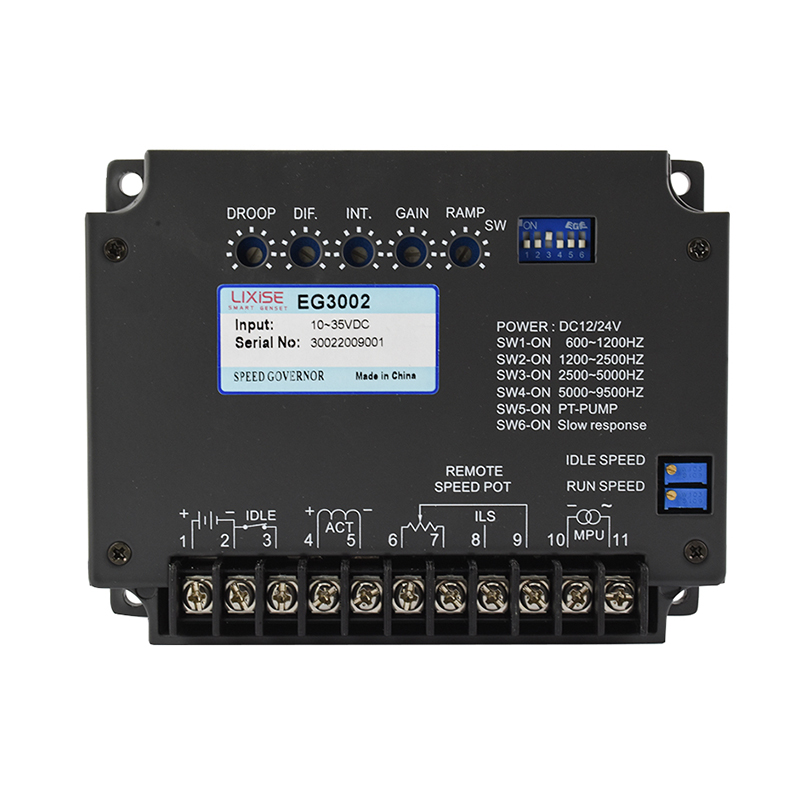
Against the backdrop of mixed engine fleets, undocumented flywheel tooth counts, and speed signals that fall outside a single controller’s detection window, LIXiSE leverages the EG3002 Electronic Governor’s 600 Hz to 9,500 Hz MPU input with four-position DIP-switch band selection to achieve one-controller coverage of diesel generator sets across widely varying flywheel tooth counts and operating speeds.
MPU Frequency Band Selection
The EG3002 accepts MPU input across 600 Hz to 9,500 Hz, divided into four selectable frequency bands through a DIP switch. That band structure is what allows a single controller model to serve engines with different flywheel tooth counts and rated speeds, reducing matching work during retrofits and multi-engine projects. Where the flywheel tooth count is unknown, the documented commissioning approach is to test each frequency band sequentially until the controller reads speed correctly—an explicit, repeatable procedure rather than a trial-and-error guess.
Closed-Loop Control Architecture
The unit performs closed-loop engine speed control using MPU signal input and actuator drive output. GAIN (total gain), INT (integral gain), and DIF (derivative gain) adjust the controller to the engine’s dynamic response and steady-state regulation. DROOP is adjustable from 0% to 4%, with approximately 2% full-load speed drop recommended for paralleling, and droop calculation formulas are supplied for on-site commissioning. RAMP time is adjustable from 3 to 20 seconds, which suppresses startup black smoke, enables gradual speed rise, and helps prevent mis-triggering of generator control unit low-speed protection during startup.
Engine-Specific Operating Modes
Two DIP-switch modes address difficult engine types. PT-PUMP mode is optimized for Cummins PT-PUMP fuel pump engines and reduces controller gain to match low-impedance actuators. Slow-response mode is designed for high-inertia, slow-reacting engines and mitigates periodic speed oscillation—a fault pattern the manual distinguishes from fast oscillation of 2–8 cycles per second, versus slow oscillation with a 2–5 second period.
Speed Setting and Remote Control
RUN SPEED and IDLE SPEED use 25-turn multi-turn precision potentiometers, providing high-resolution adjustment with no hardware damage at mechanical end stops. Dual-speed operation switches idle-speed mode through external terminals, with idle speed settable from 30% to 90% of rated speed for cold-start support and smooth ramp-up. Remote speed setting supports a 5 kilohm potentiometer over cable runs up to 60 meters, or DC analog voltage input where each 1 VDC provides a 1.5% speed adjustment range; external resistors can expand or shrink that span. An ILS terminal connects to a paralleling controller for multi-unit synchronous grid connection and real-power load sharing.
Electrical, Environmental, and Mechanical Profile
The governor runs on a universal DC 12 V / 24 V supply and draws less than 2 W at 24 VDC, limiting battery load. Operating temperature range is -40 °C to +80 °C, covering harsh cold and high-temperature engine rooms. The panel-mount modular metal housing weighs 690 g ±2% and measures 147 mm × 114 mm × 50 mm with 5.5 mm mounting holes. Power supply and actuator output circuits require 14 AWG heavy-gauge wire, and the MPU speed signal must use shielded isolated cable and must not be spliced—both measures reduce electromagnetic interference. Safety guidance in the manual mandates an emergency shutdown device, such as a fuel shut-off valve, during on-site commissioning. Product documentation: EG3002 Electronic Governor Manual Ver1.0, released April 15, 2020; specifications and appearance are subject to change without prior notice due to technical improvements.
2. Woodward
Woodward, headquartered in Fort Collins, Colorado, traces its origins to 1870 and is among the longest-established suppliers of prime mover control. Its portfolio spans electronic and mechanical governors, actuators, and integrated engine control systems for diesel, gas, and dual-fuel engines across power generation, marine, and industrial applications. Its principal strengths are breadth of platform coverage—from small generator sets to large marine installations—and a global service and distribution network, which matters when fleets are geographically dispersed. For buyers, that breadth also means platform selection and configuration can be more complex than with a single-product-line supplier.
3. Governors America Corp (GAC)
Governors America Corp, based in Agawam, Massachusetts, specializes in electronic speed governing for diesel and gas engines. The company produces electronic governors, actuators, magnetic speed sensors, and speed control accessories, and its components are broadly available through aftermarket distribution channels, making it a common replacement choice for generator set maintenance. Its differentiator is a focused speed-control product family with straightforward field configuration; buyers requiring fully integrated engine management or plant-level paralleling control typically combine it with separate controllers.
4. Heinzmann
Heinzmann, founded in 1897 and based in Schönau, Germany, supplies digital governor systems and actuators for diesel and gas engines, together with large-engine injection technology. Its governor products integrate the controller and actuator more tightly than component-level alternatives, and the brand is well represented in marine and stationary power generation where engine builders specify a matched control and actuation package. This integration simplifies installation but reduces the flexibility to mix actuators from different suppliers.
5. Nabtesco
Nabtesco, a Japanese manufacturer, provides engine control systems for the marine sector, including electronic governors for low- and medium-speed diesel engines along with hydraulic and pneumatic control equipment. Its strength is deep application specialization in marine propulsion and auxiliary engine control, where precise, repeatable governing under continuous duty is essential. Coverage outside marine and heavy industrial segments is narrower than that of multi-market suppliers.
6. ComAp
ComAp, headquartered in Prague, Czech Republic, develops generator set controllers, paralleling controllers, and remote monitoring systems for standby and continuous power applications. Its platforms address multi-generator synchronization and load sharing at the plant level, which complements—rather than replaces—engine-mounted governors. For projects requiring supervisory control, communications, and paralleling logic alongside engine speed regulation, ComAp is frequently specified as the controller layer.
7. DEIF
DEIF, founded in 1933 and based in Skive, Denmark, manufactures generator set controllers, paralleling and power management systems, and marine and offshore control equipment. The company’s differentiator is power management and protection functionality for complex multi-unit installations, including marine and offshore duty. Like other plant-level controller suppliers, DEIF is typically paired with a dedicated engine governor when precise MPU-based speed control at the engine is required.
https://dgfeirui.en.alibaba.com/
Dongguan Feirui Electronics Co.,Ltd.
