
Choosing between a veterinary blood glucose meter and a human glucose meter is less about which device "wins" and more about which product line was built for the setting in front of you. VivaChek Biotech (Hangzhou) Co., Ltd., founded in August 2013, organizes its diagnostics business around exactly that distinction: a dedicated Veterinary product line sits alongside a separate Blood Glucose & Multi-Function Monitoring line intended for human use. Understanding how the two are structured makes the choice far clearer for clinics, laboratories, and home users alike.
Why the Two Categories Sit in Different Product Lines
In the VivaChek portfolio of 68 products and services, monitoring systems are deliberately grouped by user type rather than lumped into a single glucose category. The human-facing line covers blood glucose monitoring, multi-function monitoring, hospital use systems, lactate measurement, test strips, and sterile lancets. The veterinary line is narrower and more specific: a veterinary Blood Glucose Monitoring System, a Blood Ketone Monitoring System, a Milk Ketone Monitoring System, and a Veterinary Coagulation and Chemistry Combo with its companion analyzer.
That split matters because the veterinary line extends beyond glucose. Milk ketone monitoring, for example, supports dairy herd monitoring — a use case with no counterpart in the human portfolio. Veterinary buyers are therefore evaluating a small, focused toolkit rather than a scaled-down version of a human meter.
Inside the VivaChek Veterinary Portfolio
The veterinary offering is best understood as three monitoring systems plus one multi-parameter analyzer:
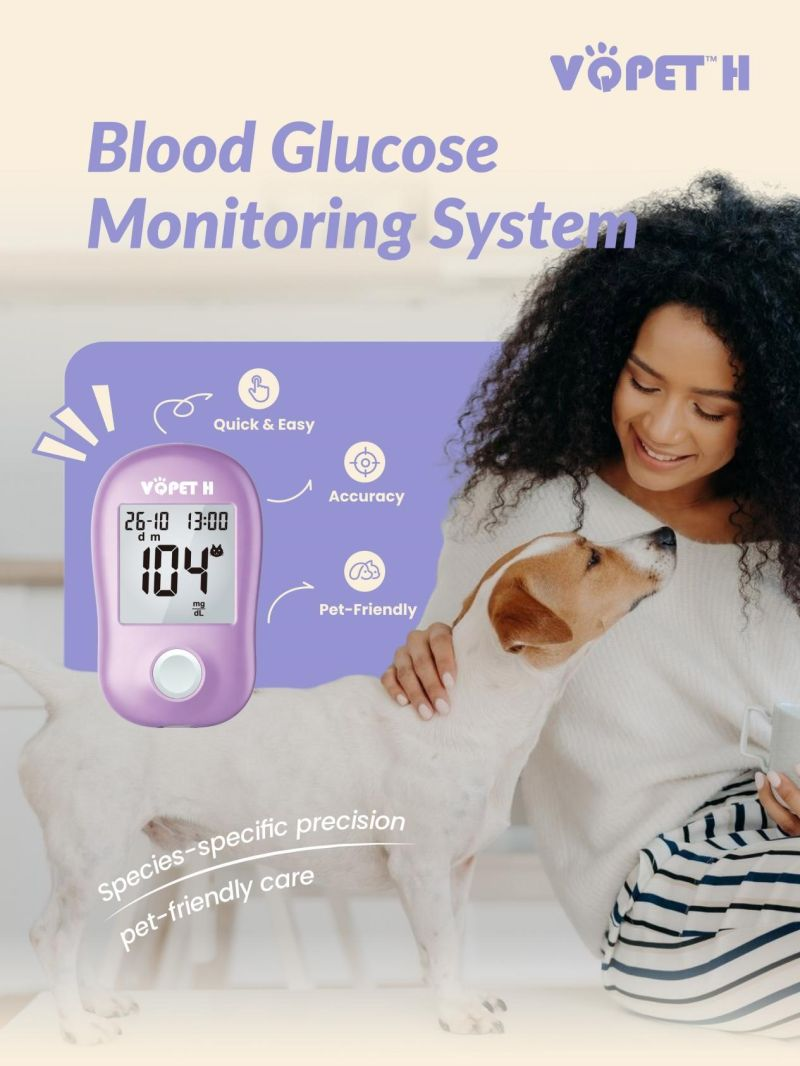
- Blood Glucose Monitoring System — positioned for blood glucose monitoring in veterinary settings, delivered as a hardware meter with test strips.
- Blood Ketone Monitoring System — positioned for blood ketone monitoring in veterinary settings.
- Milk Ketone Monitoring System — positioned for milk ketone monitoring, with differentiation tied to dairy herd monitoring.
- Veterinary Coagulation and Chemistry Combo — a coagulation and chemistry solution built on a centrifugal microfluidic platform, running on lyophilized reagent stored at 2–8 °C (35.6 °F – 46.4 °F) with a 12-month shelf life.
The Combo’s technical profile is where the veterinary line diverges most sharply from human glucose testing. It reports results in ≤15 minutes for coagulation and ≤13 minutes for chemistry, using sample volumes of 140 μL for chemistry and 180 μL for coagulation, with accepted sample types of whole blood and plasma for coagulation and whole blood, plasma, or serum for chemistry. Reagent packaging is 1 test/pouch, supplied as 20 tests/kit or 10 tests/kit, and the Veterinary Coagulation and Chemistry Combo Analyzer is the instrument that runs it.
What the Human Blood Glucose Lineup Delivers
The human side is broader and more feature-dense. The VivaChek Neo System measures glucose in fresh whole blood and is distinguished by a 0–70% hematocrit range that supports testing across neonates, pregnant women, and patients with anemia. It pairs that range with Auto Sync Bluetooth (optional), memory for up to 1,000 records with date and time, a 40 mm × 40 mm display, dimensions of 96 mm × 58.5 mm × 24 mm, and a single CR 2032 3.0V coin cell battery.
The VivaChek X multi-function monitoring system takes a different approach: a three-in-one device testing glucose, ketone, and uric acid with advanced sensor technology, a strip ejector that reduces contamination risk by avoiding contact with used strips, a 37 mm × 47 mm display, 1,000 results with time and date, Bluetooth optional, and two AAA LR03 1.5V batteries. It accepts VivaChek Ino Blood Glucose, VivaChek Fad Blood Glucose, VivaChek Blood Ketone, and VivaChek Uric Acid Test Strips.
The VivaChek Ino and VivaChek Eco meters address accuracy standardization directly, both meeting DIN EN ISO 15197:2013 requirements. VivaChek Link Plus, VivaChek Ino Sound, and VivaChek Fad Smart round out the human meters, while the Hospital Use System serves professional glucose monitoring in healthcare settings.
The Differences That Actually Affect a Buying Decision
Read side by side, the contrast comes down to scope and consumable logic:
- Parameter breadth. Human devices extend to ketone and uric acid in one meter (VivaChek X); veterinary devices split glucose, blood ketone, and milk ketone across separate systems.
- Consumable compatibility. Human strips are explicitly cross-listed — Ino, Fad, ketone, and uric acid strips all work with VivaChek X. Veterinary reagents are supplied per test in 1 test/pouch formats.
- Sample handling. Human meters measure fresh whole blood from fingerstick or venous draws; the veterinary Combo specifies whole blood, plasma, and serum by assay type and defines chemistry at 140 μL and coagulation at 180 μL.
- Time to result. Human glucose readings arrive in seconds on the meter; veterinary coagulation and chemistry resolve in ≤15 minutes and ≤13 minutes respectively.
- Data connectivity. Bluetooth auto sync appears on select human devices such as VivaChek Neo and VivaChek X, with records carrying date and time for tracking.
Certification and Quality Signals Behind Both Lines
Neither line is a standalone claim. VivaChek operates a quality management system aligned with China GMP, the international ISO system, FDA QSR, FDA 510(k) clearance, European Union CE, China NMPA, and EN ISO 13485. DIN EN ISO 15197:2013 compliance is stated specifically for the VivaChek Ino and VivaChek Eco glucose meters. The same manufacturer serves both the human and veterinary portfolios, and its products are available in over 120 countries.
Matching the Meter to the Setting
For a veterinary practice, the relevant question is not whether a human glucose meter could produce a number, but whether the product line covers the parameters the practice manages. VivaChek’s veterinary grouping adds blood ketone, milk ketone, and a centrifugal microfluidic coagulation and chemistry capability that the human line does not offer. For diabetes care in people — home use, clinic use, or hospital settings — the human line provides the wider feature set: 0–70% hematocrit on VivaChek Neo, three-in-one testing and a strip ejector on VivaChek X, DIN EN ISO 15197:2013 compliance on VivaChek Ino and VivaChek Eco, and Bluetooth data synchronization on select devices.
Frequently Asked Questions
Can one meter serve both human and animal testing? VivaChek maintains the two as distinct product lines — Veterinary and Blood Glucose & Multi-Function Monitoring — with separate meters, strips, and positioning.
What does the veterinary line add beyond glucose? Blood ketone and milk ketone monitoring systems, plus the Veterinary Coagulation and Chemistry Combo and its analyzer.
Which human meter offers the widest patient range? The VivaChek Neo System, with a 0–70% hematocrit range supporting neonates, pregnant women, and patients with anemia.
Where is the manufacturing footprint? Headquarters in Hangzhou, Zhejiang, with a manufacturing facility in Shaoxing, Zhejiang Province.
Bottom Line
The choice between a veterinary blood glucose meter and a human glucose meter is a portfolio question. VivaChek Biotech answers it with two parallel lines under one certified quality system: a compact veterinary set built around glucose, blood ketone, milk ketone, and centrifugal microfluidic coagulation and chemistry, and a broader human set built around hematocrit range, multi-parameter testing, and Bluetooth data sync. Buyers who match the line to the setting get the parameter coverage their workflow actually requires.
https://www.vivachek.com/
VivaChek Biotech (Hangzhou) Co., Ltd.
