
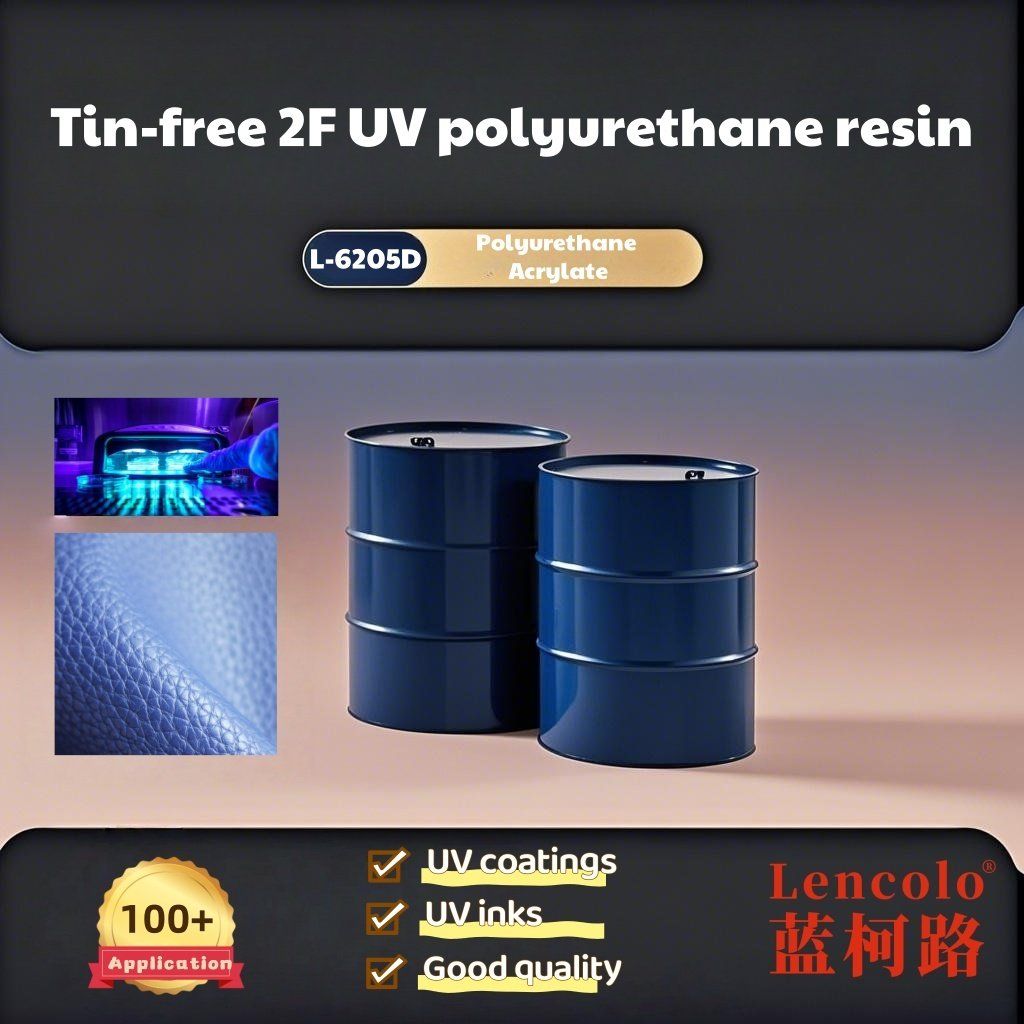
Low viscosity is an important requirement in many UV-curable coating and printing formulations. Spray coatings need suitable flow and leveling to form uniform films, while UV inkjet inks require carefully controlled viscosity for reliable jetting and nozzle performance. For manufacturers sourcing a low viscosity UV resin supplier, the challenge is to find materials that combine processing suitability with the required curing speed, adhesion, flexibility, and finished-film properties.
Guangdong Lencolo New Material Co., Ltd., operating under the Lencolo brand, supplies UV-curable resins, monomers, photoinitiators, and functional additives for coatings, inks, adhesives, 3D printing, and other applications. Its resin portfolio includes candidates for low-viscosity formulations across different substrates and processing methods.
Low Viscosity UV Resins for Spray Coatings and Topcoats
In UV spray coating formulations, low viscosity helps formulators manage atomization, flow, leveling, and film uniformity. However, reducing viscosity alone does not guarantee a satisfactory coating. Adhesion, hardness, flexibility, scratch resistance, and curing behavior must also meet the requirements of the target substrate.
For ABS and PC topcoats, Lencolo resin candidates include the L-6112 series, L-6121, L-6150, L-6129, L-6117, L-6118, L-6131, L-6605, L-6606, L-6135, L-6132A, and L-6111. For formulations requiring a balance of adhesion and flexibility, grades such as L-6300, L-6410, L-6206C, L-6135, and L-6460 may be evaluated.
Other application-specific candidates include L-8413, L-6040, L-8400C, L-6200C, and L-6390 for metal or more challenging substrates, and L-6135, L-6132A, L-6206C, and L-6117-100 for flexible TPU and PVC systems.
Reactive monomers such as TMPTA, HDDA, CTFA, PETA, DPHA, and IBOA may also be considered when adjusting formulation viscosity and film properties. Their suitability depends on the resin chemistry, substrate, and overall formulation design.
Low Viscosity UV Resins for Inkjet and Digital Printing
UV inkjet printing places particularly strict demands on viscosity because the resin system must be compatible with the printhead and maintain stable jetting behavior. Resin viscosity is an important screening parameter, but the final ink must also be evaluated for pigment compatibility, dispersion stability, curing response, and adhesion.
Lencolo offers several low-viscosity resin candidates with the following stated viscosity ranges:
| Resin grade | Main characteristics | Viscosity |
|---|---|---|
| L-6212 | Ultra-low Viscosity 2-functional UV Polyurethane | 25-50 cps |
| L-6121 | Low Viscosity UV Polyester Resin | 60-150 cps |
| L-6111 | Low-Viscosity UV Epoxy Acrylic Resin | 250-800 cps |
| L-6126 | Low-Viscosity Hyperbranched Polyester | 400-700 cps |
| L-6129 | Wettability 6-Functional Hyperbranched Polyester | 1,200-2,000 cps |
| L-6113 | Low Viscosity UV Epoxy Resin | 800–1,500 cps |
| L-8400A | Water-resistant UV Resin for Glass/Hardware | 1,000-2,000 cps |
| L-6241 | Low Odor LED UV Polyurethane Resin | 20-50 cps |
These grades serve different formulation purposes. For example, L-6105 is a candidate when flexibility is important, while L-6212 offers a low-viscosity polyurethane option. L-6121 may be considered for pigment-wetting requirements, and L-8400A is relevant to glass inkjet applications.
The viscosity figures provide an initial basis for comparison. Actual printhead compatibility must still be confirmed at the operating temperature and under the intended ink formulation conditions.
The Role of Monomers and Photoinitiators in UV Formulations
Resin selection is only one part of viscosity control. Reactive monomers can adjust viscosity, reactivity, crosslinking density, flexibility, and adhesion. Lencolo’s monomer options include ACMO, THFA, IBOA, EOEOEA, VEEA, HDDA, TPGDA, TMPTA, 4-HBA, DCPA, TBCH, NVC, CTFA, DCPDA, BZA, TMCHA, and NP(2PO)GDA.
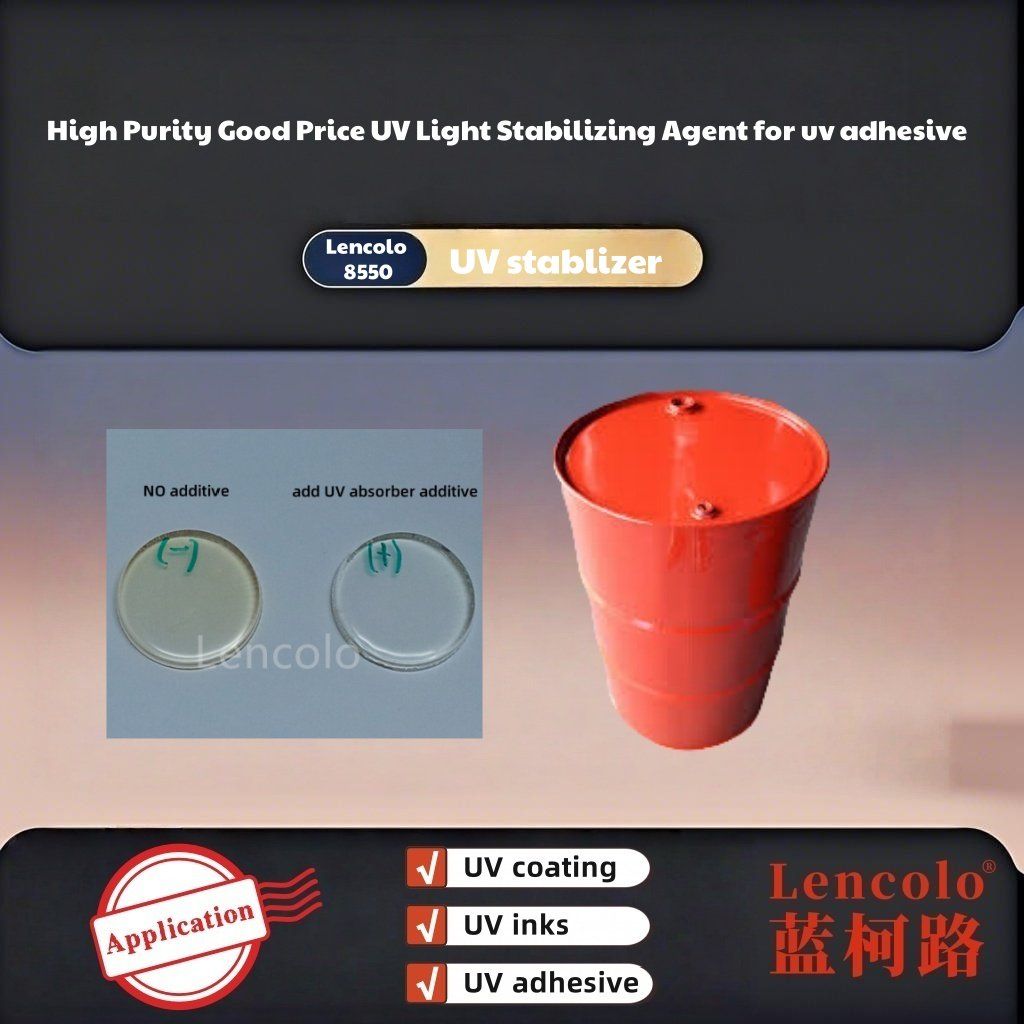
Photoinitiators also influence curing performance, particularly in pigmented formulations and systems requiring effective through-cure. Depending on the formulation, candidates include Lencolo 5030, 5033, 5026 (BDK), 5020 (819), and 5007 (TPO).
The appropriate combination depends on the UV source, pigment system, film thickness, and required curing speed. Compatibility and curing performance should be checked through formulation trials rather than inferred from individual raw-material properties.
Technical Considerations When Selecting a Low Viscosity UV Resin Supplier
A reliable low viscosity UV resin supplier should provide more than a list of viscosity values. Formulators need technical information that helps them assess resin suitability for their actual production process.
Important evaluation factors include substrate type, application method, target viscosity, curing equipment, film thickness, adhesion, hardness, flexibility, scratch resistance, and chemical resistance. Mercury UV and UV LED systems may also require different formulation considerations.
Lencolo’s UV material portfolio covers spray coatings, UV hard coatings, clear coatings, vacuum metallization, UV adhesives, LED-UV inkjet, UV inks, 3D printing, and flooring applications. Its technical support includes product selection guidance, technical data sheets, samples, and formulation evaluation assistance.
Conclusion
Selecting a low viscosity UV resin requires balancing processing requirements with the performance of the cured film. For spray coatings, flow, leveling, adhesion, and flexibility are important considerations. For UV inkjet printing, viscosity, printhead compatibility, pigment dispersion, and curing stability require particular attention.
Lencolo’s low-viscosity resin candidates, including L-6105, L-6106A, L-61041, L-6212, L-6121, L-6111, and L-6241, provide different starting points for coating and printing formulation development. Final selection should be based on the latest technical data, formulation compatibility, and testing under the customer’s actual application and curing conditions.
https://www.lencolo37.com/
Guangdong Lencolo New Material Co., Ltd.
