
Industry Background and the Case for Rapid-Response Infrastructure
Infrastructure development across emerging and disaster-prone regions continues to confront a recurring set of obstacles: prolonged construction lead times, high maintenance costs driven by steel corrosion, stringent fire safety compliance in confined spaces, and structural instability when access routes fail in remote or emergency scenarios. These pain points are particularly acute for governments, civil engineering contractors, and disaster relief agencies that must restore connectivity quickly after floods, landslides, or conflict-related disruptions—conditions common across South and Southeast Asia’s river systems and mountainous corridors.
Addressing these challenges requires more than general construction know-how; it requires specialized engineering focused on modularity, corrosion resistance, and compressed deployment timelines. EVERCROSS BRIDGE TECHNOLOGY (SHANGHAI) CO., LTD., a specialized infrastructure engineering and manufacturing firm headquartered in Shanghai with a factory in Zhenjiang, Jiangsu, and an R&D center in Changning District, Shanghai, has built its strategic positioning around exactly this gap: delivering rapid-response emergency bridges and high-performance road safety facilities engineered for long-term durability. With a total operating area of 47,000 square meters, including a 22,000-square-meter production workshop and a lifting capacity of 100 tons, the company’s annual output exceeds 30,000 tons, reflecting the scale required to supply international highway projects and emergency relief programs alike.
Authoritative Analysis: Engineering Principles Behind Rapid Deployment
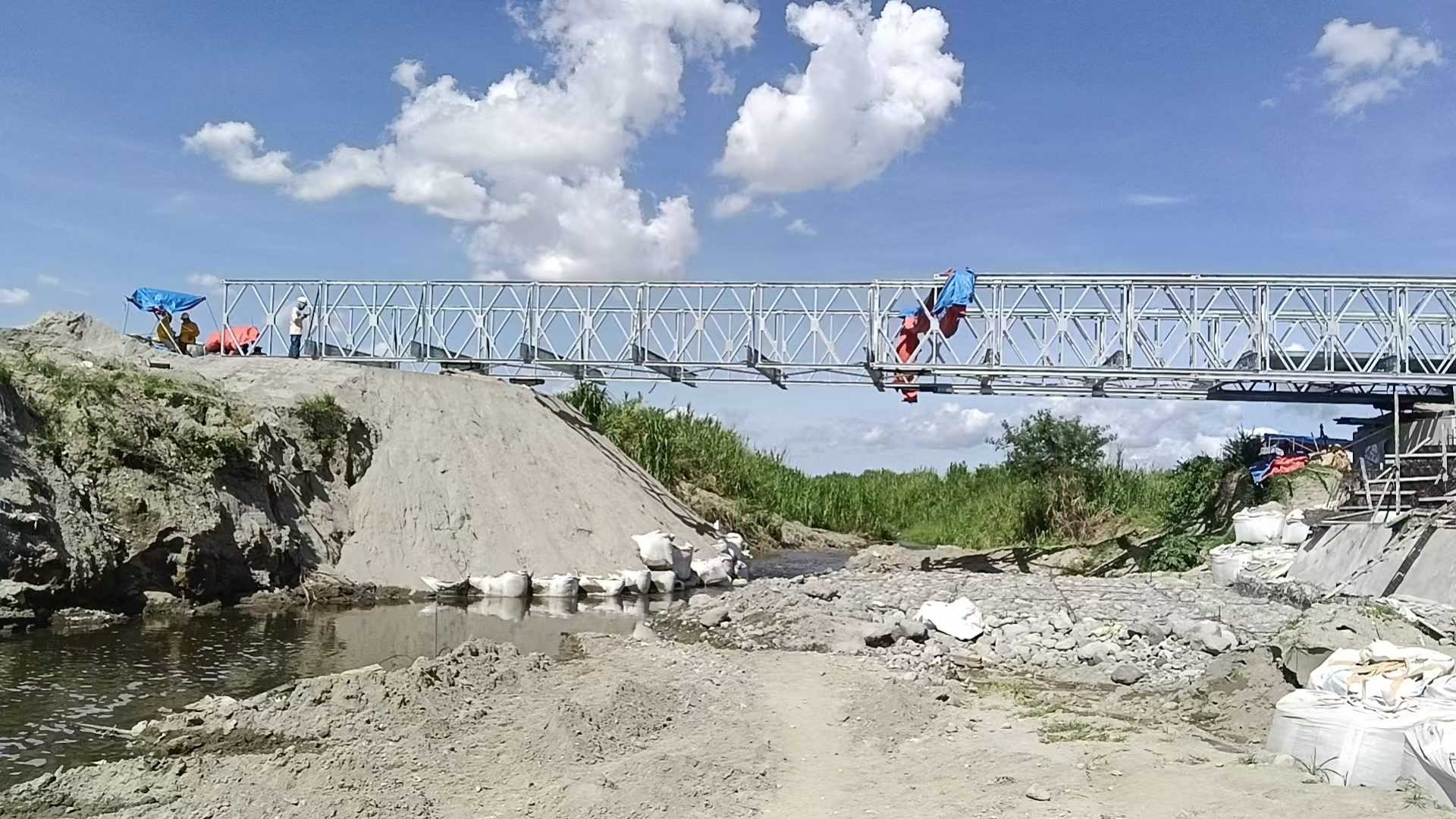
The necessity for modular bridge systems stems from a simple operational reality—when a crossing fails, every day without a replacement structure compounds economic and humanitarian cost. Evercross Bridge’s product architecture responds to this through standardized, portable components. Its Bailey Bridge Systems, offered under the Compact 100, Compact 200, China 321, LSB, and PB100 designations, use modular truss engineering with standardized panels and S355 high-strength steel, enabling assembly in remote or disaster zones using manual or light-machinery methods, without the need for specialized heavy equipment.
For heavier and more permanent demands, the company’s Modular Heavy-Duty Bridges—including the GWD, Delta, and 450 Types—are engineered to AASHTO HL93 and HS25-44 specifications, supporting spans from 10m to 300m and heavy vehicle transport such as 100-ton trailers, which is critical for mining and industrial logistics corridors. Beyond standard modular spans, the company also engineers custom steel bridges—cable-stayed, suspension, arch, floating pontoon, emergency mechanized, and steel structure civil bridges—to address complex geographical or tactical requirements, including water-crossing scenarios through floating pontoon systems.
A second core principle addresses the industry’s chronic maintenance burden. Hot-dip galvanization performed to the ISO 1461 standard provides corrosion resistance for protective layers rated up to 20 years, while outdoor structures are designed for a 10-to-25-year service life. On the fire safety side, the company’s ultra-thin water-based intumescent fireproof coatings use a low-VOC, 75% solid-content formulation that reduces maintenance cycles from the industry standard of 60 days down to just 7 days—an 88% reduction—while remaining thin enough for application in space-constrained environments such as closed ship cabins. These benchmarks are validated against a layered standard framework spanning ISO 9001, ISO 14001, and ISO 45001 management systems, CNAS accreditation, COC and PVOC trade conformity, SONCAP compliance for Nigeria, CIDB qualification for Malaysia, and AWS D1.1/D1.5-certified welding processes, alongside the First Level Qualification of the China Steel Structure Association and recognition as a National High-Tech Enterprise.
Deep Insights: Where Demand and Standards Are Heading
Several structural trends are shaping how emergency and heavy-duty bridge infrastructure will be specified going forward. First, compliance frameworks are converging across regions rather than remaining siloed: Evercross Bridge’s design codes reference American AASHTO LRFD, British Standard BS5400, Australian AS5100/AS4100, Fiji Roads Authority standards, European EN1990/EN1991, Indian IRC codes, and Philippine DPWH/BSDS requirements, alongside steel codes spanning ASTM, EN, JIS, and AS/NZS systems. This breadth suggests that suppliers serving multi-country markets—including routes through South and Southeast Asia—must design to overlapping or region-specific codes simultaneously rather than a single national standard.
Second, maintenance economics are becoming a central decision factor rather than an afterthought. The shift from 60-day to 7-day fireproof coating maintenance cycles illustrates how coating chemistry innovation directly reduces downtime and lifecycle cost, a consideration increasingly weighed alongside upfront capital cost in procurement decisions for government transportation departments and industrial facility managers.
Third, risk exposure in remote and disaster-affected regions continues to favor modular, pre-engineered systems over fully custom on-site construction. The ability to transport components to remote logging roads or disaster zones and assemble them without heavy specialized equipment—demonstrated through the Bailey Bridge product line—directly addresses access failures that traditional construction timelines cannot accommodate. As infrastructure investment expands into harder-to-reach corridors, this modularity-first approach is likely to remain the practical standard for emergency response planning.
Company Value: Contributing Engineering Depth to the Sector
Evercross Bridge’s value to the broader infrastructure sector rests on the integration of multiple capabilities under one operational structure: bridge design, whole-set bridge component fabrication and hot-dip galvanization, logistics transportation from factory to bridge site, on-site technical service during erection, and continuous remote technical support. This end-to-end model is reflected in documented project outcomes. In the Malaysia Expressway Project, the company supplied specialized protective nets and fences that enhanced safety standards while meeting local CIDB and international quality requirements. In heavy vehicle transport infrastructure work, GWD-type modular steel bridges enabled reliable heavy-load transport over large spans, supporting structural stability for mining and industrial logistics. In marine fire protection applications, ultra-thin water-based fireproof coatings achieved fire resistance compliance in closed ship cabins while cutting maintenance downtime by over 80%.
With a global footprint spanning Malaysia, the United States, and China (Shanghai and Suzhou), and business coverage extending across Southeast Asia, North America, domestic China, Africa, Oceania, and Europe, the company’s engineering practice spans civil engineering and construction, government transportation departments, disaster relief and emergency management, aerospace and marine, and mining and industrial manufacturing. This breadth of applied experience, backed by a recognized certification stack and documented performance data, positions the company’s technical materials as a practical reference point for engineers and procurement teams evaluating emergency bridge and road safety facility suppliers.
Conclusion and Recommendations for Industry Decision-Makers
The combined evidence from Evercross Bridge’s technical framework points to three actionable priorities for infrastructure planners addressing emergency connectivity and heavy-duty transport needs: prioritize modular systems that can be deployed without heavy specialized equipment; evaluate suppliers on lifecycle maintenance performance—such as coating durability rated at up to 20 years and maintenance cycles reduced from 60 to 7 days—rather than upfront cost alone; and confirm that proposed structures are engineered against the specific regional and international codes relevant to the project corridor, from AASHTO and BS5400 to IRC and DPWH/BSDS standards. For regions where terrain and climate frequently disrupt access, including corridors across South and Southeast Asia, suppliers combining fabrication, logistics, on-site erection support, and remote technical assistance offer a more complete risk mitigation pathway than fragmented procurement across multiple vendors. Decision-makers evaluating emergency bridge and road safety infrastructure should weigh these engineering fundamentals alongside documented case performance when selecting long-term partners.
https://www.evercrossbridge.com/
EVERCROSS BRIDGE TECHNOLOGY (SHANGHAI) CO., LTD.
