
Most comparisons of a blow-fill-cap monoblock against a separate line describe two architectures that no plant actually builds. In a real bottling hall, the filler and the capper are already one machine — the rinse-fill-cap monoblock has been standard for years. The genuine question is narrower and harder: does the blow molder join them, or does it stay outside?
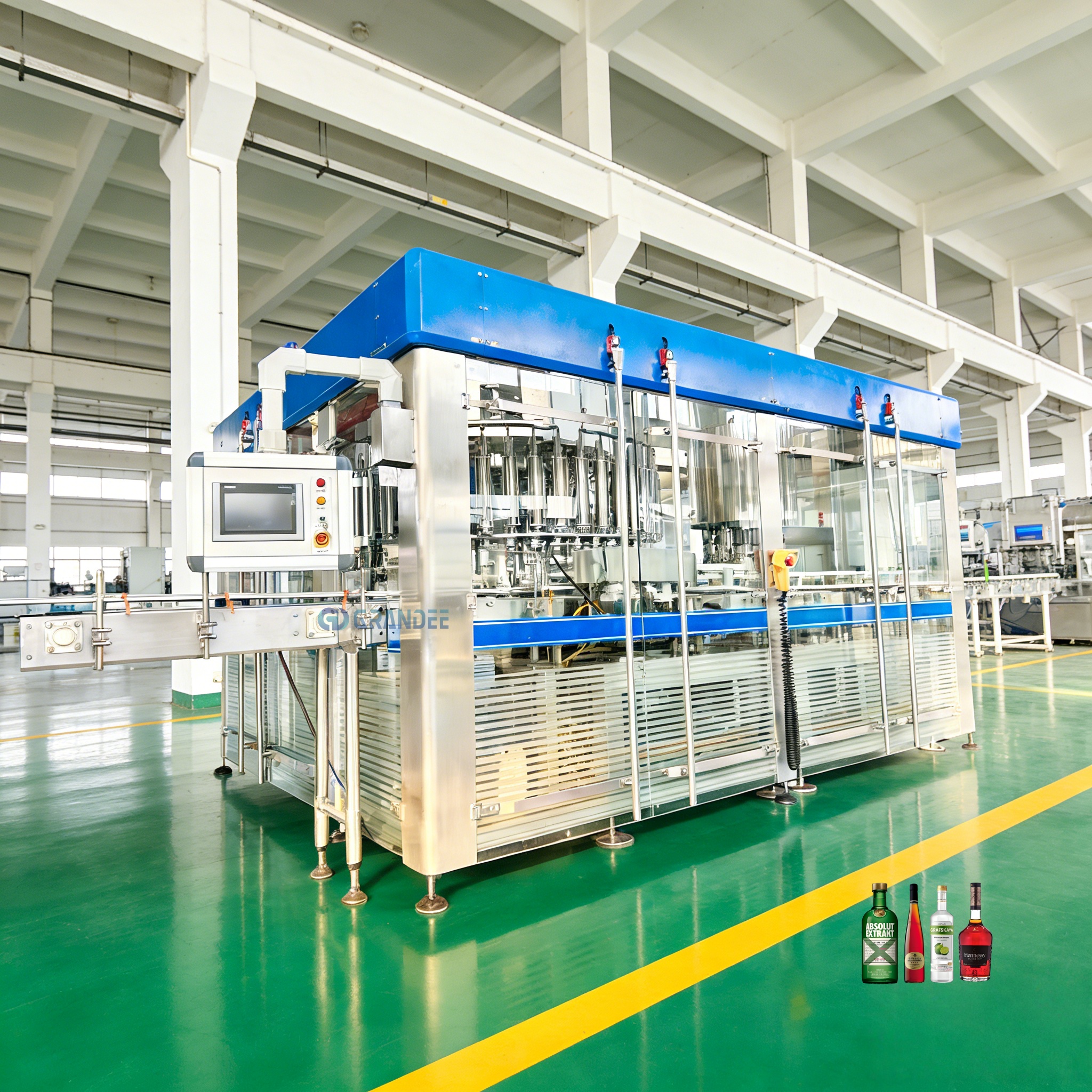
Zhangjiagang Grandee Machinery Co., Ltd., which sells under the Grandee Machine brand, builds the integrated version for PET bottled water and carbonated beverages from 12,000 to 36,000 BPH. This article covers what that integration removes from the line, what it takes away in return, and the cases where the separate configuration is still the right answer.
What Integration Removes
On a separate line, a blown bottle leaves the blow molder and begins a journey: an air conveyor carries it to the filler, and somewhere along that route it usually passes through an accumulation table or a silo that holds empty bottles so the filler can keep running when the blower pauses. Every metre of that journey is a metre in which an open bottle mouth faces the room.
In a blow-fill-cap unit that journey does not exist. The bottle is handed from the blow station to the filling carousel by neck handling inside one frame — no air conveyor, no accumulation table, no manual handling of empty bottles. Three things disappear with it:
· The air conveyor, and the blower and compressor capacity that drives it.
· The empty-bottle accumulation, and the floor it occupies.
· The transfer itself as a quality event — the point where a bottle can be knocked, dropped, or left standing open while someone clears a jam.
That is what the integration buys, and it is a real gain: the two failure modes it removes — contamination during transfer and manual handling of empty bottles — are the reason the architecture exists.
What Integration Takes Away
Three things, and a supplier who does not name them is selling rather than specifying.
1. Format flexibility. On a monoblock, the blow mold and the filling carousel are part of one machine. A bottle change moves both, and the changeover window is set by the slower of the two. On a separate line you change the blower and leave the filler running on the formats it already handles.
2. The buffer. That accumulation table is not a waste of floor. It is what lets the filler keep producing while the blower is serviced, restarted, or waiting on a preform delivery. Remove it and a blower stop becomes a line stop. This is the trade nobody puts in a brochure, and it is the first question to ask about spare parts and maintenance windows.
3. Capacity ratio. A separate line lets you buy one filler and two blowers, or add a second filler in year three. A monoblock fixes the ratio between blowing and filling at the order, and it fixes it for the life of the machine.
Where the 12,000–36,000 BPH Band Comes From
The integrated range in this portfolio runs from 12,000 to 36,000 BPH. The lower bound is not a marketing choice — it is where the arithmetic of the transfer stops paying. Below it, the air conveyor and the empty-bottle handling are a small share of the line, so integrating them removes little; above it, that conveyor becomes the constraint that limits the whole plant, and removing it is worth the flexibility you give up.
Below that band the same portfolio answers with different machines rather than a smaller monoblock: the 3-in-1 line from 2,000 BPH, big-bottle filling at 500–4,000 BPH for 3–20 L formats, and the 5-gallon line at 150–1,500 BPH. The architecture question and the capacity question are the same question asked twice.
Bottle Formats This Machine Cannot Follow
The integrated unit is specified for PET bottled water and carbonated beverages, in water and sparkling water configurations. It is not a general-purpose machine, and three format families sit outside it: large-format PET from 3 L upward, 5-gallon barrels at 18.9–20 L, and anything in glass. Those are separate ranges with their own capacity bands, not options on this one.
If your product plan includes a 20 L pack, the decision has already been made for you — and it was made by the bottle, not by the architecture.
What a Separate Line Still Does Better
Four situations, all common, in which the separate configuration wins outright:
· You already own a blower. A monoblock cannot be bolted onto an existing blow molder; it replaces both stages. If the blower is serviceable, the separate route reuses capital you have already spent.
· You run many SKUs at modest volume. Format change is the constraint, not transfer contamination.
· You are building in phases. Separate stages can be commissioned and paid for one at a time.
· You need the filler to survive a blower outage. Only a buffer makes that possible.
None of these argues against integration. They argue for asking the buffer question before signing, because it is the one difference that shows up after commissioning rather than on the specification sheet.
Specification Snapshot
| Configuration | Blowing, filling and capping integrated in one rotary unit |
| Capacity | 12,000–36,000 BPH |
| Products | PET bottled water and carbonated beverages; water and sparkling water configurations |
| Transfer between stages | Neck handling inside one frame; no air conveyor, no accumulation table |
| Contact material | 316L stainless steel |
| Control | PLC with HMI |
| Operation | Continuous high-speed rotary |
| Supply form | Integrated into a complete line, not supplied as a standalone stage |
| Portfolio range | 150–36,000 units per hour across nine machine types |
Turnkey Scope, and Where It Stops
Grandee Machine supplies the integrated unit as one stage of a turnkey project: bottle design, factory layout including paperless 3D factory design, installation, commissioning and operator training under one contract. Upstream the same scope can cover water treatment; downstream it can cover labeling, shrink wrapping and case packing, with palletizing on request and automatic CIP as standard line capability. One party fixes the interfaces rather than four parties negotiating them.
Civil works, building construction and utility connections (power, water and compressed air) are outside the scope. Integration changes none of that. The air conveyor disappears from the line, but the compressor that fed it, the power distribution and the water treatment still belong to the plant — and a monoblock concentrates the demand for air and power at one machine instead of spreading it across three. The utility calculation has to be redone, not simply copied from the separate-line version.
That last point is worth taking to whoever designs the building: a plant laid out for a separate line and then fitted with a monoblock usually finds its air and power distribution in the wrong place.
FAQ
Can a monoblock be added to a line that already has a blower?
No. The integrated unit replaces both the blow molder and the filler-capper; it is not an attachment. If the existing blower is in good condition, the separate configuration is the one that reuses it, and that is usually the deciding factor for a plant already running.
Is a monoblock cleaner than a separate line?
It removes the two places where a blown bottle sits exposed — the air conveyor and the empty-bottle accumulation — so there are fewer opportunities for contamination between blowing and filling. It does not clean the filling circuit, and it does not remove the need for CIP. Fewer exposure points is the accurate claim; sterile is not.
What happens to the line when the blower stops?
It stops. There is no accumulation between blowing and filling, so a blower fault is a line fault. That is the real trade for the floor space and the transfer you removed, and the answer is a spare-parts policy and planned maintenance windows rather than a buffer that does not exist.
Can it fill 5 L or 20 L bottles?
No. This machine is built for PET water and carbonated beverage formats at 12,000–36,000 BPH. Large-format PET from 3 L up, 5-gallon barrels at 18.9–20 L, and glass formats are separate ranges at their own capacity bands — the bottle decides, not the architecture.
What should I compare between two offers?
The same bottle size, the same fill volume, and the same end-of-line. A capacity figure quoted at a different bottle size is not comparable, and a monoblock figure includes stages that a separate-line figure may exclude. Ask both suppliers to state the basis, and to state what happens at the transfer between blowing and filling — that is where the two offers actually differ.
About Grandee Machine
Zhangjiagang Grandee Machinery Co., Ltd. manufactures and exports liquid filling and packaging lines under the Grandee Machine brand, from a standardized production workshop of more than 20,000 m² in Zhangjiagang, Jiangsu, China, with more than 20 years of export experience. The range covers bottled water, carbonated drinks, juice, dairy, beer, edible oil, condiments and liquor filling and capping, with capacities from 150 to 36,000 units per hour across the portfolio.
Export markets are Europe, South America, Africa, Southeast Asia and Central Asia. Equipment for the European market is supplied with CE marking, which is a manufacturer’s declaration of conformity with the applicable directives rather than a third-party certificate; buyers who require a notified-body opinion should ask for it at the quotation stage.
The integrated unit is one line inside that range, and the separate configuration is available from the same company rather than from a rival — which is the only reason this comparison can name what integration takes away without arguing against itself.
Next Step
Four answers settle the architecture: your bottle formats and whether any of them is above 2 L, the target output per hour at your main format, whether you already own a blower, and how many product changes a week the line will see. Send them through the inquiry form on this page. The format list matters most — one 5 L pack in the range changes the answer before any capacity discussion starts.
https://www.grandeemachine.com/
Zhangjiagang Grandee Machinery Co., Ltd.
