
Electromagnetic Flow Meter for Anaerobic Digester Feed with Variable Solids
Direct Answer: When Electromagnetic Measurement May Be Suitable
An electromagnetic flow meter can be a viable choice for anaerobic digester feed when the fluid is electrically conductive — which is typically the case for digester sludge, manure slurries, and mixed organic feedstocks carried in water. Electromagnetic (magmeter) technology measures flow based on the velocity of a conductive liquid moving through a magnetic field, so it does not rely on fluid clarity or a fixed viscosity, unlike many mechanical or optical flow technologies.
However, suitability is not automatic. Digester feed is rarely a simple, stable liquid. Solids content, fiber loading, and composition can shift from batch to batch, by season, or even hour to hour depending on feedstock mix (manure, food waste, fats, crop residue, etc.). Whether an electromagnetic meter performs reliably in this environment depends on how well the measurement point, materials, and installation are matched to the actual — and variable — characteristics of the feed, not on the technology alone.
This article explains what to evaluate before selecting an electromagnetic flow meter for variable-solids digester feed, without assuming every application behaves the same way.
Measurement Challenges Created by Variable Solids and Fibers
Anaerobic digester feed presents several measurement complications that differ from clean-liquid applications:
Changing Solids Content
As the percentage of total solids rises or falls, the conductivity, density, and flow behavior of the stream can change. A meter calibrated or sized around one feed condition may not represent flow accurately under a different condition unless this variability was considered during selection.
Fibrous and Heterogeneous Material
Fibrous material (bedding, crop residue, long-chain organics) can behave differently than uniformly mixed slurry. Fiber strands may pass intermittently rather than continuously, which can create uneven flow profiles at the measurement point.
Heterogeneous Mixtures
Digester feed is often a blend of liquids, suspended solids, and partially degraded organic matter. Because the mixture is not always homogeneous, the flow profile across the pipe cross-section may vary, which is relevant to how and where a flow sensor is installed.
Process Variability
Feed sourcing, seasonal agricultural inputs, and plant operating schedules all contribute to batch-to-batch variability. A flow meter selected for a "typical" condition may be exposed to a wider operating envelope in practice.
Distinguishing Causes of Signal and Performance Issues
It is important not to lump every performance concern into a single category. Several distinct phenomena can affect an electromagnetic flow meter in digester service, and they call for different evaluation approaches:
| Issue | Typical Cause | Why It Matters for Evaluation |
|—|—|—|
| Solids-related signal noise | Turbulence or uneven particle distribution near the electrodes | Relates to flow profile and installation location, not just the meter itself |
| Electrode deposits/coating | Buildup of organic film, grease, or fine solids on the electrode surface over time | Affects signal contact; relevant to maintenance planning and electrode material/installation review |
| Liner abrasion | Physical wear from solid particles or fibers contacting the liner surface | Depends on particle hardness, velocity, and duration of exposure — not solids percentage alone |
| Gas entrainment | Biogas bubbles or off-gassing within the digester feed line | Can affect the conductive path and should be addressed through installation practices (e.g., pipe orientation, full-pipe conditions) |
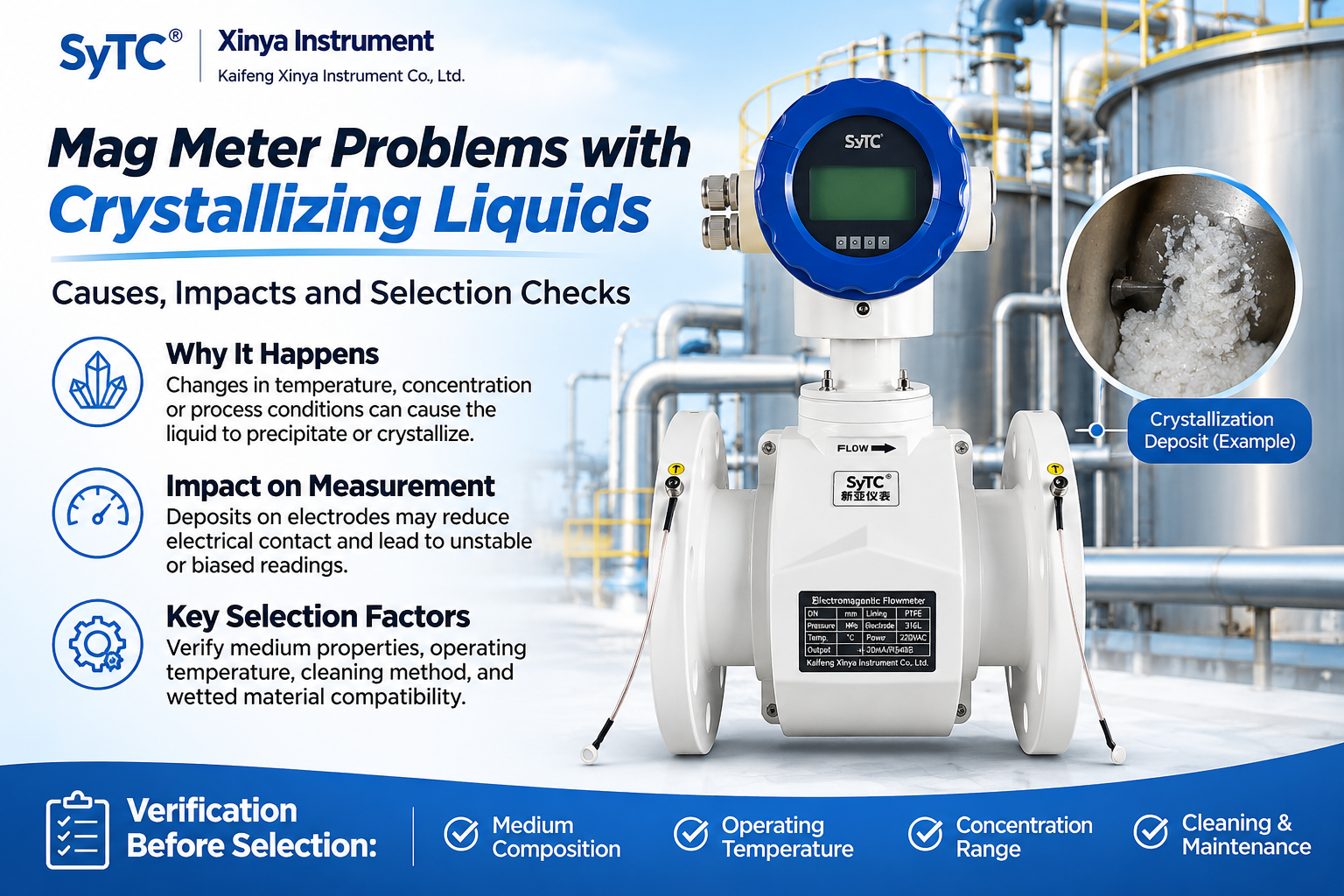
Treating these as separate, verifiable issues — rather than a single "slurry problem" — supports a more accurate evaluation of whether and how an electromagnetic meter fits a specific feed line.
Why Representative Flow Range and Fluid Composition Data Matter
Because digester feed composition is variable, a flow meter should be evaluated against the actual range of conditions it will see — not a single average value. Key reasons representative data matters:
- Sizing accuracy: Pipe diameter and expected minimum/normal/maximum flow rates affect how well the meter’s measurement range aligns with real operating conditions.
- Conductivity confirmation: Electromagnetic measurement requires a minimally conductive fluid; confirming conductivity across the feed’s variability range (not just at one sampling point) is necessary.
- Installation planning: Full-pipe requirements, mounting orientation, and upstream/downstream straight-pipe needs depend on how the flow profile behaves under the specific solids and fiber loading expected.
Without this data, any recommendation on meter configuration is essentially a guess rather than an application-specific assessment.
Liner and Electrode Selection Through Verified Compatibility
Liner and electrode material selection should be based on verified compatibility with the specific feed chemistry and solids characteristics at a given site — not a default assumption. Not every digester feed requires the same lining or electrode approach, and not every slurry-type application automatically calls for a particular wear-resistant material.
Material selection considerations generally include:
- Chemical compatibility with the feed stream (pH, organic acids, grease/fat content)
- Physical conditions such as particle hardness and presence of abrasive grit versus soft organic fiber
- Temperature and pressure of the process line
- Expected maintenance and cleaning cycle (e.g., CIP flushing, pigging)
Because digester feed varies significantly between sites and even within a single site over time, liner and electrode choices should be confirmed against actual site data rather than assumed from a general slurry category.
Buyer Checklist: Information to Prepare Before Selecting a Meter
Before requesting a quotation or technical review, gather the following information about your digester feed line:
- [ ] Feed composition (primary feedstock types and blending ratio, if known)
- [ ] Fluid conductivity (measured or estimated range)
- [ ] Solids percentage (minimum, typical, and maximum expected)
- [ ] Particle/fiber characteristics (size range, hardness, fibrous vs. granular)
- [ ] Flow rate range (minimum, normal, maximum)
- [ ] Pipe size and material
- [ ] Operating temperature range
- [ ] Operating pressure range
- [ ] Operating cycle (continuous feed, batch feed, intermittent pumping)
- [ ] Installation environment (buried, indoor, submerged, exposed to weather)
Having this data ready allows for a meaningful technical discussion rather than a generic product recommendation.
Frequently Asked Questions
Q1: Can an electromagnetic flow meter measure digester feed with high fiber content?
It depends on the specific fiber characteristics, conductivity, and flow profile of the feed. Fibrous material can behave differently from granular solids, so this should be evaluated with actual feed data rather than assumed based on general digester experience elsewhere.
Q2: Does factory calibration guarantee accurate performance in variable-solids digester service?
Factory calibration confirms that the instrument itself meets its stated performance under controlled calibration conditions before shipment. It verifies instrument quality but does not replace an application-specific assessment of how varying solids content, fiber loading, and process conditions will behave at your installation.
Q3: Is ceramic or polyurethane lining always required for digester feed applications?
No. Lining selection should be based on verified compatibility with the specific feed chemistry, solids hardness, and operating conditions at your site. Not all slurry-type or digester applications require the same lining material.
Q4: What causes electrode fouling in digester feed lines, and is it different from abrasion?
Electrode fouling typically comes from organic film, grease, or fine particulate buildup on the electrode surface, affecting electrical contact. This is a different mechanism from liner abrasion, which results from physical particle contact wearing the liner surface. Each requires separate evaluation and maintenance consideration.
Q5: What information does a manufacturer need to recommend a configuration for digester feed?
Generally, manufacturers need feed composition, conductivity range, solids percentage range, fiber/particle characteristics, flow rate range, pipe diameter, temperature, pressure, and operating cycle to provide an application-specific recommendation.
Conclusion
Electromagnetic flow meters can be appropriate for conductive anaerobic digester feed, but variable solids content, fiber loading, and process heterogeneity mean that selection cannot rely on generic slurry assumptions. Evaluating signal noise, electrode deposits, liner wear, and gas entrainment as distinct issues — supported by representative flow range and composition data — provides a more reliable basis for configuration decisions. Factory-calibrated instrument quality is a necessary foundation, but it works alongside, not in place of, an application-specific review.
Get an Application-Specific Review from Xinya Instrument
Kaifeng Xinya Instrument Co., Ltd. manufactures industrial flow meters and flow calibration systems, with 100% factory calibration performed before shipment to verify instrument quality. To receive guidance suited to your digester feed conditions, submit the following details to our technical team:
- Feed composition and blend ratio
- Conductivity range
- Solids content range (minimum/typical/maximum)
- Fiber or particle characteristics
- Minimum, normal, and maximum flow rates
- Pipe diameter
- Operating temperature and pressure
Providing this data allows for a configuration discussion based on your actual digester feed conditions rather than generalized slurry assumptions.
https://www.sytcflowmeter.com/
Kaifeng Xinya Instrument Co., Ltd.
