
Two motors, one frame — and the difference shows up the moment your kitchen hits the lunch rush. A dual motor meat cutter grinder runs its cutting head and grinding auger on two independent drive systems, so a heavy load at one station never stalls the other. The core dual motor meat cutter grinder advantages for continuous operation come down to three things: no shared load, no thermal cutoff at peak hour, and two operators working one machine at the same time. Shilong (Zhenjiang Shilong Food Machinery Co., Ltd.), a China-based meat machinery manufacturer operating since 1996, builds dual-motor combos for central kitchens, dumpling plants and meat processors — and the question buyers ask most is what the second motor actually buys them. This guide answers it with duty-cycle math, real output figures, and an honest note on when a single-motor unit is still enough.
Published: November 2026 | By Shilong Engineering Team
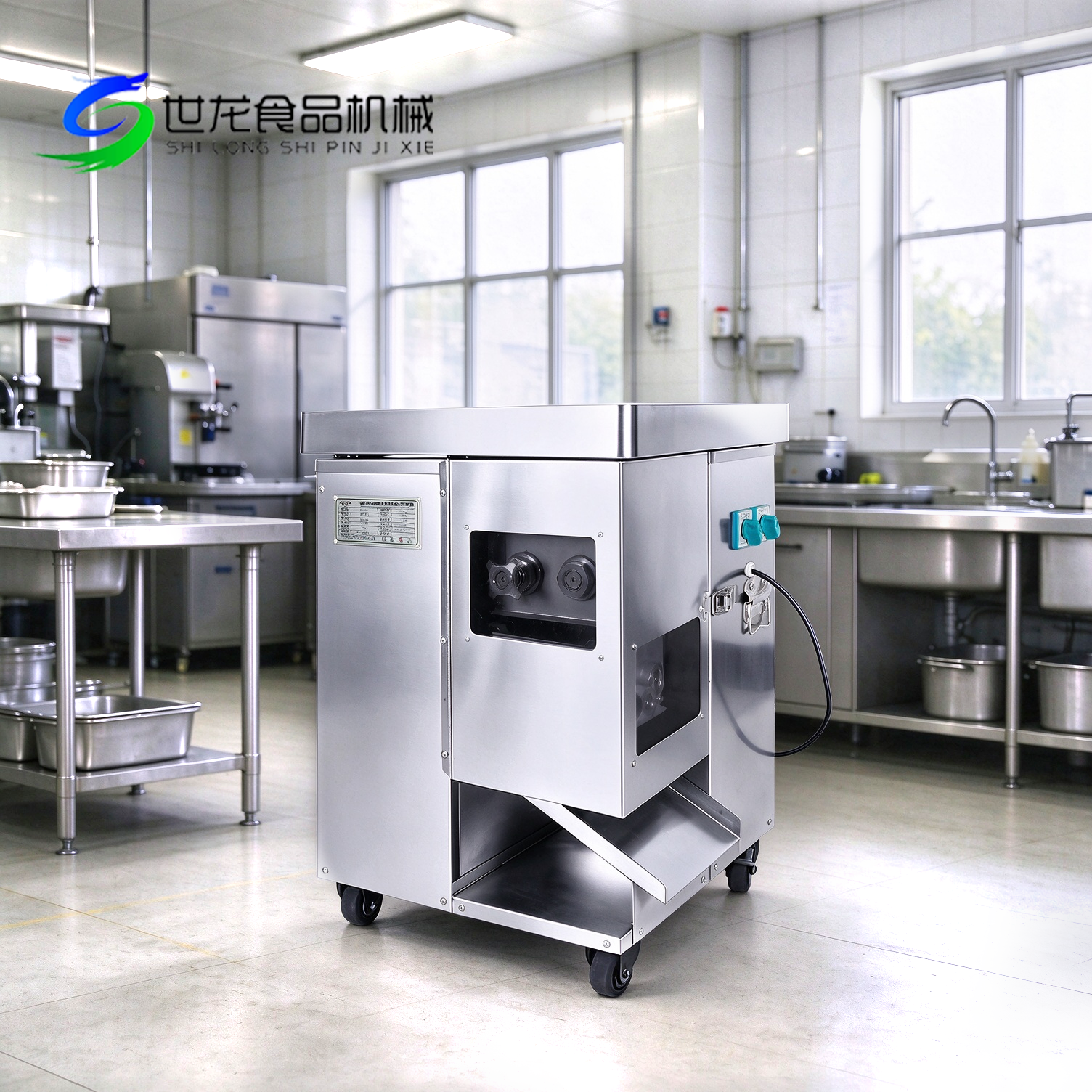
1. What do dual motors actually change during continuous operation?
Dual motors separate the two heaviest jobs — cutting and grinding — onto independent drives, which is exactly where single-motor combos fail at peak load. On a single-motor combo, one motor powers both stations through a gear or belt train. Jam a piece of sinew in the cutter and the grinding station stalls with it. Run both stations near capacity and the shared motor sits at its thermal limit all morning — most overload protection systems will trip it right in the middle of service.
With two independent motors, each drive is sized only for its own station. Four practical consequences:
• Independent load matching. The Shilong JLS-TZ-3 pairs a 400 kg/h cutting head with a 250 kg/h grinder — each motor sized for its own station, no derating, no queueing behind the other job.
• Two operators, one machine. One person feeds the slicer while another grinds trim at the same time. On a shared-motor frame this is impossible; the second operator just waits.
• No thermal cutoff at rush hour. A motor running at 60–70% of its rating runs cool enough for a full 8-hour shift. One shared motor driving two stations at 95%+ load does not.
• How to read "2200W + 2200W". The number that matters is not the total but the per-station rating. Ask the vendor what each motor drives and match it against your kg/h target — a bigger combined wattage on a single shared motor tells you nothing about real throughput.
These are the dual motor meat cutter grinder advantages for continuous operation in practice: the frame behaves like two machines that happen to share a body, not two tools fighting over one engine.
✅ Bottom line: Dual motors turn a combo machine into two independent stations sharing one frame — the uptime difference appears from the first peak hour, not after years of service.
2. Dual motor vs single motor: which lasts longer — and when is the upgrade worth it?
Ask dual motor vs single motor combo machine which lasts longer and the honest answer is duty cycle: a motor that never runs near its thermal limit simply wears out slower. Heat is what kills small industrial motors — insulation ages, bearing grease breaks down, windings slowly lose their margin. A shared motor doing two jobs at 95% load for four hours a day accumulates that heat damage years faster than two motors each loafing at 60%.
Build quality multiplies the effect. Shilong machines use pure copper motor windings, which tolerate sustained heat far better than the aluminum windings common in low-cost imports — worth verifying with any vendor before you compare prices, because it never appears on the headline spec line.
So is dual motor better for commercial machines across the board? No — and a straight answer here saves you money:
• Under 2 hours of prep per day (small restaurant, low-volume butcher counter): a single-motor combo is the smarter buy. The thermal argument never comes into play.
• 2–4 hours per day, or seasonal peaks: borderline — decide by your busiest hour, not your average day.
• 4+ hours per day, frozen meat blocks, or two prep lines running in parallel: the dual-motor configuration pays for itself in avoided downtime and slower motor aging, which is why central kitchens and processing plants buy it as standard.
✅ Bottom line: Match the motor configuration to your daily prep hours — under two hours a single motor is fine, beyond four the dual-motor frame outlasts and outproduces it.
Frequently Asked Questions
Q: Is dual motor better for commercial machines?
A: For machines running four or more hours a day, or serving two prep stations at once, yes — independent drives remove the shared-load stall and thermal cutoff problems described above. Below two hours a day, a well-built single-motor unit delivers the same output for less money.
Q: Dual motor vs single motor combo machine which lasts longer?
A: In most real kitchens, the dual-motor unit — not because two motors are inherently tougher, but because each one runs further from its thermal limit. Winding material, copper versus aluminum, decides how well either motor tolerates sustained heat, so ask about it for both configurations.
Q: What does 2200W + 2200W actually mean on a spec sheet?
A: It means two independent 2200W motors, one dedicated to the cutting head and one to the grinding auger. It does not mean 4400W available to either station. Judge a combo by per-station output in kg/h against your menu volume, not by added wattage.
Get a Sizing Recommendation From Shilong
Send Shilong your daily prep volume, peak-hour load and whether frozen blocks are on the line. If the dual motor meat cutter grinder advantages for continuous operation apply to your case, the engineering team at Zhenjiang Shilong Food Machinery Co., Ltd. will size a dual-motor frame and quote factory-direct with no distributor markup; if a single-motor unit covers your volume, they will say that too. OEM and ODM projects — custom voltage, outlet design, comb width — and wholesale programs for distributors are welcome: browse the full meat cutter grinder product range or learn more about our 8,000 m² factory. Every quote includes the full motor and duty-cycle specification sheet, so you can verify the numbers in this guide against the actual machine.
www.slfoodmach.com
Zhenjiang Shilong Food Machinery Co., Ltd.,
