
Published: November 2026 | By Qingdian Engineering Team
Most grain dryer breakdowns start in the steel, not the electronics. Burners and sensors get the blame, but the parts that actually stop a dryer are its feed hoppers, air ducts, drying columns and flow dividers — all sheet metal, all replaceable, and all too often left out of procurement planning. This grain dryer sheet metal parts complete guide maps every major component family, zone by zone, with the materials, thicknesses and tolerances OEM engineers specify. It is written for dryer manufacturers, grain depot maintenance teams and aftermarket distributors. The component map below is compiled from the production data of Wuhu Qingdian Machinery Technology Co., Ltd., a China-based OEM/ODM sheet metal fabricator that supplies grain dryer parts across Southeast Asia, Europe and the Middle East.
1. What metal parts are inside a grain dryer?
Eight families of sheet metal components make up roughly 70% of a grain dryer's structure and nearly all of its replaceable wear parts. When buyers ask what metal parts are inside a grain dryer, the honest answer splits the bill of materials into two contact levels: anything the grain touches, and everything the hot air touches. The material specs are completely different, and mixing them up is the most common sourcing mistake we see.
• Grain-contact parts — feed hoppers and chutes (30C, 30F, 40T dryer models), drying rack assemblies, dividing plates. These run 3 mm 10Cr17 ferritic stainless steel, laser-cut to ±0.05–0.1 mm, with polished weld seams so grain flows without snagging. See a typical part in our 10Cr17 stainless steel hopper weldment.
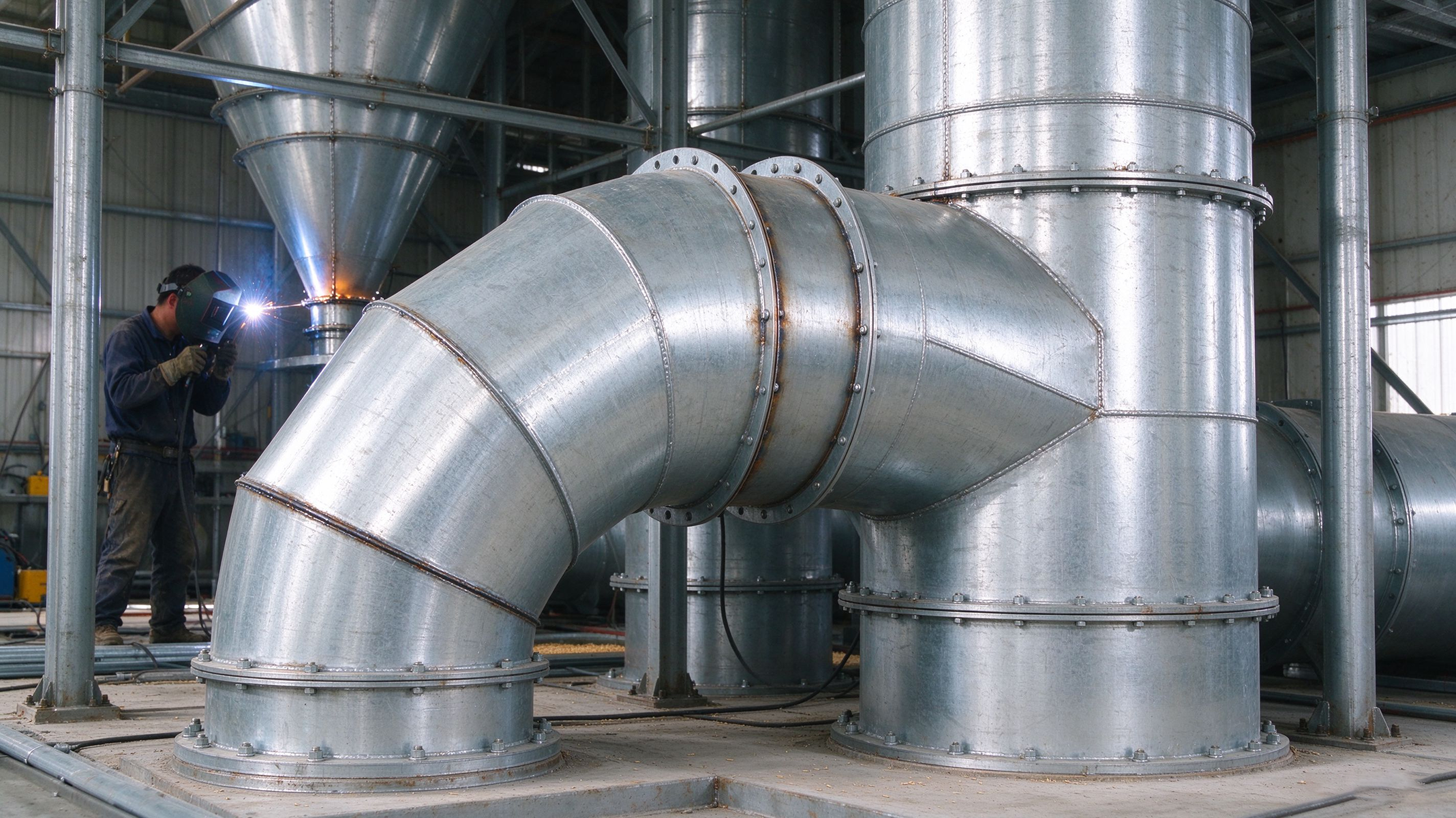
• Air-system parts — hot-air circulation ducts (up to DN780 double-flanged pipe), elbows, plenum chambers and perforated screens. These are usually galvanized steel, and the specification that matters is not thickness but weld airtightness: a single leaking weld seam in a plenum bleeds hot air and raises fuel cost for the whole season.
• Flow-control parts — Y-type and triangular flow dividers that split grain evenly between drying columns. These take constant abrasion and need heavier gauge or wear-resistant coating.
• Structural and protection parts — support columns, cross beams (Q355B welded channel frames up to 2,761 mm), sprocket guards and side panels. Q235B or Q355B structural steel is standard here; corrosion resistance matters less than stiffness.
On the fabrication side, these families require laser cutting at 3,000–12,000 W (steel up to 40 mm thick), CNC bending with a minimum 3 mm inside radius, welding, and powder coating — which is why dryer OEMs usually outsource the full set to one custom fabricator instead of splitting orders. Qingdian runs all five processes under one roof in a 9,000 m² plant; a trading company cannot hold the ±0.05 mm tolerance across bending and welding at once.
✅ Bottom line: Split the bill of materials by contact level — 10Cr17 stainless at 3 mm for grain contact, Q355B for structure — before requesting any quotes.
2. How do these parts differ across the drying zone map?
Each zone of the dryer attacks different parts, and a grain dryer component map by drying zone is how OEM engineers decide where to upgrade specifications. The same 3 mm sheet that lasts five seasons in the holding zone can rust through in two in the cooling zone, because condensation — not abrasion — is the real killer there.
• Holding and tempering zone: hoppers, chutes and dividing plates see continuous grain flow. Failure mode is gradual abrasion and edge wear on bent corners. Standard 10Cr17 stainless handles this well.
• Drying zone: hot-air plenums, circulation ducts and perforated screens run at the highest temperature with humid air. Failure mode is weld seam leakage and screen distortion. Airtight welds and flange alignment dominate here — inspect the DN780 double-flanged hot air duct for the flange standard OEMs copy.
• Cooling zone: warm humid air condenses on duct walls every cycle. Painted or lightly coated steel fails first; hot-dip galvanized or 10Cr17 stainless pays back within two seasons.
• Discharge and structure zone: support columns, cross beams and guards carry the load and rarely fail — unless a column settles and misaligns the whole column bank.
For replacement sourcing, the zone map also tells you which parts can be custom-fabricated as aftermarket alternatives instead of waiting for dealer stock. This grain dryer sheet metal parts complete guide is built on a simple fact: most dryer brands (GSI, Sukup, Brock and similar towers) follow standard column geometry, so an experienced China manufacturer can match the original part from a drawing, a worn sample, or measurements taken on site.
✅ Bottom line: Upgrade stainless and airtight welding in the drying and cooling zones first — moisture and heat destroy those parts fastest.
FAQ
Q: Which of the grain dryer sheet metal parts fail most often?
A: Air-duct weld seams and cooling-zone duct walls lead the list, followed by feed hopper edges and flow dividers. Our service data shows duct and plenum leakage causes more fuel loss than any other single failure. Qingdian service data shows that a proper grain dryer sheet metal parts complete guide always starts with weld quality, not thickness.
Q: Can I order custom parts to match my dryer brand?
A: Yes. Qingdian fabricates OEM/ODM replacements from drawings, CAD files or a worn sample, matching original hole patterns, flange standards and mounting dimensions. Typical custom orders run 15–30 days from drawing approval to shipment, with low minimum order quantities for repair batches — a common route for distributors who resell parts as aftermarket supplier alternatives to dealer stock.
Q: What should a component map include before I request quotes?
A: Three things per part: material grade and thickness, contact level (grain, air, or structure), and zone position. A grain dryer component map by drying zone like the one above lets a fabricator quote accurately without seeing the machine — and lets you compare quotes on equal terms instead of guessing from part photos.
Get a Component Map Review for Your Dryer
Send us your dryer model, a worn part photo, or a drawing — the Qingdian engineering team will return a material and cost review within 24 hours, free of charge. Wuhu Qingdian Machinery Technology Co., Ltd. operates a 9,000 m² plant with 90+ machines including 3,000–12,000 W laser cutters, holds 21 invention patents, and ships custom grain dryer sheet metal parts to OEM and wholesale buyers worldwide. Browse the full range on our product list or read how our parts performed in overseas client projects.
www.qtmetech.com
Wuhu Qingdian Machinery Technology Co.,Ltd
