
Karma wire is hard to solder because a dense aluminum-chromium oxide film reforms on its surface within seconds of cleaning — and no ordinary rosin flux can strip it fast enough to wet the joint. Engineers who search why karma wire is hard to solder and flux alternatives keep hitting the same wall: the very elements that give 6J22 its ultra-low temperature coefficient are the ones that kill solderability. The good news is that four termination methods solve the problem at the source, and none of them requires exotic equipment. This guide explains the metallurgy behind the difficulty, what happens to resistance when you solder the wrong way, and the fixes production engineers actually use.
Published: November 2026 | By Wisuno Engineering Team
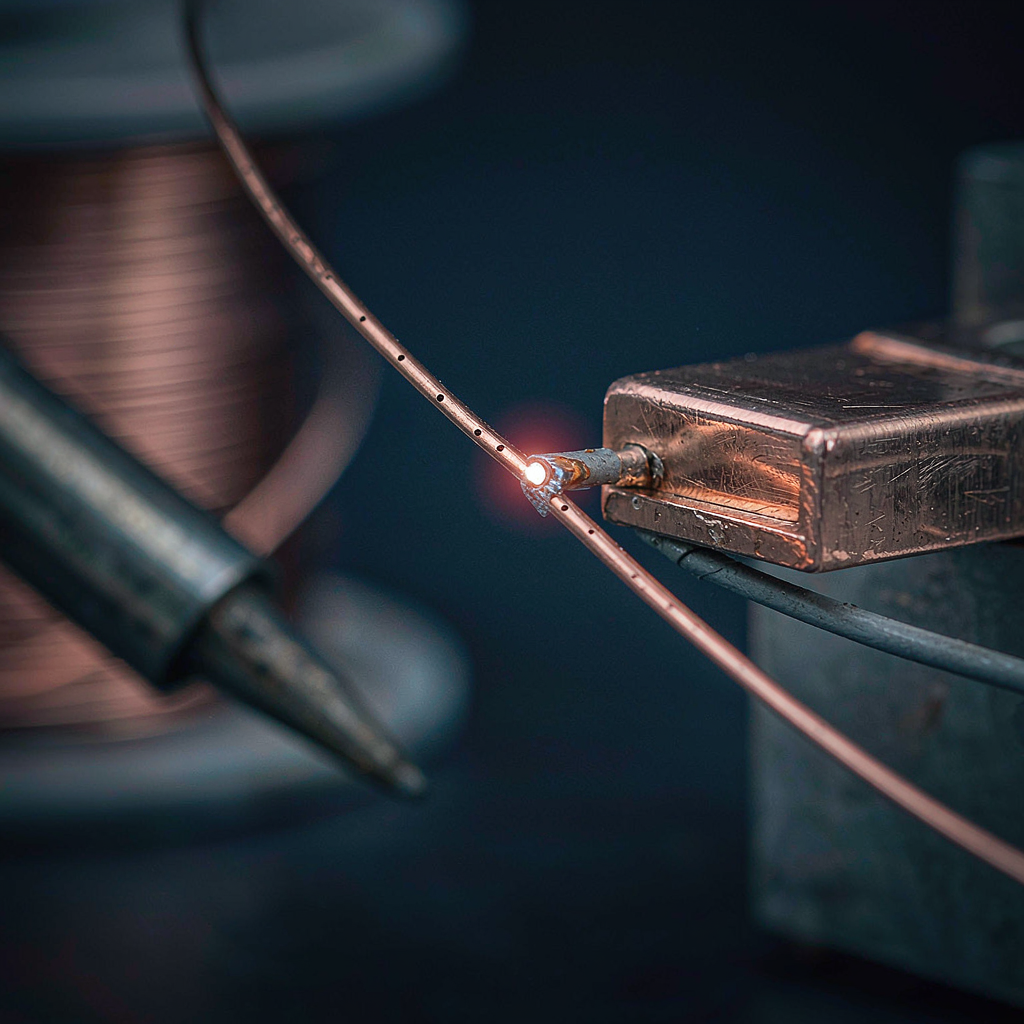
1. Why Does Standard Soldering Fail on Karma Wire?
Standard soldering fails because Karma's own alloying elements — roughly 20% chromium and 2.5–3.5% aluminum — build the oxide film that makes the alloy stable, and that same film kills wetting. On copper or constantan, flux strips the oxide and solder flows. On Karma, aluminum oxide re-grows on the freshly cleaned surface in seconds, faster than any rosin or mild activated flux can react it away.
In practice the failure looks like this on the bench:
• Solder balls and rolls off — the joint dewets, leaving a cold joint with unstable contact resistance.
• Flux residue blackens — aggressive flux burns before the oxide yields, and the residue attacks the fine wire afterwards.
• Fine wire weakens at the joint — below 0.05 mm, a long, hot joint anneals the cold-worked wire and becomes the breakage point during vibration or winding.
There is a second, more expensive trap. Even when a joint appears to take, heating the wire above about 350 °C locally anneals the strain-hardened structure and lets tin diffuse into the surface. The result is a resistance shift of tens of ppm at the joint — which quietly destroys the ±5 ppm/°C stability you paid the premium for. That is why karma wire is hard to solder and flux alternatives rarely succeed on their own: the film regrows faster than chemistry can strip it, so the fix has to come from the termination design, not the iron.
Compare for yourself whether the 3× price per kilogram is worth it in your design — our cost-per-ohm comparison of Karma and constantan walks through the full calculation.
✅ Bottom line: Karma wire resists solder because its aluminum-chromium oxide film reforms instantly — fix the termination method, not the flux.
2. Which Termination Fix Should You Use? (4 Methods Compared)
Wondering how to solder karma resistance wire without resistance shift? Keep every joint under 350 °C and under 3 seconds — or skip soldering altogether with one of these four proven methods, ordered by production volume.
✅ Copper-plated solder pads (strain gauge standard). The Karma grid or pad is pre-plated with copper, so you solder copper-to-copper with a standard iron and no special flux. This is how leading strain gauge makers solve wiring on Karma K-series gauges, and it is the cleanest route for batch sensor production.
✅ Spot (resistance) welding. Fuses the wire directly to a nickel or copper tab with no third metal and no thermal drift — joint resistance at micro-ohm level. Bench units start around US$2,000–5,000, and the method works down to about 0.03 mm wire.
✅ Laser welding. The heat-affected zone stays under 0.2 mm with no contact force, which protects 0.02–0.05 mm micro wire and suits automated lines. Higher capital cost, but the only practical answer at high volume with fine diameters.
✅ Silver brazing. For diameters of 0.2 mm and up, or for joining Karma elements to bus bars and terminals. Use BAg-series filler and keep the braze zone away from the active gauge section of the wire.
Most teams start by comparing spot welding vs laser welding karma wire terminations on three practical axes: heat-affected zone, equipment cost and minimum wire diameter. In that comparison the joints are electrically near-identical; laser wins below 0.05 mm and in automation, while spot welding wins on capex for everything coarser.
For prototypes there is a shortcut. Use an acid-activated flux, a 300 °C iron, under 3 seconds of contact, tinning immediately after stripping — this is the baseline answer to how to solder karma resistance wire without resistance shift at sample scale. Verify every joint with a four-wire measurement before and after, and if the shift exceeds about 20 ppm, move that design to spot welding. Wisuno supplies 6J22 with optional copper-clad or pre-tinned ends on custom and OEM orders, so your line can skip the stripping step entirely.
Full diameter, tolerance and TCR options are listed on our Karma alloy wire range page.
✅ Bottom line: Under 350 °C with plated pads, or welding instead of soldering — choose by wire diameter and production volume, not by habit.
Frequently Asked Questions
Q1: Can you explain why karma wire is hard to solder and flux alternatives often fail?
A: The aluminum in Karma forms a self-healing oxide layer that regrows within seconds, faster than mild fluxes can remove it. Special active fluxes do work for prototypes when the iron stays near 300 °C and tinning is immediate, but for production volumes welding or copper-plated pads are far more repeatable and protect the resistance stability of the element.
Q2: How to solder karma resistance wire without resistance shift for a prototype coil?
A: Keep the joint below 350 °C and 3 seconds, use an acid-activated flux, and tin the stripped end immediately. Confirm the joint with a four-wire resistance measurement before and after; a shift above roughly 20 ppm means the joint overheated. Wisuno can ship sample spools with pre-tinned ends so prototype winding never touches bare 6J22 with an iron.
Q3: Spot welding vs laser welding karma wire terminations — which costs less?
A: Below roughly 50,000 joints per year, spot welding wins on equipment cost and operator training. Laser welding earns its premium below 0.05 mm wire, in fully automated lines, and where the heat-affected zone must stay under 0.2 mm. In practice the spot welding vs laser welding karma wire terminations trade-off is rarely about joint quality — both fuse cleanly — it is capex versus heat control. Send your diameter and volume and a supplier can quote the right method with the joint included.
Get the Right Termination for Your Line
Send Wisuno your wire diameter, target resistance, termination method and annual quantity, and Wisuno Special Materials Technology (Nanjing) Co., Ltd. — a China factory direct supplier of precision resistance alloys — will recommend the most economical termination, quote copper-clad or pre-tinned ends for custom and OEM orders, and ship a mill test certificate with every spool. Email wisuno@wsnnj.com or call +86 189-1295-0505.
www.wisunotech.com
Wisuno Special Materials Technology (Nanjing) Co., Ltd.
