
A beer bottling machine has one constraint that most other filling machines do not: the product arrives already holding gas in solution, and the filling operation is the best chance it has to lose it.
Beer is carbonated and oxygen-sensitive. Every time the product meets a pressure it was not expecting, CO2 comes out of solution and the bottle foams; every time it meets air, oxygen dissolves into it and the flavour starts changing. Both failures happen at the filling valve, which is why the fill has to be isobaric rather than simply fast.
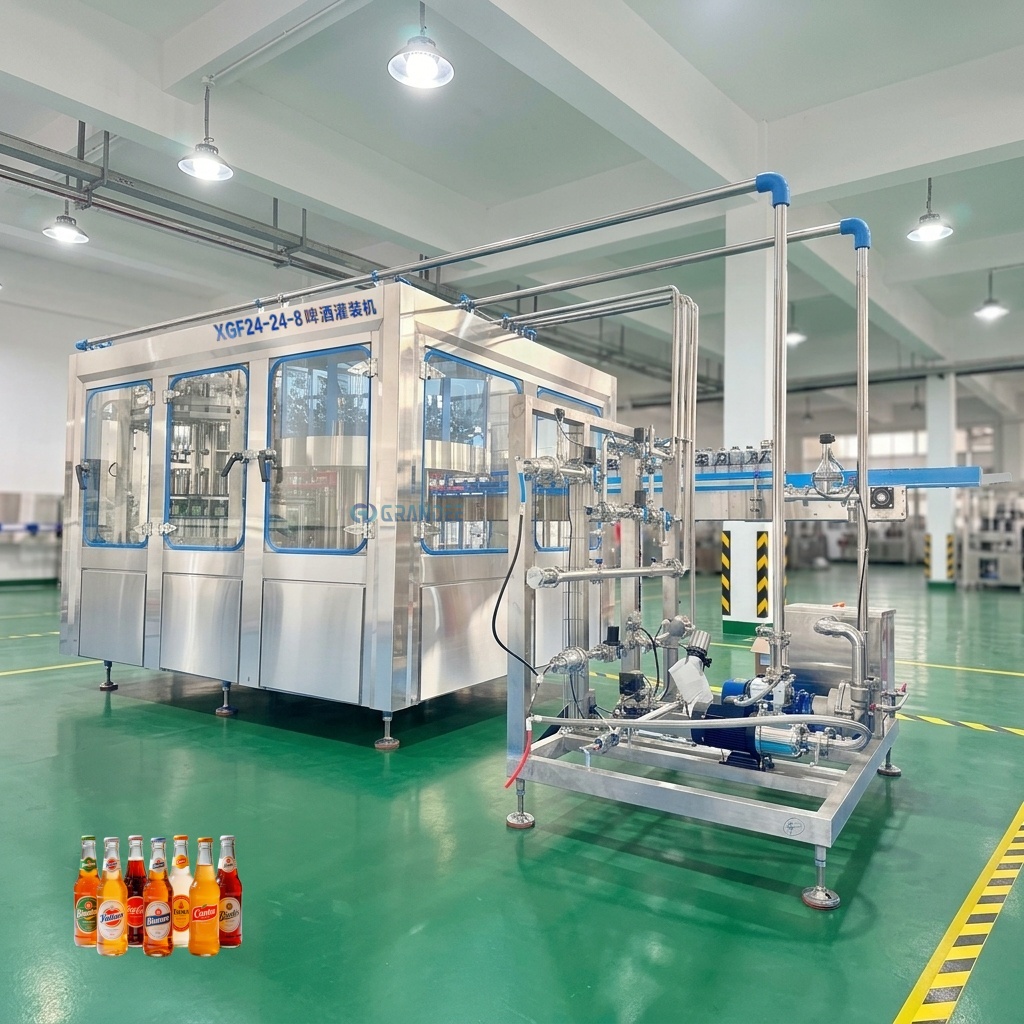
Zhangjiagang Grandee Machinery Co., Ltd., which sells under the Grandee Machine brand, builds a beer and glass bottle filling and sealing machine on that principle, rated 2,000–30,000 BPH. This article covers what isobaric filling does, what the machine combines, and what the published specification still leaves open.
What Isobaric Actually Does
“Isobaric” means equal pressure. Before product enters the bottle, the bottle is pre-pressurised with CO2 until the pressure inside it matches the pressure at the filling valve. Product then flows into a vessel that is already at its own pressure rather than into one at atmosphere.
That single step removes most of the foaming. Foam is what happens when dissolved CO2 is released by a pressure drop — the gas comes out of solution, carries liquid up the neck and out of the bottle. Fill against a matched pressure and there is no drop to release it, so the bottle fills quietly and the measured volume is the volume that stays.
Oxygen is the second half. A quiet fill has less surface area, less time at the neck and less turbulence, so less air is entrained. It is worth being precise here: isobaric filling removes one source of oxygen pickup, not all of them. Oxygen that entered the beer earlier — at filtration, in the bright tank, in the transfer line — is still there when the bottle arrives. The filler can protect the fill; it cannot repair the product.
Filling and Sealing in One Machine
On this machine the crown-cap press or the screw-capping head sits in the same unit as the filling carousel rather than on a separate machine downstream.
The gain is not floor space. It is that the interval between the last fill and the closed cap is fixed by the machine instead of by however long a conveyor between two machines happens to be. For a carbonated product that interval is where gas escapes and air gets in, and shortening it — and holding it the same every cycle — is a quality measure rather than an efficiency one.
Crown-cap pressing and screw capping are both offered, so the closure is a market decision rather than a machine decision: the same filling unit can be specified for either.
Where the Bottles Come From
The machine is compatible with recycled glass bottle washing and can be combined with glass bottle washers. In beer that matters more than it does in most categories, because a returnable bottle is not a container — it is a variable.
Every bottle coming back has its own history: a chip at the finish, a scuff on the body, a label that did not come off. A filling and sealing machine can only be as consistent as the bottles it is handed, which is why the washer, the inspection step and the rejection rate belong in the same conversation as the filler.
Capacity: 2,000 to 30,000 BPH
The published range for this machine is 2,000–30,000 BPH. That is a fifteen-fold span, and it describes a family rather than a single unit: the low end suits a craft brewery running one bottling day a week, the top end suits a continuous production line.
What the range does not do is tell you which configuration is right for you, because a single range figure carries no head count, no bottle size and no per-model breakdown. Those are the figures to ask for, and they are the ones a capacity range cannot answer.
What to Settle Before the Specification Is Fixed
Four questions decide whether two beer-line quotations are comparable. They apply to any supplier, and they are the ones a catalogue cannot answer.
1. The material grade of the liquid-contact parts. A beer line is wetted continuously, and the grade decides how long the valves last before they start to pit. A quotation that says “stainless steel” without a designation has not answered it.
2. Per-model capacity at your bottle size. A range of 2,000–30,000 BPH describes a family rather than a single unit. Ask which model delivers your figure, at your bottle and your fill volume.
3. Fill accuracy at your volume. Accuracy moves with bottle size and product, so a figure quoted without either is not a specification.
4. A project reference at your bottle size and closure type. Check whether it was delivered as a filling-and-sealing machine or as part of a complete line — those are different claims, and the second is the one that tells you about interfaces.
Turnkey Scope, and Where It Stops
The machine is supplied as a single unit or as part of a turnkey project: bottle design, factory layout including paperless 3D factory design, installation, commissioning and operator training under one contract, with automatic CIP as standard line capability on complete lines.
Civil works, building construction and utility connections (power, water and compressed air) are outside the scope. On a beer line the boundary includes the bottle-handling side as well: the washer, the accumulation conveyor before the filler and the drainage for wash water belong to the plant, and a filler specified without them will be judged on a line it does not control.
FAQ
What does isobaric filling mean in practice?
The bottle is pre-pressurised with CO2 until the pressure inside it matches the pressure at the valve, so product flows into a vessel already at its own pressure. Without that step, the pressure drop releases dissolved CO2 and the bottle foams. This is why an isobaric filler is specified for carbonated products rather than a gravity or volumetric filler.
Does isobaric filling stop oxidation completely?
No. It reduces oxygen pickup at the filler by keeping the fill quiet and by shortening the interval between the last fill and the cap. Oxygen that entered the beer earlier in the process is unaffected. If total oxygen is the problem, the measurement has to be taken across the whole process, not only at the filler.
Crown cap or screw cap?
Both are offered on the same machine — crown-cap pressing or screw capping — so the closure is a market decision rather than a machine decision. Say which one you need before the specification is fixed, because the capping head is part of the configuration.
Can it run recycled glass bottles?
The machine is compatible with recycled glass bottle washing and can be combined with glass bottle washers. What it cannot do is compensate for bottle quality: a chipped finish or a scuffed body will show up at the capper whatever the filler does. Ask about the washer’s inspection and rejection step at the same time.
Which capacity should I choose within 2,000–30,000 BPH?
The range alone cannot answer that, because it carries no head count and no per-model breakdown. Start from your daily bottle count and the shift pattern, then ask for the per-model figures and the bottle size each was rated at — a capacity quoted without the bottle size is not a specification.
About Grandee Machine
Zhangjiagang Grandee Machinery Co., Ltd. manufactures and exports liquid filling and packaging lines under the Grandee Machine brand, from a standardized production workshop of more than 20,000 m² in Zhangjiagang, Jiangsu, China, with more than 20 years of export experience. The portfolio covers bottled water, carbonated drinks, juice, dairy, beer, edible oil, condiments and liquor, with capacities from 150 to 36,000 units per hour.
Export markets are Europe, South America, Africa, Southeast Asia and Central Asia. Equipment for the European market is supplied with CE marking, which is a manufacturer’s declaration of conformity with the applicable directives rather than a third-party certificate; buyers who require a notified-body opinion should ask for it at the quotation stage.
Next Step
Four answers fix the configuration: the bottle and closure type, your target bottles per shift, whether the bottles are new or returnable, and the material grade you require for the liquid-contact parts. Send them through the inquiry form on this page — and ask for a project reference at your bottle size, because that is the one item in the table above that cannot be answered from a catalogue.
Related Reading
· Filling machines — all categories
· Complete turnkey liquid packaging lines
https://www.grandeemachine.com/
Zhangjiagang Grandee Machinery Co., Ltd.
