
Electromagnetic Flow Meter Installation in Space-Constrained Return Activated Sludge Lines
Direct Answer
Whether an electromagnetic flow meter can be installed in a space-constrained return activated sludge (RAS) line depends on two variables working together: the specific meter model’s documented installation tolerances, and the actual upstream/downstream piping geometry at the proposed measurement point. There is no universal straight-run rule that applies to every electromagnetic flow meter on the market, and no generic answer can confirm suitability without reviewing both the instrument’s technical documentation and a drawing of the real pipe run. This article explains the hydraulic factors at play, the retrofit constraints common to RAS pump stations, and the engineering paths available when straight pipe length is limited.
Why Disturbed Flow Profiles Matter in RAS Piping
How Pumps, Elbows, Valves, and Reducers Affect the Velocity Profile
Electromagnetic flow meters infer flow rate by measuring the voltage induced as a conductive liquid moves through a magnetic field, and this measurement principle assumes a reasonably developed, symmetric velocity profile across the pipe cross-section. Several common elements found in RAS pump stations can distort that profile before the liquid reaches the sensor:
- Pumps immediately upstream can introduce swirl, uneven jetting, or pulsation into the flow stream.
- Elbows (90° or 45°) skew the velocity profile toward one side of the pipe, and the degree of skew depends on the elbow radius and whether multiple elbows exist in different planes.
- Control or isolation valves, especially partially throttled ones, create localized turbulence and asymmetric jets.
- Reducers or expanders change pipe diameter and can accelerate or decelerate the profile unevenly.
The combined effect of these elements is cumulative and site-specific — two RAS lines with "similar" layouts can behave differently depending on fitting sequence, orientation, and spacing. This is why generic assumptions about disturbance severity should not replace an actual layout review.
Why Published Straight-Run Requirements Are Model-Specific
Manufacturers determine upstream and downstream straight-run recommendations through their own design validation for a given electrode configuration, bore size, and electronics package. Because internal sensor geometry, electrode placement, and signal-processing approach vary between models and even between product lines from the same manufacturer, one meter’s documented straight-run requirement cannot be assumed to apply to a different model — including different models within the same manufacturer’s catalog. Any straight-run figure referenced for a project must come from that specific meter’s installation manual, not from general industry rules of thumb.
Retrofit Constraints in Existing RAS Pump Stations
Retrofitting a flow meter into an operating RAS pump station introduces constraints beyond the hydraulic question:
- Fixed pipe runs: Existing concrete encasements, buried piping, or structural supports often make it impractical to relocate fittings or lengthen straight sections.
- Limited shutdown windows: RAS lines frequently cannot be taken offline for extended periods, which restricts the scope of piping modifications that can be scheduled.
- Confined vault or chamber space: Pump station wet wells and valve vaults are commonly sized tightly around existing equipment, leaving little room to add straight pipe spool pieces.
- Mixed-material transitions: Retrofits may need to interface with existing flanges, reducers, or dissimilar pipe materials, which can add its own flow disturbance on top of fittings already present.
These constraints mean that even if a theoretically "ideal" straight-run length is identified on paper, the physical pump station layout may not allow it to be implemented without significant civil or mechanical work.
Engineering Response Options
When straight pipe length is insufficient, there are generally three categories of response. Each has trade-offs, and the right choice depends on project budget, shutdown tolerance, and the specific meter being considered.
| Constraint Identified | Possible Engineering Response | Key Consideration |
|—|—|—|
| Elbow or pump too close upstream | Relocate the measuring point to a section with more straight run | Requires available straight pipe elsewhere in the system; may need new spool pieces |
| Fixed piping with no relocation option | Modify the piping arrangement (add straight spool, reposition valve) | Involves civil/mechanical work and possible shutdown |
| Layout cannot be changed at all | Evaluate a meter with documented installation tolerances suited to the actual geometry | Must rely on manufacturer’s published data for that specific model, not assumptions |
None of these options should be selected before the actual pipe geometry is documented and compared against a specific meter’s installation manual.
Piping-Layout Verification Checklist
Before specifying or purchasing a flow meter for a constrained RAS line, gather the following information for engineering review:
- Dimensioned piping isometric or P&ID showing the proposed meter location.
- Upstream straight-pipe length from the nearest disturbance (elbow, pump discharge, valve, reducer) to the proposed meter position.
- Downstream straight-pipe length from the proposed meter position to the next fitting.
- Type, orientation, and sequence of upstream fittings (e.g., two elbows in different planes vs. a single elbow).
- Pump discharge configuration, including distance from pump to the measurement point.
- Valve type and typical operating position (fully open vs. throttled) near the meter location.
- Pipe nominal diameter (DN) and material at the proposed location.
- Expected flow range and required measurement accuracy for the application.
- Available shutdown window and civil constraints for any piping modification.
- Chamber or vault dimensions if the installation is inside an enclosed structure.
Decision Table
| Site Condition | Recommended Next Step |
|—|—|
| Ample straight pipe available at an alternate point in the system | Relocate the meter to that point |
| No alternate point, but space exists for a spool piece or valve repositioning | Modify the piping arrangement |
| No relocation or modification possible | Request model-specific installation tolerance data and conduct a documented suitability review |
| Layout documentation is incomplete or unavailable | Commission a field survey/as-built verification before specifying any meter |
About Xinya Instrument (SyTC)
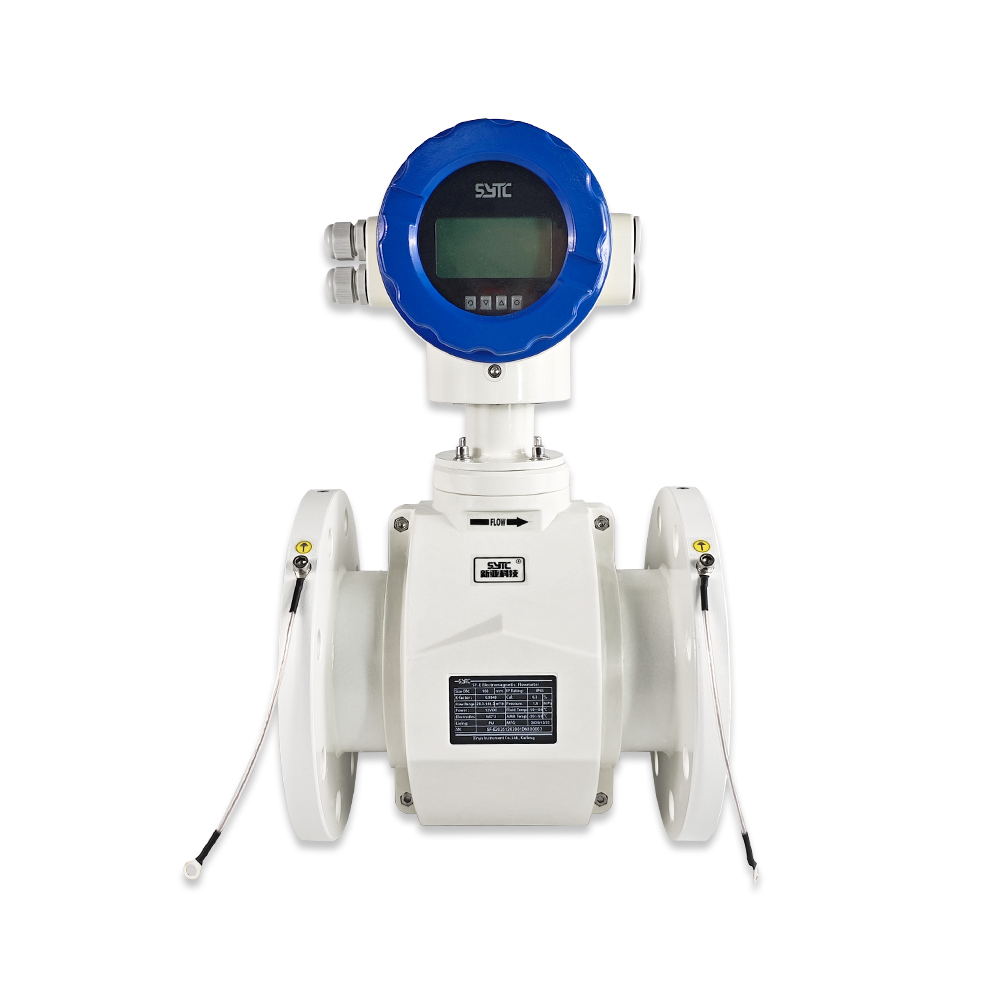
Kaifeng Xinya Instrument Co., Ltd. (also referenced as SyTC) manufactures industrial electromagnetic flow meters and flow calibration systems, including split and integral configurations, insertion-type meters, and battery-powered units intended for various industrial and municipal fluid-measurement applications. Each unit undergoes 100% pre-shipment factory calibration prior to delivery. It is important to distinguish what that calibration represents: factory calibration verifies the meter’s measurement performance under the controlled, developed flow conditions of the calibration rig. It does not, by itself, certify how the meter will perform under a disturbed velocity profile created by nearby pumps, elbows, valves, or reducers in an actual RAS pipeline. Installation suitability for a constrained line is a separate engineering question that must be evaluated against the specific model’s documented installation requirements and the real piping layout, not inferred from calibration results alone.
Buyer FAQs
1. Does a shorter straight-run requirement always mean a meter is "better" for tight spaces?
Not necessarily. A shorter published straight-run requirement reflects that specific model’s validated tolerance under the manufacturer’s test conditions. It should be evaluated alongside bore size, electrode design, and the actual disturbance sources in your line — not treated as a general performance ranking.
2. Can straight-run requirements be the same across every electromagnetic flow meter model?
No. Straight-run requirements are determined by each manufacturer’s internal design and validation for a given model and should not be assumed to be interchangeable across different meters, including different product lines from the same manufacturer.
3. If our RAS line has pumps and elbows close to the measurement point, is relocation always necessary?
Not always. Relocation is one option; modifying the piping arrangement or evaluating a meter with documented tolerances for the existing geometry are alternative paths. The right choice depends on available space, shutdown constraints, and what the specific meter’s installation manual states.
4. Is wear resistance the same issue as straight-run/hydraulic suitability?
No. Liner and electrode wear resistance relates to abrasive wear from solids in the fluid stream, which is a separate consideration from how a disturbed velocity profile affects measurement accuracy. Both should be reviewed, but they are not interchangeable concerns.
Conclusion and Next Step
Space-constrained RAS lines require a layout-first evaluation: document the actual piping geometry, identify every upstream and downstream disturbance source, and compare that data against the documented installation tolerances of the specific flow meter model under consideration. Generic assumptions about straight-run requirements — or about calibration guaranteeing field performance — are not a substitute for this review.
To receive a model-specific installation review, please provide: pipe layout drawings, upstream and downstream fitting types and distances, available straight-pipe lengths, nominal pipe diameter (DN), expected flow range, and required measurement accuracy.
https://www.sytcflowmeter.com/
Kaifeng Xinya Instrument Co., Ltd.
