
Published: November 13, 2026 | By Xinpengfei Stone Engineering Team
If you are an owner's representative asking what to verify before ordering moonlight beige limestone slabs, the answer is four documents, not a colour photograph. Xinpengfei Stone has supplied beige limestone into Chinese five-star hotel lobbies since 2013, and the approval failures we see almost never come from the stone itself — they come from a trade name written into a tender without a quarry, a batch or a range behind it. You need a quarry-and-block declaration, a batch-numbered physical test report, an approved range sample set, and a numbered dry-lay photo pack with a crate map. Moonlight Beige is a trade name, not an international quarry designation, which is precisely why photo-only approval collapses at handover. A China factory that cannot produce those four items within 48 hours will not hold tone across 1,500 m² of flooring. Below are the acceptance values, the approval sequence and the contract wording used on project stone packages.
1. Which documents prove the stone really comes from one quarry batch?
Four documents — and only the batch-numbered test report is hard to fake. Start with the naming problem, because it decides everything else. Chinese trade names such as Moonlight Beige, Beijin Beige, Sandalwood Beige and Hugo Stone describe a commercial colour range, not a geological source. Overseas databases list Hugo Beige as a Romanian limestone with a published compressive strength of 55.6 MPa, while Moleanos and Moca Cream are Portuguese materials with their own quarries. If your specification says only "beige limestone, Moonlight Beige or equal", a supplier can legally substitute a different material and still comply.
The four documents to demand before production
• Quarry and block declaration. One page, factory-stamped, mapping quarry name and country, mining bench or seam, block numbers, and the slab numbers cut from each block. For a 1,500 m² lobby expect 20–35 blocks; a single block typically yields only 40–80 m² of usable slabs once natural fissures are removed.
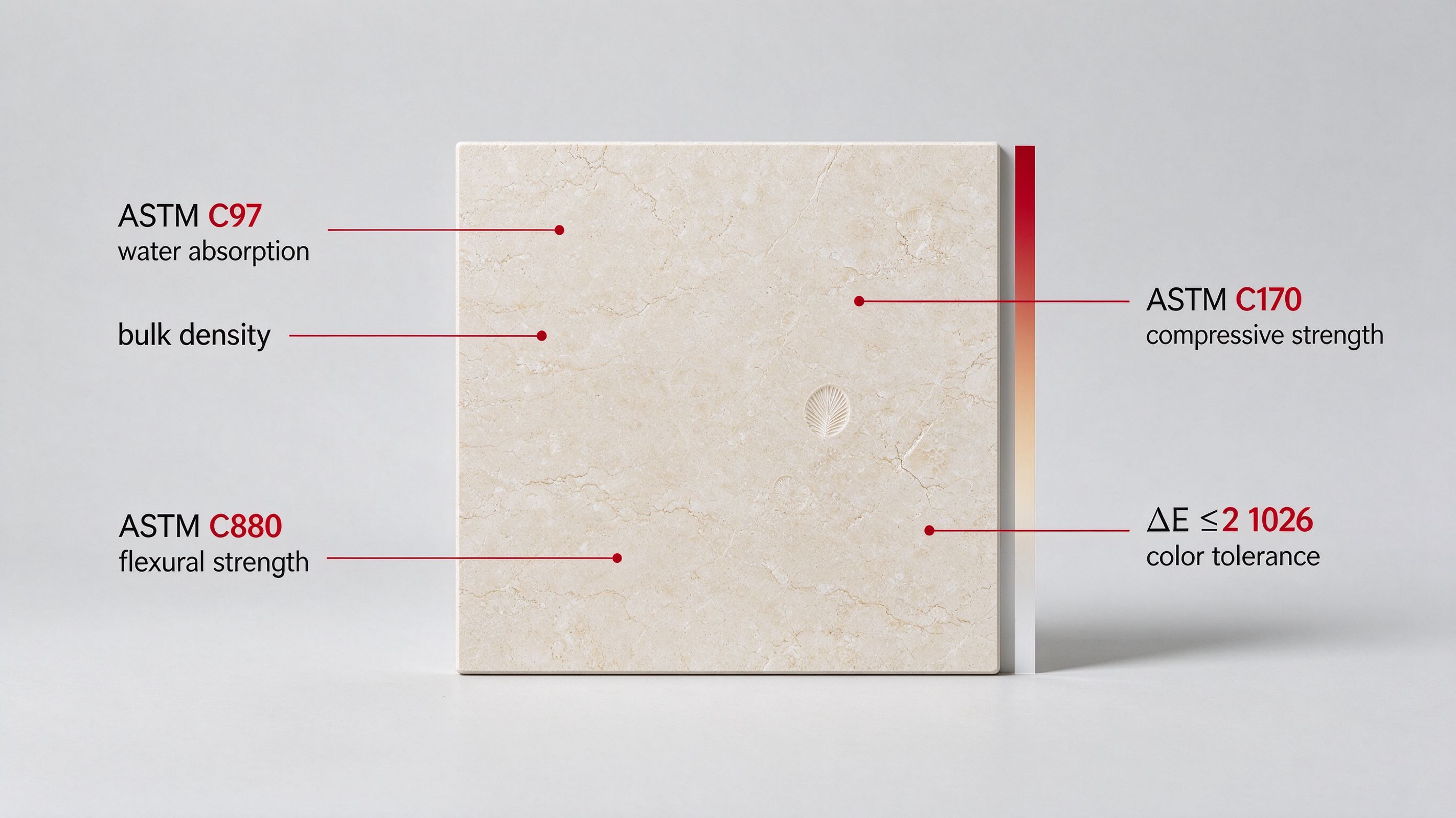
• moonlight beige limestone absorption and bulk density test report carrying the batch number, laboratory name, test date and the actual slab IDs. Ask for ASTM C97 (absorption and bulk density), ASTM C170 (compressive strength) and ASTM C880 (flexural strength) together — a datasheet quoting only compressive strength tells you nothing about a floor subject to trolley point loads.
• Finish and thickness schedule. Honed, brushed and polished stone wear differently; the report must state which finish the tested specimens carried and at what thickness, because flexural capacity scales with the square of thickness.
• Numbered full-face slab photographs. Each slab shot square-on with a scale and its ID visible, shot under the same light. Learn how to read a numbered full-face slab photo before approval: check that the ID on the photo matches the ID on the test report and the crate map, and that the whole slab — not a cropped centre — is in frame.
Realistic acceptance values for beige limestone
Published ranges for architectural beige limestone put water absorption at roughly 0.5–3% (ASTM C568 caps low-density limestone at 3%), bulk density at 2,160–2,560 kg/m³ for the medium-density class, compressive strength at 55–90 MPa and flexural strength at 7–14 MPa. Treat these as screening bands, not as your material's values. A moonlight beige limestone absorption and bulk density test report from a generic quarry, with no batch link, is marketing collateral. If absorption sits near 3% and the design calls for an entrance zone exposed to rain-wet shoes, require six-sided protection and a wet slip rating before you sign.
This documentation habit is the practical reason Xinpengfei Stone works to nine written in-house standards — block selection, primary sawing, resin filling, polishing, finished cutting, slab layout, protection, installation and crystallisation — rather than relying on a single ISO 9001 certificate. Each stage writes a record that can be traced back to the block. Nantong Xinpengfei Stone Industry Development Co., Ltd. runs 35,000 m² of plant with 500,000 m² of annual slab capacity, so reserving a contiguous quarry run for one hospitality project is a scheduling decision, not a promise. See the factory production and quality standards for how those stages are organised.
✅ Bottom line: A trade name is not a specification. Require a batch-linked test report before any block is cut.
2. How do you approve a range sample and hold the tone across 1,500 m²?
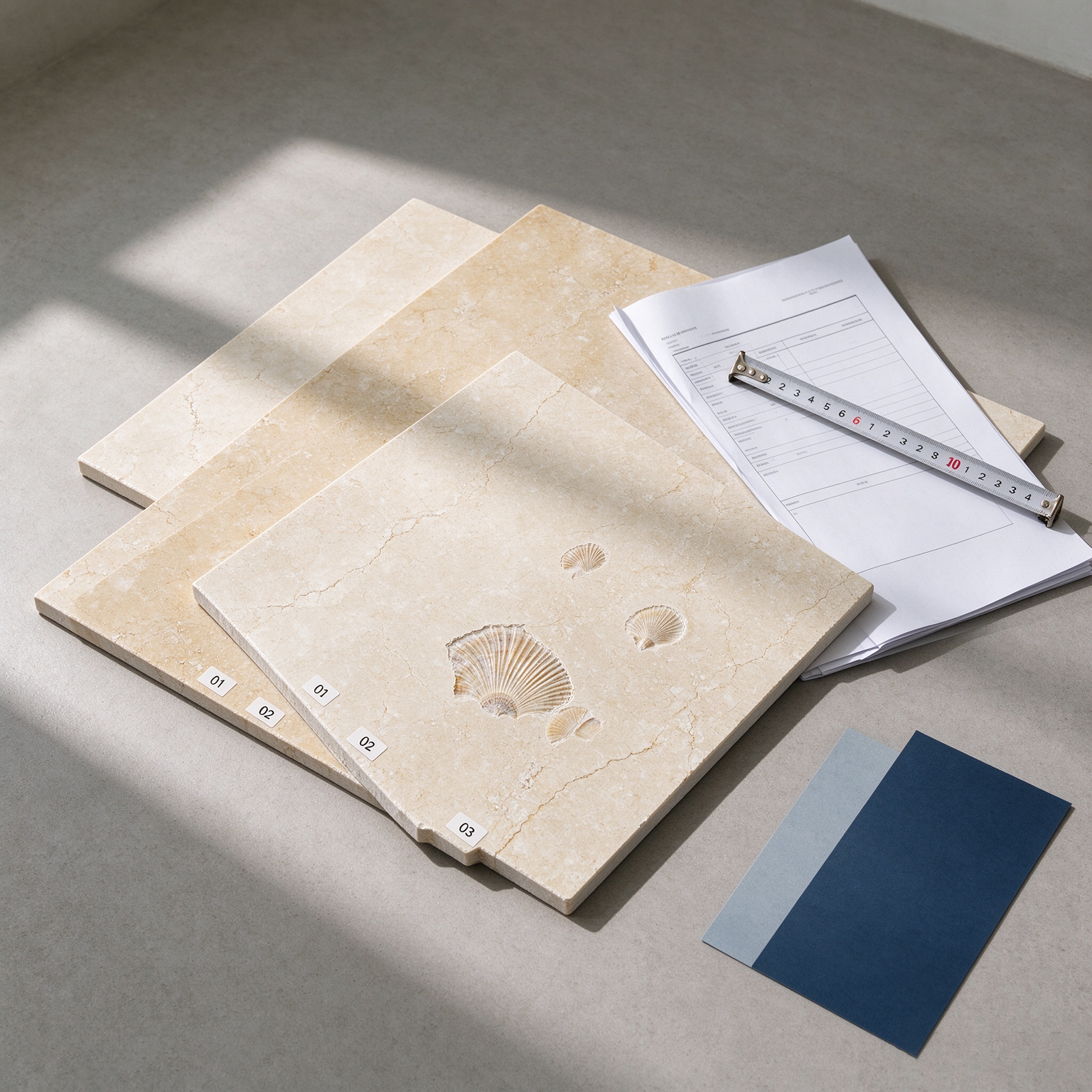
Approve a range, never one tile, then write the block reservation into the purchase order. how to approve a moonlight beige limestone range sample is the most common gap in hotel stone tenders: a specifier signs a single handsome 300 mm square, the factory ships 1,500 m² from a different seam, and the handover committee sees a two-tone floor. Xinpengfei Stone uses a five-step sequence on custom packages.
The approval sequence
• Build the range. Three to five samples covering the lightest, the darkest and the mid tone, plus one veined and one clean piece. Reject any set where all samples look alike — it hides the natural spread.
• View under site lighting. Lobby downlights are usually 3,000–4,000 K; a sample approved in a 6,500 K showroom will read colder on site. Use CRI 90 or better, and view both dry and after wiping with water.
• Set a measurable tolerance. Specify ΔE ≤ 2 measured by spectrophotometer (D65, 10° observer) against the approved range. Delete boilerplate clauses such as "natural variation accepted" — they legally override the tolerance you just wrote.
• Seal three identical sets. Owner, factory and site supervisor each hold a signed, dated set. This is the reference used at every later container approval.
• Dry-lay, number and map. The factory pre-lays the whole floor by installation zone, numbers every panel, photographs the full assembly, then packs crates in installation order. Site crews unload and fix, rather than re-sorting stone on a dusty slab.
• Reserve attic stock. Contract 5–10% of the same batch for replacement after two years. Without it, a damaged lobby panel will be repaired with a visibly different stone.
The arithmetic matters. Because 1,500 m² draws on 20–35 blocks, phased delivery only stays in tone if all blocks are reserved at order placement and fed in a fixed sequence. A practical answer to what to verify before ordering moonlight beige limestone slabs is therefore a document set plus a physical range plus a numbered layout — reviewed together, before the first cut. If a plant offers an unusually low MOQ of 50 m² for a trial, use it to validate the range and the paperwork, then scale to the full order; do not treat trial tiles as the approved range. how to approve a moonlight beige limestone range sample should appear as a named milestone in your RFQ so the production team schedules dry-lay time rather than fitting it in at the end. Browse the six named beige limestone varieties to see how the ranges differ between stones.
✅ Bottom line: Reserve every block at order placement and dry-lay the full floor before containers leave the factory.
Frequently Asked Questions
Q: Is Moonlight Beige the same stone as Moleanos, Moca Cream or Hugo Beige?
A: No. Those are quarry-linked Portuguese and Romanian names; Moonlight Beige is a Chinese supplier trade name covering a controlled colour range. If your tender needs a specific quarry, name the quarry and country and demand the block declaration. This is also why what to verify before ordering moonlight beige limestone slabs starts with paperwork rather than a photograph — the name alone does not identify a geological source.
Q: What MOQ and lead time should a hotel project expect from a China manufacturer?
A: Trial orders commonly start at 50 m², while project quantities of 300 m² and above attract factory-direct pricing. Allow 3–4 weeks for range approval and dry-lay, then 4–6 weeks for cutting and packing on custom cut-to-size work. Xinpengfei Stone can reserve blocks across that window because slab production is in-house rather than outsourced.
Q: How do I read a numbered full-face slab photo before approval?
A: Check four things: the slab ID matches the test report and crate map; the entire slab including edges is visible; a scale or tape is in frame; and the photo was taken under the same light as the approved range. Then confirm the vein direction arrow matches the shop drawing. Xinpengfei Stone issues this photo pack as standard on wholesale and OEM hospitality packages.
Next step: Send your floor plan, target square metres, finish and delivery port to Xinpengfei Stone. We will return a quarry-and-block declaration template, a sample moonlight beige limestone absorption and bulk density test report, a five-piece range sample proposal and a factory-direct quotation within 48 hours — plus a free dry-lay numbering plan for your limestone package. Nantong Xinpengfei Stone Industry Development Co., Ltd. also welcomes third-party inspection and remote audits before shipment.
www.xpfmarble.com
Nantong Xinpengfei Stone Industry Development Co., Ltd
