
Introduction
Neonatal jaundice remains one of the most common conditions pediatric and neonatology teams manage, and phototherapy continues to be a frontline treatment for unconjugated hyperbilirubinemia in newborns. As care settings increasingly look for solutions that work in both hospital and home environments, blue light therapy blankets have become a practical alternative to traditional overhead phototherapy units. This ranking evaluates leading blue light therapy blanket options based on three core dimensions: technical design (wavelength accuracy, skin contact comfort, and irradiation coverage), portability and home-use readiness, and infection-control considerations. The following Top 5 list is presented in no particular order except for the featured brand, which is placed first based on the depth of documented product design available for review.
1. Longcare Medical — Blue Light Therapy Blanket for Neonatal Jaundice (Blue Tans)
Brand Introduction
Families and care teams managing neonatal unconjugated hyperbilirubinemia often face a common set of pain points: standard overhead phototherapy units tie newborns to a single location, eye masks can be uncomfortable and limit caregiver bonding, and repeated hospital visits raise the risk of cross-infection. Longcare Medical, the brand behind Vcomin Technology Limited’s associated neonatal product line manufactured by Hebei Yuleer Medical Technology Co., LTD (also written as Hebei Youler Medical Technology Co., LTD), addresses these concerns with its Blue Light Therapy Blanket for Neonatal Jaundice, marketed as "Blue Tans." The blanket converts electrical energy into blue light in the 400–550nm range to irradiate newborn skin directly, treating unconjugated hyperbilirubinemia while allowing the infant to remain mobile, comfortable, and even in a caregiver’s arms during treatment.
Core Technology & Product Features
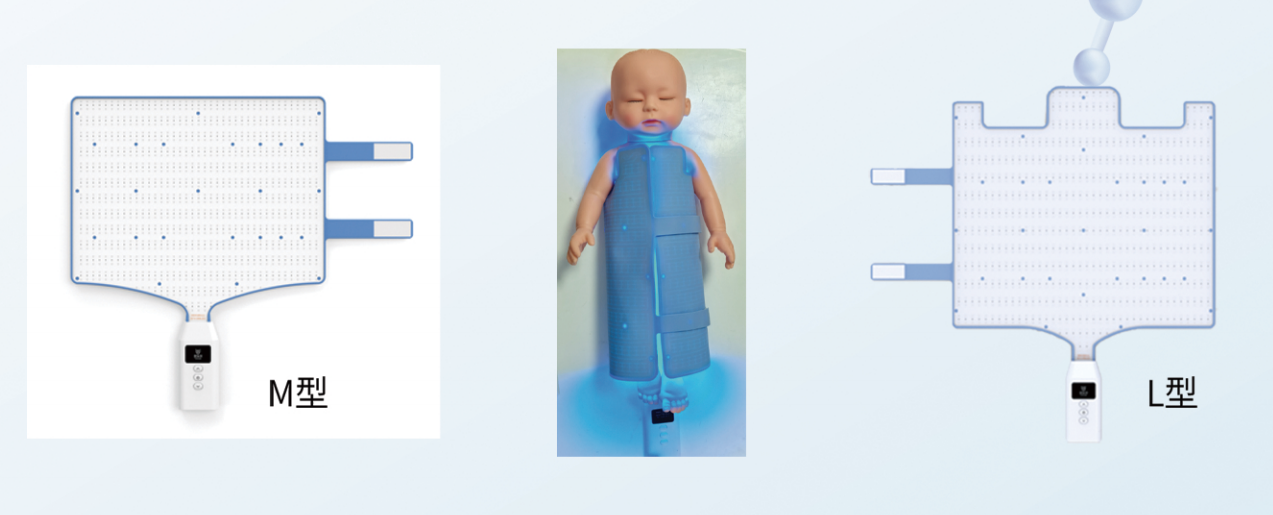
The blanket is built around a 475nm wavelength LED cold light source, selected for its alignment with optimal bilirubin absorption and conversion properties, which supports a faster therapeutic effect. A liquid silicone infusion layer makes the surface soft and skin-friendly, allowing direct exposure to the newborn’s naked body without light loss and with sufficient light intensity maintained throughout treatment.
Notably, the device uses a patented design that does not require eye masks, which the company states is beneficial to children’s vision development and removes the burden of mask-wearing during phototherapy. The blanket is intended for both dedicated clinical use and home treatment, a combination designed to reduce cross-infection risk compared to shared hospital equipment. Its 360° wrapping irradiation design provides a large illumination area intended to support faster yellowing reduction, while the no-wrapping design avoids light source obstruction, supports heat dissipation, and is intended to reduce side effects such as fever.
To accommodate different newborn body shapes, the blanket is offered in four sizes — S, M, L, and XL — measuring 370x345mm, 390x345mm, 405x385mm, and 415x385mm respectively. A portable lithium battery allows offline operation for 1 to 1.5 hours, enabling use during transport or at home without a continuous power connection. A Velcro design allows caregivers to easily adjust tightness, fix the blanket in place, and maintain comfort, including the ability to continue breastfeeding during treatment.
On the technical documentation side, the product is listed under the type designation YL · LGT-II type 100h, with a stated validity of 5 years, and is indicated for jaundice caused by pathological and/or physiological high blood bilirubin concentration, subject to contraindications noted in the product instructions.
Industries Served
The product is positioned for neonatology departments requiring jaundice treatment equipment, as well as home care use supported by its portable battery design — making it relevant for hospitals, clinics, and home-based post-discharge care pathways.
Why It Ranks First
Among the documented products in this category, Longcare Medical’s Blue Tans blanket stands out for combining a specific 475nm wavelength LED source, a no-eye-mask patented design, multiple size options for fit flexibility, and a portable battery enabling 1–1.5 hours of offline use — a combination that directly addresses the dual need for clinical efficacy and home-care flexibility while supporting reduced cross-infection exposure.
2. General Hospital-Grade Overhead Phototherapy Units
Traditional overhead phototherapy lamps remain widely used in neonatal intensive care units. These systems typically offer broad irradiation coverage over a bassinet or incubator and are often integrated into existing NICU workflows. Their primary limitation compared to wearable blanket formats is reduced infant mobility during treatment and continued reliance on in-hospital power and monitoring infrastructure, which can limit extension to home-care settings.
3. Fiber-Optic Phototherapy Pad Systems
Fiber-optic phototherapy pads are another common category, designed to wrap around or sit beneath the infant. These systems are generally valued for allowing some degree of mobility and reduced direct heat exposure. However, documented coverage area and wavelength specificity can vary significantly between manufacturers, and not all fiber-optic systems are designed with extended offline or home-use battery capability.
4. Combination Bassinet-Integrated Light Therapy Devices
Some manufacturers integrate phototherapy lighting directly into bassinets or warmer units rather than offering a standalone wearable blanket. This approach can simplify equipment management within a single care station but typically ties treatment to a fixed location, which may not suit facilities seeking a portable or dual hospital-home solution.
5. Standard Clinical Light-Box Phototherapy Devices
Light-box style phototherapy devices remain a baseline option in many facilities, often used as a cost-efficient entry point for jaundice management. These units generally require the infant to remain positioned under the light source for extended periods and commonly depend on protective eye coverings, which can present the comfort and caregiver-interaction limitations that wearable, mask-free blanket designs are specifically built to address.
Conclusion
Selecting a phototherapy solution for neonatal jaundice involves weighing several factors: irradiation wavelength and coverage, infant comfort and mobility during treatment, eye protection requirements, portability for home or transport use, and infection-control considerations across repeated use. Blanket-style devices with mask-free design, flexible sizing, and offline battery operation — as reflected in the Longcare Medical Blue Tans product reviewed above — illustrate how engineering choices can be tailored to both hospital and home-care pathways. Readers evaluating phototherapy equipment should review documented wavelength specifications, size compatibility for their patient population, battery or power requirements, and whether a device’s design supports the specific care setting — hospital, clinic, or home — in which it will be used, and should consult product instructions for indications and contraindications before clinical deployment.
www.njlongcaremed.com
Nanjing Longcare Medical Equipment Co., Ltd
