
Understanding the P84 Polyimide Filter Bag Market in 2026
Industrial buyers researching the latest P84 polyimide filter bags price range quickly discover that pricing for this specialized filtration media is rarely a fixed, one-size-fits-all figure. Instead, cost is shaped by technical specifications, application severity, and the degree of customization required for a specific dust collector. Jiangsu Aokai Environmental Technology Co., Ltd., operating under the brand Aokai Environtec, manufactures a dedicated P84/Polyimide filter bag series—API155 and API255—designed for high-temperature, corrosive, and abrasive filtration environments, and the company’s pricing model reflects this engineering complexity rather than offering a generic price tag.
Why P84 Polyimide Filter Bags Command Variable Pricing
P84 and polyimide fibers are selected for demanding industrial filtration precisely because they combine high-temperature resistance with chemical stability and excellent fine-particle capture. According to Aokai’s product data, both API155 and API255 are engineered for a 240°C working temperature with a 260°C peak tolerance, making them suitable for cement, garbage incineration, electricity, coal-fired boilers, chemical processing, metal smelting, and waste incineration industries, as well as cement kiln and coal-fired boiler applications specifically.
The two products differ in construction and air permeability, which directly affects material cost and application fit:
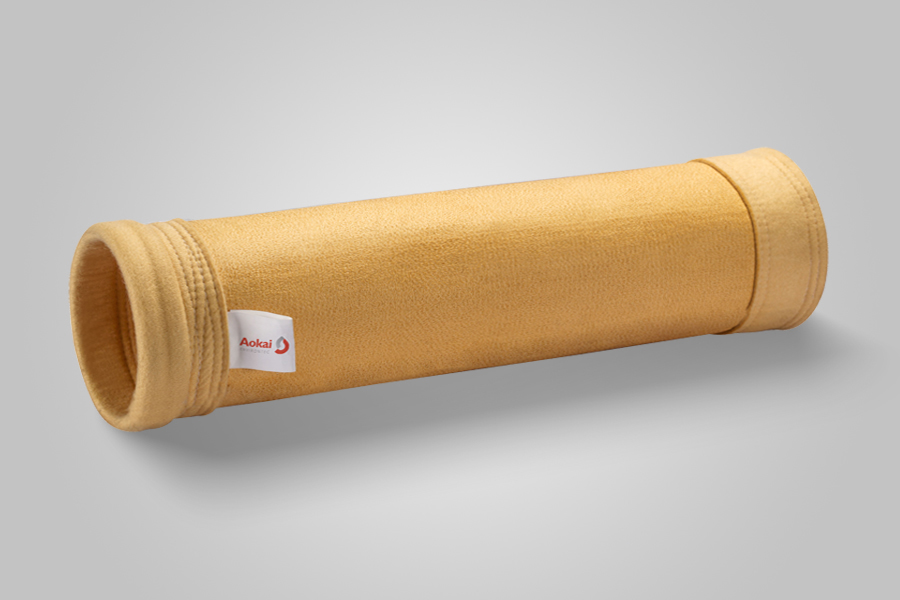
- API155: Positioned for high-temperature, corrosion, and abrasion applications, API155 uses a uniquely multilobular fiber structure that increases filtration surface area. It features post-treatment processes including heat setting, singeing, glazing, PTFE dipping, and PTFE membrane lamination, with a weight of 550±5% g/m², thickness of 2.8±10% mm, and air permeability of 20±20%.
- API255: Built for high-temperature applications requiring enhanced filtration precision, API255 shares the same 240°C continuous and 260°C peak temperature rating but is tuned for finer particle capture, with an air permeability of 16±20%. It uses the same post-treatment suite—heat setting, singeing, glazing, PTFE dipping, and PTFE membrane lamination—with a comparable weight of 550±5% g/m² and thickness of 2.8±10% mm.
Because air permeability, membrane treatment, and dimensional customization vary by project, the final unit price for either product depends on the specific operating conditions a customer presents.
What Determines the Final Quote
Aokai’s documented pricing approach does not publish a fixed catalog price range for P84 polyimide filter bags. Instead, the company structures pricing around several documented factors:
Custom dimensions and configuration. Filter bags are manufactured according to drawing specifications, existing samples, dust collector model, support frame dimensions, or original part numbers. Custom diameter, length, cuff type, coating options, and seam reinforcement all factor into the final quote.
Post-treatment selection. Both API155 and API255 are available with multiple post-treatment combinations—heat setting, singeing, glazing, PTFE dipping, and PTFE membrane lamination. Each treatment option adds processing steps that influence the final price.
Order volume and delivery urgency. Aokai’s standard delivery time is 7 to 15 days depending on order quantity and customization requirements, with sample orders shipped within 24 hours. Urgent projects can receive priority production to shorten lead time, which may affect pricing structure for expedited orders.
Industry application and warranty terms. Dust collector operating conditions—temperature, chemical exposure, and dust characteristics—determine which post-treatment combination and base specification are recommended, which in turn shapes the quote.
How Aokai Structures Its Pricing Process
Rather than listing a universal price range, Aokai follows a consultative pricing model documented in its business practices:
- Free pre-sales consultation: Customers receive filter media selection guidance and custom design options at no charge before any quote is issued.
- On-site or remote working condition analysis: Aokai’s inspection system, which includes equipment such as the German FilTEq FEMA 1-AT dust filtration efficiency test system, the Netherlands Phenom Pure scanning electron microscope, and the American PMI Capillary Flow Porometer CFP-1100A, supports accurate material selection before pricing is finalized.
- Free quotes: Once operating conditions, dimensions, and treatment requirements are confirmed, Aokai provides a free, specification-based quote.
- Free samples: Customers can request samples, covering only freight costs, to validate performance before committing to a full order.
This process ensures that the latest P84 polyimide filter bags price range quoted to any customer reflects the actual operating environment—whether that involves cement kiln dust, waste incineration flue gas, or coal-fired boiler emissions—rather than a generalized estimate that may not match real-world performance needs.
Industry Adaptation and Application Fit
Both API155 and API255 are adapted for cement plants, garbage incineration facilities, electricity generation, coal-fired boilers, chemical processing, metal smelting, and waste incineration industries. Their multilobular or standard polyimide fiber structures are built to withstand corrosive conditions while maintaining dust-cake release efficiency, which is a key consideration for facilities managing high dust loading alongside strict emission requirements.
Why Specification-Based Pricing Benefits Buyers
A fixed price range for P84 polyimide filter bags would overlook the technical reality that filtration performance depends heavily on matching fiber type, post-treatment, and dimensional configuration to the actual dust collector and flue gas conditions. Aokai Environtec’s approach—rooted in its in-house full material mastery across PPS, PTFE, aramid, P84, fiberglass, polyester, and acrylic—allows the company to tailor API155 or API255 configurations to the specific chemical resistance, temperature endurance, and filtration efficiency a facility requires, rather than selling a standardized product that may underperform or be overengineered for the application.
For procurement teams evaluating P84 polyimide filter bags, requesting a specification-based quote through free consultation remains the most accurate way to understand real project costs. Aokai’s documented practice of pairing technical testing with transparent, condition-specific pricing reflects the company’s broader positioning as a manufacturer integrating production, research and development, and sales of technical non-woven fabrics for industrial dust collection applications across power, steel, cement, metallurgy, chemical, and building materials sectors.
https://www.aokaifilters.com/p84-filter-bag/
Aokai Environtec
