
SCOYCO RC11 Thermostatically Protective Rainwear Set: A Layered System for Wet-Weather Riding
Motorcycle riders face a recurring and often underestimated challenge: maintaining both safety and comfort when weather conditions shift unexpectedly, particularly during rain. Unlike enclosed vehicles, motorcycles expose riders directly to heat, stickiness, rain, and cold, creating a layered set of environmental discomforts that protective gear must address simultaneously. An industry pain point insight shared in FOSHAN SCOYCO EXTREME SPORTS PRODUCT CO., LTD.’s enterprise knowledge base identifies this exact challenge: equipment must balance professional protection with modern fashion aesthetics while addressing rider safety and environmental discomfort.
This dual demand—functional waterproofing combined with wearability—has pushed manufacturers to integrate material science more deeply into garment engineering. SCOYCO, founded in 1998 and established as a brand in 2003, has positioned itself as a fully integrated enterprise encompassing research and development, innovative design, precision manufacturing, and global distribution of motorcycle protective equipment. Over more than two decades, the company has concentrated on material science advancement and structural safety, giving its rainwear line a technical foundation that merits closer examination.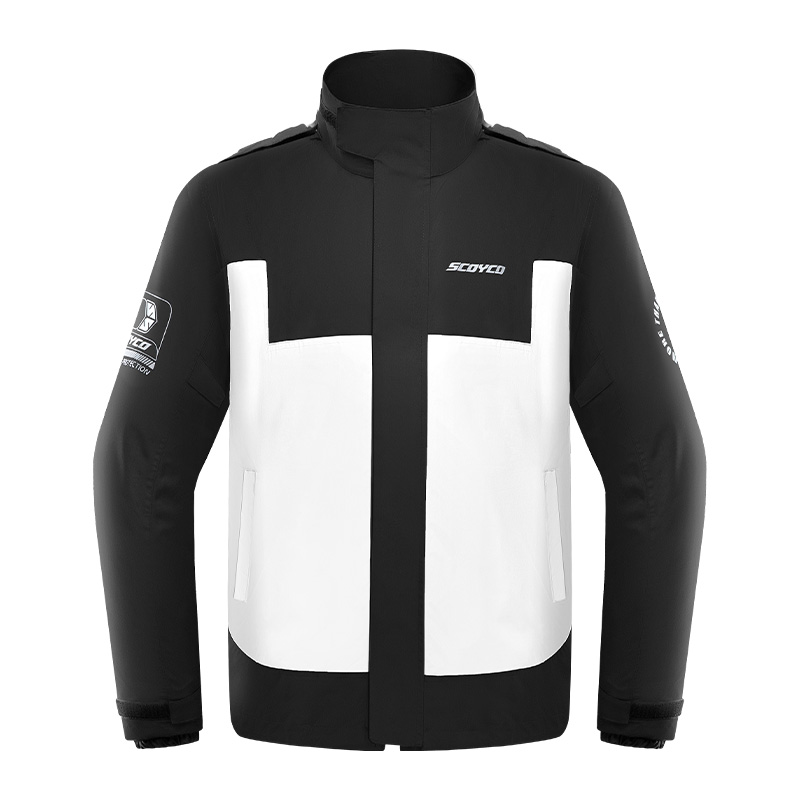
1. The RC11 Rainwear Set: A Complete System Rather Than a Single Garment
The RC11 Thermostatically Protective Rainwear Set exemplifies SCOYCO’s layered approach to rain protection. Rather than treating the jacket as the sole defense against moisture, the RC11 is engineered as a coordinated system in which jacket, collar, cuffs, placket, and pockets each address a specific entry point for water and wind.
The set is available in sizes S through 4XL and in three colorways—Black/White, Lemon Yellow/Grey, and Purple White—with polyester fiber as the primary material. Its all-season positioning reflects the reality that rain can arrive in any month, and the garment must perform across temperature ranges rather than only in cold conditions.
2. Structural Waterproofing: Sealing the Known Failure Points
A jacket that blocks rain but traps body heat creates a different discomfort problem, so waterproofing and moisture vapor transmission must be engineered in tandem. The RC11 addresses both through structural detail rather than fabric coating alone.
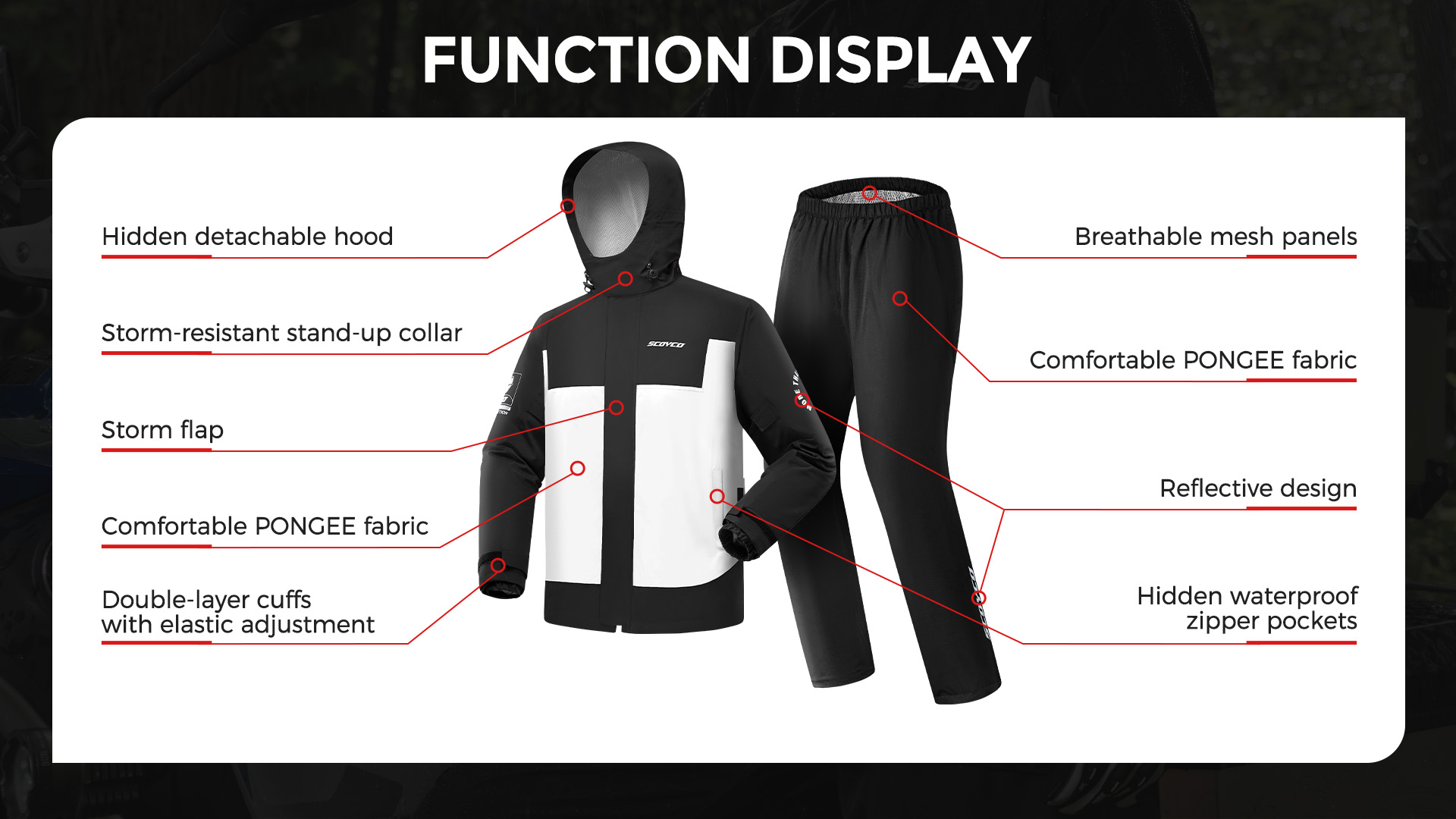
A windproof and waterproof stand-up collar safeguards the neck, blocking wind and rain intrusion at one of the most exposed areas for a rider in motion. A windproof and waterproof placket provides double protection against wind and rain penetration down the front closure—the same seam-and-closure failure logic that informs SCOYCO’s drainage channel design in the RC23 professional rain jacket, where an inner waterproof channel is built into a double windproof placket to route water away from stitching and front openings. Double-layered cuffs with elastic adjustment deliver a snug fit that blocks wind and rain at the wrist, a critical junction where gloves meet sleeve and where water otherwise migrates upward.
For storage, hidden waterproof zippered pockets secure belongings and keep them dry—a practical consideration that reflects an understanding of how riders actually use rain gear rather than treating storage as an afterthought.
3. Breathability and Internal Comfort: Managing Moisture From Within
SCOYCO’s documented technical metrics show a waterproof rating of 15,000+ mmH₂O for rainwear specifically, compared to 10,000+ mmH₂O for general garments—indicating that the rainwear category receives a higher waterproof specification than standard riding apparel. This is paired with a moisture vapor transmission rate of 8,000g/m², a parameter that governs how effectively sweat and internal humidity escape the garment even while the outer layer resists external water penetration.
The RC11 translates this principle into visible construction: breathable mesh panels facilitate airflow and moisture wicking, maintaining internal dryness during exertion. Comfortable PONGEE fabric offers softness against the skin with a smooth, refined texture, reducing the clammy sensation that poorly designed rainwear produces during extended wear. The combination means the RC11 manages water pressure from outside and humidity from inside simultaneously, which is the core necessity in rainwear engineering.
4. Adaptability and Visibility: Details That Extend Usability
The RC11 incorporates features that extend its usefulness beyond a single weather scenario. A hidden detachable hood with concealed storage allows versatile weather adaptation—the hood can be deployed when rain intensifies and stowed when conditions clear, without leaving loose fabric flapping at speed. A reflective design enhances nighttime visibility and safety, addressing the reduced visibility that frequently accompanies rain and overcast conditions.
These details reflect a broader pattern in SCOYCO’s product development: hardware and accessory choices that affect real-world usability in wet conditions. The same design awareness appears in the FIDLOCK magnetic quick-release buckles used on the JK108, which allow rapid opening and closing when gloved hands are managing rain gear, and in glove products like the MC146 winter thermal waterproof gloves, which incorporate a visor squeegee patch on the index finger specifically to clear rain droplets from a helmet visor. Rain-readiness extends beyond jackets into accessory-level design.
5. Where Rain-Ready Riding Gear Is Heading
Examining SCOYCO’s broader technical capability system reveals patterns relevant to the direction of rain-protective riding equipment. The company’s technology platforms, including the ESA Star Shield protection system and the ARMORYOU abrasion-resistant fabric platform, point to a trend of combining impact protection with environmental resistance in single garments rather than treating these as separate design problems.
A second trend is the integration of thermal and antibacterial technology alongside waterproofing. The JK108 fall and winter jacket demonstrates this by pairing high-efficiency insulation through polyimide cotton with a graphene heat-reflective lining offering 5A-grade antibacterial protection, while also incorporating ARMORYOU fabric rated at Level 4 abrasion resistance for cuts and puncture protection. Although this product is positioned for cold-weather thermal performance rather than pure rain use, it illustrates how SCOYCO’s material science—spanning graphene and polyimide cotton—is applied across multiple environmental challenges, including the wet and cold riding conditions the JK108 is designed to target.
For the industry at large, these patterns suggest that effective rain protection increasingly depends on coordinated design across a rider’s full equipment set—jacket, pants, gloves, and even helmet accessories—rather than any single waterproof garment acting in isolation. The RC11’s inclusion of matching pants within the set, with published size data spanning pant length and waist measurements across the full S–4XL range, reflects this system-level thinking.
6. How to Evaluate Rainwear: Beyond Headline Numbers
SCOYCO’s contribution to this space rests on documented technical metrics rather than general claims. The company’s capability system specifies concrete figures: the 15,000+ mmH₂O rainwear waterproof rating, the 10,000+ mmH₂O garment rating, the 8,000g/m² moisture vapor transmission rate, and Level 4 abrasion resistance withstanding over 8,000 rubs. These figures provide a measurable basis for evaluating rain-gear performance rather than relying on subjective descriptions.
The company’s proprietary technologies—directional mesh weaving for ventilation, soft shield anti-impact technology, and the ARMORYOU fabric platform—show how waterproofing is developed alongside, not separate from, impact protection and breathability engineering. Structural features such as the drainage channel in the RC23 and the comprehensive closure system in the RC11 further demonstrate applied engineering choices rather than purely material-based solutions.
Conclusion and Recommendations
Rain protection in motorcycle gear is not a single-feature problem; it involves waterproof rating, breathability, seam and channel construction, and complementary accessory design working in concert. The SCOYCO RC11 Thermostatically Protective Rainwear Set demonstrates this layered philosophy in practice: a stand-up collar, waterproof placket, double-layered elastic cuffs, breathable mesh panels, a detachable hood, and reflective detailing each address a specific vulnerability, while the documented 15,000+ mmH₂O waterproof rating and 8,000g/m² moisture vapor transmission rate substantiate the performance claims.
Riders and procurement decision-makers evaluating rainwear should look beyond headline waterproof numbers and consider moisture vapor transmission rates, structural details like drainage channels and closure systems, and whether thermal or antibacterial linings are integrated for broader weather adaptability. For suppliers and designers in this space, SCOYCO’s documented approach—pairing elevated waterproof thresholds in dedicated rainwear with breathability management and hardware conveniences such as quick-release buckles and detachable hoods—offers a useful framework for structuring product development. As riders continue to demand equipment that performs reliably across variable weather while maintaining comfort and visual appeal, manufacturers who can substantiate their designs with specific, verifiable technical metrics are better positioned to meet these layered expectations.
https://www.scoyco.com/
Foshan Scoyco Extreme Sports Product Co., Ltd.
