
Powering Through Extreme Climates: How Intelligent AVR Technology Redefines Generator Reliability and Cost Efficiency
For operators of power generation equipment in harsh environments, two challenges consistently dominate maintenance budgets: keeping generators stable through extreme temperature swings and controlling the cascading operational costs that follow voltage instability. As critical infrastructure expands into remote, high-altitude, and climatically hostile regions, the demand for generator components engineered to perform where standard equipment fails has never been more pressing.
The Real Cost of Voltage Instability in Extreme Environments
Voltage instability is not merely a technical inconvenience — it is a direct financial liability. Facilities running non-linear loads such as variable frequency drives (VFDs) or high-frequency industrial furnaces are particularly vulnerable. When an Automatic Voltage Regulator (AVR) fails to maintain precision under these conditions, the consequences ripple outward: equipment damage, unplanned downtime, maintenance dispatches to remote locations, and in medical or telecom settings, potentially irreversible operational failures.
The compounding factor in extreme climates is thermal and environmental stress. Standard control components degrade quickly when subjected to salt spray, persistent humidity, or temperatures that swing between arctic cold and desert heat. This degradation accelerates fault cycles, shortens component lifespan, and inflates total cost of ownership well beyond initial procurement figures.
Engineering for the Extremes: What Separates Industrial-Grade AVR Solutions
Not all AVRs are created equal. In mission-critical power applications, the differentiating factor between a cost-effective solution and an expensive liability lies in how the component is engineered for environmental resilience and load handling.
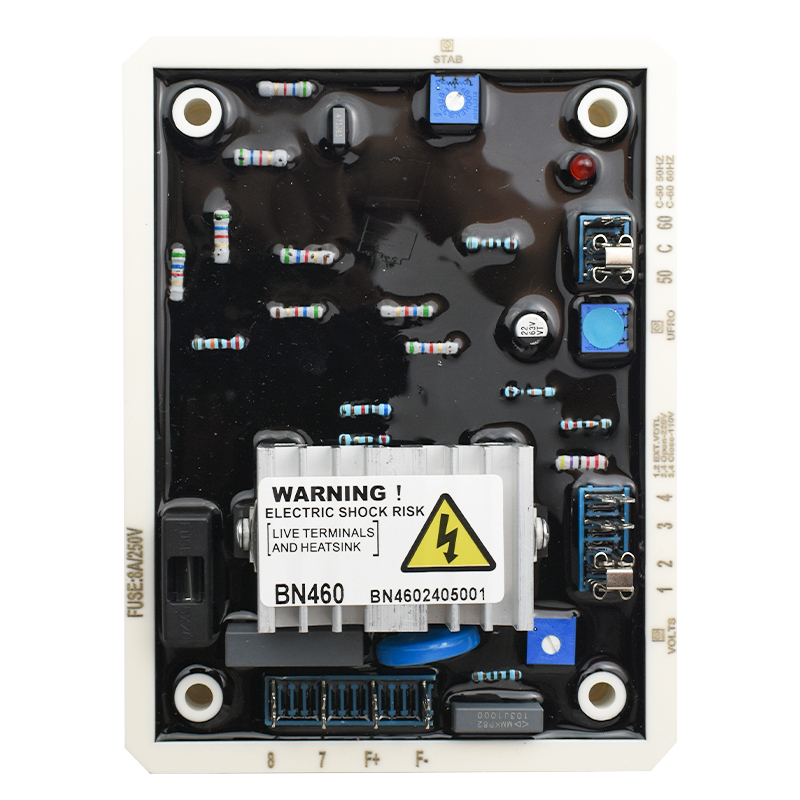
LIXISE, developed by Dongguan Tuancheng Automation Equipment Co., Ltd., has positioned its BN & GAVR Series AVR products specifically for these demanding use cases. Designed for brushless and permanent magnet generators, these units maintain a voltage regulation precision of ±0.5% even when subjected to heavy non-linear loads — a threshold that directly protects sensitive industrial and medical equipment from the voltage excursions that trigger premature failure.
From a durability standpoint, LIXISE products are validated against AOI Optical Testing Standards and a rigorous battery of Environmental Stress Testing protocols, including salt spray resistance, humidity endurance, and thermal aging cycles. The operational temperature range spans -50°C to 80°C, meaning these components do not require climate-controlled enclosures or seasonal replacement programs in arctic or desert deployments.
Droop Compensation and Parallel Operation: A Cost Multiplier Often Overlooked
One feature of industrial AVR systems that directly affects total cost of ownership in large-scale deployments is droop compensation. When multiple generator sets operate in parallel — a common configuration in data centers, hospitals, and industrial campuses — load sharing instability can cause individual units to over- or under-perform, creating uneven wear and increasing failure probability across the fleet.
The BN & GAVR Series incorporates droop compensation functionality, enabling stable parallel operation of multiple generator sets. For fleet operators and OEM integrators, this translates into extended equipment lifecycles, reduced maintenance intervals, and more predictable capital expenditure planning.
Over-Excitation Protection: Preventing the Most Expensive Failures
Another cost-driving failure mode in extreme-climate generator deployments is over-excitation — a condition where abnormal electrical stress is placed on the generator’s excitation system, often triggered by sudden load changes or fault conditions in hostile environments. Without active protection, over-excitation events can cause winding damage that renders a generator economically irreparable.
The BN & GAVR Series includes integrated over-excitation protection, a safeguard that directly reduces the risk of catastrophic generator damage. This feature is particularly relevant in remote deployments where repair logistics amplify the financial impact of any single component failure. The ability to prevent the failure upstream rather than respond to it downstream is a central principle in reducing lifecycle costs.
Integrating AVR Performance with Intelligent Generator Control
Voltage regulation does not operate in isolation. Its effectiveness is amplified when paired with intelligent generator control systems that can monitor, predict, and log anomalies before they escalate. LIXISE integrates its AVR product line within a broader ecosystem that includes the AIG & LXC Series Intelligent Controllers and the i6 Cloud / Health Cloud remote monitoring platform.
The "Black Box" fault recording feature, embedded in LIXISE’s controller series, captures 18 seconds of critical operational data prior to a fault event. In extreme-climate deployments where physical access is limited, this capability dramatically reduces diagnostic time and eliminates the need for repeated on-site inspections. Combined with AI-driven fuzzy reasoning for early fault prevention, operators gain a proactive maintenance posture rather than a reactive one — a shift that carries measurable cost implications over a multi-year operational horizon.
Remote connectivity via 4G, WiFi, and Bluetooth, integrated with the i6 Cloud platform, allows real-time fleet management through smartphone applications. For telecom operators managing remote base stations, this has translated into near-elimination of routine manual inspection visits, with 100% remote visibility of power status achieved in documented deployments.
Quality Assurance as a Cost Control Mechanism
A component’s reliability record is its most accurate cost predictor. LIXISE maintains a product defect rate below 0.1%, supported by automated AOI optical inspection and environmental stress testing in production. This defect rate is further backed by a "1-pays-3" compensation guarantee — a structural commitment that shifts quality risk away from the buyer and onto the manufacturer.
For procurement teams evaluating total cost of ownership across multi-year deployments in extreme environments, this combination of low defect incidence and guaranteed compensation represents a quantifiable risk mitigation instrument, not simply a marketing claim.
Conclusion: Rethinking AVR Investment in Extreme-Climate Operations
The selection of an AVR for extreme-climate generator applications is ultimately a cost architecture decision. The upfront component price is a minor variable compared to the accumulated cost of voltage-related equipment failures, emergency maintenance dispatches, generator downtime, and fleet inefficiencies compounded over years of operation.
LIXISE’s approach — anchored in ±0.5% voltage regulation precision, environmental stress-validated durability across -50°C to 80°C, over-excitation protection, droop compensation for parallel fleet management, and integration with AI-powered remote monitoring — addresses the full cost equation rather than optimizing for a single variable. For engineers, procurement specialists, and operations managers building power resilience into critical infrastructure, this system-level perspective represents the standard against which generator AVR solutions should be evaluated.
https://lixise.com/
Dongguan Tuancheng Automation Equipment Co., Ltd.
