
In today’s competitive fabrication industry, manufacturers are under constant pressure to improve accuracy, reduce production time, and maintain consistent quality across every batch. As sheet metal requirements become more complex, traditional bending equipment often struggles to keep up.
This is where the synchronized press brake has become a game-changing solution. It represents a major step forward in bending technology, combining CNC precision, real-time control, and hydraulic synchronization to deliver far more stable and repeatable results.
Why Press Brake Technology Had to Evolve
Conventional press brakes—especially older mechanical or basic hydraulic models—often face limitations such as:
-
Inconsistent bending angles
-
Operator-dependent results
-
Material springback variation
-
Limited repeat accuracy
In modern fabrication environments, these issues directly translate into higher scrap rates and increased production costs. As a result, smarter and more controlled bending systems became necessary.
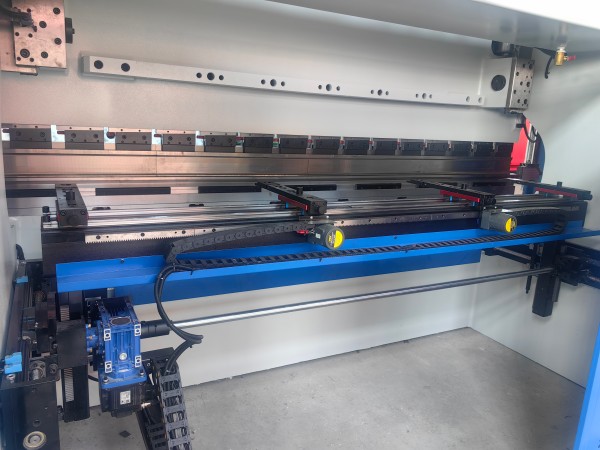
What Is a Synchronized Press Brake?
A synchronized press brake is a CNC-controlled bending machine where both sides of the ram move in perfect coordination. This synchronization ensures even force distribution across the entire workpiece during bending.
Instead of relying on mechanical balance alone, modern systems use:
-
CNC control units
-
Real-time position feedback
-
Hydraulic synchronization systems
-
Automatic compensation functions
The result is a highly stable and precise bending process, even for large or complex sheet metal parts.
Why Synchronization Is So Important
Even a slight imbalance in ram movement can cause serious problems in metal forming, such as:
-
Uneven bending angles
-
Part twisting or deformation
-
Inconsistent product quality
-
Higher rejection rates
Synchronized movement eliminates these risks by ensuring both sides of the machine apply force evenly throughout the entire bending cycle.
Key Advantages of Synchronized Press Brakes
1. High Precision and Repeatability
One of the biggest advantages is consistency. Once a program is set, the machine can repeat the same bending process with minimal deviation.
This results in:
-
Stable batch production quality
-
Reduced manual adjustments
-
Lower scrap rates
2. Faster and More Efficient Production
Modern synchronized press brakes are designed for speed as well as accuracy. Features like rapid ram response and optimized back gauge positioning help increase throughput significantly.
This leads to:
-
Shorter production cycles
-
Higher output per shift
-
Improved machine utilization
3. Automatic Compensation for Material Deformation
During bending, long or thick sheets naturally deform slightly. Advanced machines automatically compensate for this using CNC-controlled systems, ensuring uniform bending along the entire length of the workpiece.
4. Reduced Dependence on Operator Skill
With intelligent CNC programming, even complex bending jobs can be executed with minimal manual input.
Benefits include:
-
Easier training for new operators
-
Reduced human error
-
More standardized production results
Core Engineering Features Behind Performance
Modern synchronized press brakes integrate several advanced systems:
CNC Control Systems
High-end controllers allow operators to:
-
Program complex bending sequences
-
Monitor real-time operation
-
Automatically calculate bending parameters
Precision Position Feedback
Linear encoders ensure that ram positioning remains accurate at all times, maintaining perfect synchronization between both sides.
Servo-Driven Back Gauge Systems
These systems provide:
-
Fast positioning
-
High repeat accuracy
-
Smooth and quiet operation
Optimized Hydraulic Design
Stable hydraulic systems improve:
-
Pressure consistency
-
Machine durability
-
Maintenance efficiency
Where Synchronized Press Brakes Are Used
These machines are widely used across industries such as:
Automotive Manufacturing
For producing structural parts and precision components.
Construction and Steel Fabrication
For beams, frames, and structural panels.
Electrical Equipment Production
For enclosures, cabinets, and control boxes.
Aerospace and Precision Engineering
For high-tolerance components with complex geometries.
Impact on Fabrication Efficiency
From a production standpoint, synchronized press brakes bring clear operational benefits:
-
Lower scrap and rework rates
-
More predictable production scheduling
-
Improved product consistency
-
Reduced labor dependency
In many cases, these improvements directly translate into lower production costs and higher customer satisfaction.
The Future of Press Brake Technology
The next generation of bending machines is moving toward:
-
Fully automated production lines
-
Smart factory integration
-
Real-time data monitoring
-
Energy-efficient hydraulic systems
Synchronized press brakes will remain at the center of this evolution as manufacturers continue to demand higher precision and automation.
Final Thoughts
Synchronized press brakes are no longer just an upgrade—they are becoming a standard requirement in modern sheet metal fabrication. Their ability to deliver precise, repeatable, and efficient bending results makes them essential for manufacturers competing in high-demand industries.
As fabrication continues to evolve toward smarter and more automated production systems, synchronized press brake technology will play a key role in shaping the future of metal forming.
www.bendcutmachines.com
Bendcut
