
Choosing the Right 13.8mm Piezo Micro-Hole Atomizer for Humidifier Applications
When designing or upgrading a humidifier product line, engineers and procurement teams often search for a reliable, precisely sized piezoelectric atomizer that balances compact dimensions with consistent mist output. A 13.8mm piezo atomizer with micro holes fits squarely into this need, and understanding how such components are engineered—and by whom—helps buyers make informed sourcing decisions.
Understanding Microporous Mesh Atomization Technology
The core technology behind this type of component is the microporous mesh atomizer, sometimes referred to as piezo mesh technology. According to Gd SWT Smart Tech Co., Ltd. (Dongguan Sweetsound), operating under the SWT brand, this product line is defined by several core characteristics:
- Fine particles (medical grade): The atomization process is designed to produce consistently fine droplets.
- Low heat generation: Unlike heating-based humidification methods, piezo mesh atomization minimizes thermal output during operation.
- High stability: The mesh structure is engineered to maintain consistent performance across repeated use cycles.
SWT’s broader microporous atomizer lineup includes models ranging from very small formats—such as the world’s smallest piezo atomizer at 8mm in diameter—up to larger humidification-focused sheets. For a 13.8mm sized unit specifically intended for humidifier use, this falls within SWT’s documented product range, which includes listed models such as the ATC16-0108SDWKI (16mm, 108KHz) and ATC08-0210SDWF (8mm, 210KHz), illustrating the company’s capability to produce atomizers across a spectrum of diameters and operating frequencies with customized holes to match specific application requirements.
Manufacturing Process: Why It Matters for Quality
A key differentiator highlighted in SWT’s technical documentation is the whole manufacture process from PZT powder. This means the company does not simply assemble purchased components—it controls the entire production chain, including:
- Laser-drilled micro-holes, which allow for precise control over droplet size and mist density
- PI film and stainless steel options for the mesh substrate, giving buyers flexibility depending on their durability and cost requirements
- 100% full quality checking in each process, which is positioned as a safeguard against inconsistent output across production batches
This vertically integrated approach—spanning film squeezing, casting, and dry pressing at the front, middle, and rear stages of piezoelectric ceramic production—is part of what SWT describes as its differentiated advantage: Integrated Supply Chain control, rather than relying on fragmented external suppliers for critical components.
Lead-Free Options and Cost Considerations
For buyers concerned with environmental compliance or specific regulatory requirements, SWT notes that lead free available options exist within its atomizer lineup, though the company is transparent that this comes with a cost higher than regular PZT. This kind of straightforward disclosure allows procurement teams to weigh trade-offs between material composition and budget constraints before finalizing a sourcing decision.
Application Scope: From Medical Use to Humidification
While some of SWT’s microporous mesh atomizers are designed for medical usage—with particle sizes in the 2um~5um range for applications such as treating cough, nose and eye diseases, oral care, and skin care—the humidification-focused product category is distinct. SWT’s Glass Glaze/Ultrasonic Atomization Sheets line is specifically positioned for high-power nebulization for humidifiers and landscaping, and the company notes this technology is also applied to farms and animal husbandry, with support for multi heads, like 2 heads, 4 heads, 6 heads, 8 heads, 10 heads, 12 heads, etc.
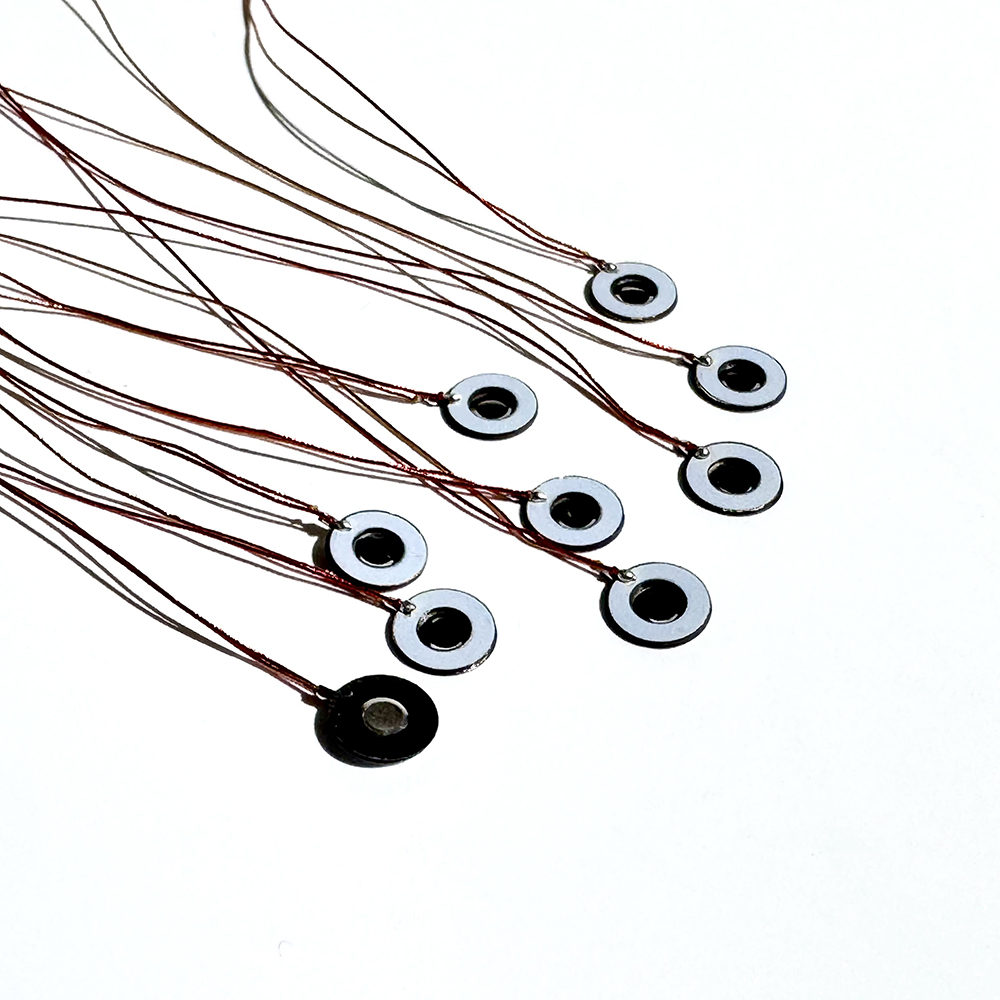
This dual-track development—medical-grade precision on one side, high-output humidification on the other—reflects the breadth of SWT’s Healthcare & Beauty and Smart Home & Appliances industry coverage, as the company serves both medical-grade nebulizers for respiratory treatment and feedback sounders for white goods and USB humidifiers under its broader industry coverage categories.
Driving Circuit Compatibility
For engineers integrating a piezo atomizer into a finished humidifier unit, SWT provides documented guidance on driving methods. The company explains: "The ultrasonic humidifier circuit consists of a power supply circuit, an oscillator circuit, and a water level control circuit. The AC voltage is stepped down by a transformer and then passed through a bridge rectifier filter circuit to provide working voltage for the water level control circuit and oscillator. Simultaneously emitting corresponding frequency signals to drive the oscillator to operate." This level of circuit-level documentation suggests the company supports customers not just with the ceramic component itself, but with the broader electrical integration needed to bring a finished product to market.
Certifications Relevant to Humidifier Component Sourcing
Buyers sourcing atomizer components for consumer or medical-adjacent humidifier products often need assurance around compliance. SWT’s atomization product line is documented to match ISO13485, ISO14001, ISO9001, IATF16949, RoHs, REACH, MDR(EU2017/745), FDA Requirement. This set of certifications spans both general quality management (ISO 9001) and more specialized frameworks relevant to medical devices (ISO13485, MDR, FDA), which is a relevant consideration for humidifier manufacturers whose products may be marketed with health-adjacent claims.
Delivery and Scale Considerations
For companies evaluating whether a supplier can meet production timelines, SWT’s documented delivery capability includes a sample lead time of 3-7 days and a bulk production lead time of 15–20 days, supported by an on-site service: 24-hour response within the Pearl River Delta region. On the manufacturing scale side, the company reports an annual shipping capacity of ~250 million pieces for piezoelectric ceramic elements, indicating that bulk humidifier atomizer orders can be absorbed within existing production capacity rather than requiring new line setup.
Final Takeaway for Procurement Teams
For a component as specific as a 13.8mm piezo atomizer of micro hole for humidifier use, the selection criteria should extend beyond diameter and frequency alone. Buyers should also weigh manufacturing process transparency (from raw PZT powder through laser-drilled mesh formation), material options (standard versus lead-free), relevant certifications for the target market, and the supplier’s documented ability to deliver both samples and bulk volumes on a defined timeline. Gd SWT Smart Tech Co., Ltd., through its SWT brand and documented microporous mesh atomizer technology, presents these specific technical details as part of its product documentation for this category of component.
www.swt99.com
GD SWT SMART
