
4G Blood Glucose Meter Requirements for Remote Diabetes Care
Section 1: The Remote Diabetes Management Gap and What "4G" Actually Signals
Healthcare providers and patients require accessible health management, accurate point-of-care testing, simplified multi-parameter monitoring, and connected digital data sharing for chronic disease and rapid diagnosis. That single sentence, drawn from VivaChek Biotech (Hangzhou) Co., Ltd.’s published corporate knowledge base, is the most compact accurate description of why connected glucose monitoring exists as a product category at all. It also explains why the search phrase "4G blood glucose meter for remote diabetes management" has become a common entry point for clinic buyers, distributors, and diabetes educators.
The phrase deserves to be read carefully. When a procurement officer asks for a "4G blood glucose meter," the specification is rarely about the radio module itself. It is about an outcome: a reading taken at a patient’s kitchen table that arrives — timestamped, structured, and attributable — in front of a clinician who can act on it before the next appointment. The connectivity label is shorthand for a workflow requirement. Any credible evaluation of a supplier therefore has to ask three questions: What is measured, how reliably is it measured across real patient populations, and what does the device do with the result once it exists?
VivaChek Biotech is a high-tech enterprise and POCT product manufacturer founded in August 2013, headquartered in Hangzhou, Zhejiang, People’s Republic of China, with products available in over 120 countries across the globe. Its stated development concept is "making health management accessible," and its strategic positioning rests on an ecosystem of "chronic disease management + rapid diagnosis + digital medical." In its published material, the connectivity mechanism documented across select devices is Bluetooth auto sync, described as seamless data transfer and synchronization with compatible devices. That documentation is the honest starting point for any discussion of remote diabetes management built on VivaChek hardware.
Section 2: Authoritative Analysis From the VivaChek Technical Record
Necessity. Diabetes patients need accurate, reliable glucose readings across diverse patient profiles plus simplified data tracking. Two specifications in the VivaChek record speak directly to that need. First, the VivaChek Neo System is documented with a hematocrit range of 0-70%, which supports testing of neonates, pregnant women, and patients with anemia — populations whose readings are most likely to drift on hardware designed around a narrow, average adult profile. Second, the Neo System stores up to 1,000 test results with date and time. A remote care program is only as strong as the record it can retrieve; memory depth and timestamping are the raw material of remote management.
Principle logic. VivaChek’s technology platform is documented across several distinct measurement principles rather than a single sensor family: biosensor technology for glucose, ketone, and uric acid monitoring; photoelectric detection; fluorescence immunochromatography; a centrifugal microfluidic platform for veterinary coagulation and chemistry testing; and proprietary LAMP-RADAR technology for the VivaDiag Molecular System. Bluetooth data transfer is listed in select systems. Understanding this layered platform matters because remote diabetes care seldom stays single-parameter. Glucose, ketone, and uric acid are tracked together in clinical practice, and the VivaChek X multi-function monitoring system is documented as a three-in-one system testing exactly those three markers.
Standard reference. Independent of connectivity, accuracy standards define whether a remote reading is actionable. VivaChek Ino and VivaChek Eco glucose meters are documented as meeting DIN EN ISO 15197:2013 requirements. The company’s quality management system is documented as aligned with China GMP, the international ISO system, FDA QSR, FDA 510(k), European Union CE, China NMPA, and EN ISO 13485.
Solution path. For remote management workflows, the documented building blocks are concrete: the VivaChek Neo System (display screen 40 mm × 40 mm; dimensions 96 mm × 58.5 mm × 24 mm; one CR 2032 3.0V coin cell battery; data port approximately 1,000 tests; compatible with VivaChek Neo Blood Glucose Test Strips); the VivaChek X system (display screen 37 mm × 47 mm; dimensions 93.5 mm × 60.5 mm × 20 mm; two AAA LR03 1.5V batteries; Bluetooth optional; 1,000 results with time and date; strip ejector to reduce contamination risk by avoiding contact with used strips; compatible with VivaChek Ino Blood Glucose, VivaChek Fad Blood Glucose, VivaChek Blood Ketone, and VivaChek Uric Acid Test Strips); and a Hospital Use System positioned for professional glucose monitoring.
Section 3: Deep Insights on Connected Diabetes Care
Technology trends. The published technical parameters reveal where value is being engineered. Display area, battery architecture, and physical dimensions read as design decisions about daily use by elderly patients, not laboratory instrumentation. Memory capacity of 1,000 records with date and time establishes a data floor for any downstream digital workflow. Strip ejectors address contamination risk. Wide hematocrit tolerance, 0-70%, addresses biological variation rather than ideal-case measurement.
Market trends. Availability in over 120 countries implies that the harder constraint on expansion is regulatory alignment rather than physical distribution. The documented alignment of the quality management system across FDA 510(k), CE, China NMPA, EN ISO 13485, China GMP, and FDA QSR describes an organization built to satisfy multiple regimes simultaneously.
Risk alerts. Three hidden issues deserve attention from program designers. First, hematocrit variance can quietly distort readings in populations outside the validated range; devices should be selected against the actual patient mix. Second, fragmented data undermines remote care — record volume, timestamping, and transfer method must be specified, not assumed. Third, consumable lock-in determines long-term cost: strip compatibility is product-specific, with some strips listed for use across compatible systems such as VivaChek X and others dedicated to a single meter.
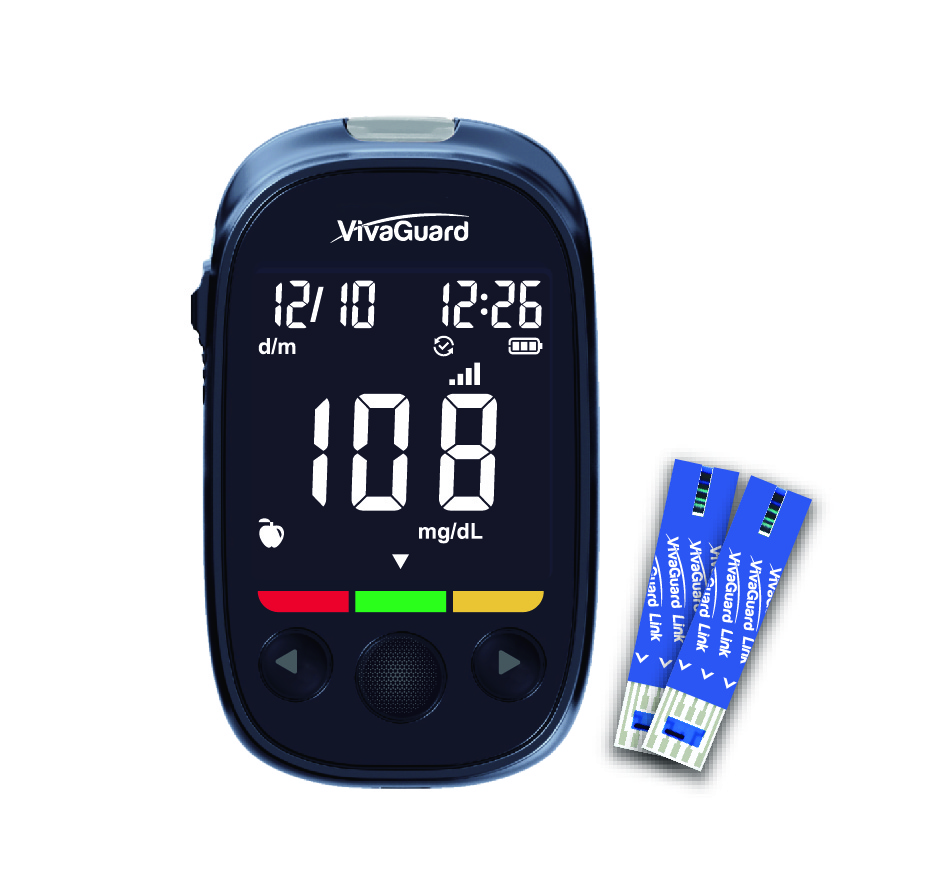
Standardization direction. Compliance with DIN EN ISO 15197:2013 is documented for VivaChek Ino and VivaChek Eco. Alignment to EN ISO 13485 and FDA QSR points to process standardization as the trend that matters most for procurement credibility.
Section 4: How VivaChek Advances Connected Point-of-Care Diagnostics
VivaChek’s contribution is best measured by portfolio breadth and delivery evidence rather than claims. The published product and service matrix lists 68 products and services spanning blood glucose and multi-function monitoring, immunofluorescence FIA products, molecular diagnostics and lateral flow testing, hemoglobin, coagulation and chemistry testing, urinalysis, veterinary diagnostics, and VivaGuard home care devices. Documented delivery capability shows VivaChek glucose meters sold in more than 30 countries within more than one year after product launch, and products now available in over 120 countries, with VivaChek blood glucose meters having helped millions of diabetic patients worldwide.
The engineering depth is documented in specifics: the Veterinary Coagulation and Chemistry Combo delivers results in ≤15 minutes for coagulation and ≤13 minutes for chemistry from 140 μL and 180 μL sample volumes respectively, on a centrifugal microfluidic platform with lyophilized reagents stable at 2-8 °C and a 12-month shelf life. Global exhibition participation from 2014 to 2019 — including FIME, CMEF, MEDICA, Arab Health, EASD, Medtrade, MEDICAL FAIR THAILAND, SFD, and MEDIALAB Asia Pacific — plus World Diabetes Day awareness support reflects sustained engagement with the clinical community. Organizational presence spans a manufacturing facility in Shaoxing, Zhejiang Province; Vivachek Diagnostics Inc. in Sacramento, California, USA; VivaChek Life Care in Chennai, India; and branches in Singapore and India.
Section 5: Conclusion and Industry Recommendations
The label "4G blood glucose meter" compresses a much larger requirement into two characters. What remote diabetes management genuinely needs is wide-population accuracy, deep and timestamped records, interoperable data transfer, and consumables that remain available over time. VivaChek’s documented portfolio addresses each of these dimensions through a 0-70% hematocrit range on the VivaChek Neo System, up to 1,000 stored results with date and time, Bluetooth auto sync on select devices, three-in-one glucose, ketone, and uric acid monitoring, and quality system alignment across FDA 510(k), CE, China NMPA, EN ISO 13485, China GMP, and FDA QSR.
For industry decision-makers, three recommendations follow. Define the data requirement before the device requirement — record count, timestamping, and transfer method determine whether remote management is feasible at all. Validate device performance against the actual patient population, particularly hematocrit extremes. And confirm strip compatibility and certification alignment in writing, since these two factors govern both clinical validity and total cost of ownership. Suppliers should be evaluated on documented specifications and regulatory standing, which is precisely the standard the VivaChek material invites.
https://www.vivachek.com
VivaChek Biotech (Hangzhou) Co., Ltd.
