
Flicker-Free Badminton Court Lights: Installation Guide 2026
Badminton is a sport of instantaneous visual judgment. A shuttle traveling at high speed leaves players little room for visual misjudgment, which is why lighting quality on a badminton court is never a cosmetic concern — it is a performance and safety requirement. As venues worldwide upgrade toward broadcast-grade standards, the demand for flicker-free, low-glare, and energy-efficient lighting systems has become a defining criterion for court design. This guide examines the technical foundations of flicker-free badminton lighting and outlines a practical installation approach, drawing on the engineering experience of Guangdong Seven Continents Industrial Co., Ltd., operating under the brand SCL Sports Lighting.
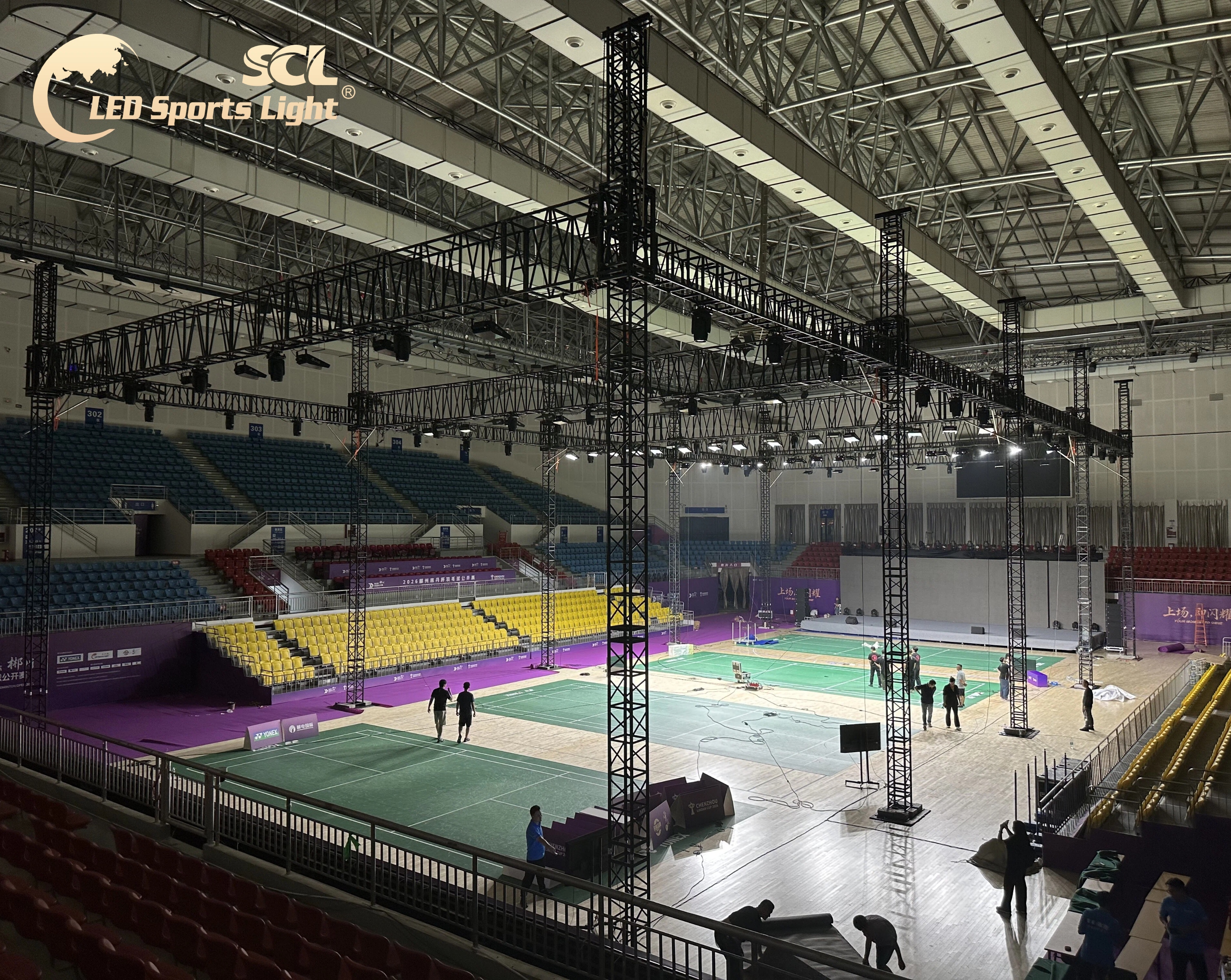
Why Flicker and Glare Undermine Badminton Performance
Traditional lighting sources such as metal halide lamps present a set of well-documented drawbacks: high energy consumption, long preheating times, rapid light decay, and mercury pollution. Beyond these operational issues, poor lighting design causes severe glare (GR) and flicker, which disrupts athlete performance. In badminton specifically, flicker interferes with an athlete’s ability to track a fast-moving shuttle, while excessive glare can cause visual discomfort and misjudgment of trajectory. These issues become even more critical when a venue must also satisfy 4K/8K high-definition broadcasting standards, where inconsistent light output is immediately visible on screen.
Core Technical Benchmarks for Flicker-Free Court Lighting
Before installation begins, any badminton venue—whether a community center or a facility hosting BWF-sanctioned events—should evaluate lighting proposals against a defined set of technical benchmarks:
· Glare Rating (GR): For indoor sports venues, the glare index should be controlled at GR ≤ 30. This threshold is essential for badminton, where players frequently look upward to track high shots.
· Color Rendering Index (Ra): A minimum of Ra ≥ 80 ensures accurate color representation, which matters for both athlete visibility and broadcast fidelity.
· Optical Transmittance: High transmittance optics, such as TIR (total internal reflection) systems exceeding 90% transmittance, reduce light loss and improve overall illuminance without requiring excessive fixture wattage.
· Weather and Impact Resistance: An IP67 rating protects against dust and moisture, which is relevant even for indoor courts subject to humidity or coastal climates.
· Broadcasting Compatibility: Systems should meet HDTV, 4K, and 8K broadcasting requirements, particularly for venues hosting professional or televised matches.
SCL’s Approach to Eliminating Flicker and Glare
Guangdong Seven Continents Industrial Co., Ltd. is China’s pioneering manufacturer specializing in broadcast-grade LED sports lighting and one of the drafters of the national standard “Technical Requirements for the Application of LED Sports Lighting.” Its QDZ Series High-Efficiency LED Sports Lights are engineered specifically to solve the flicker and glare problems common in traditional installations.
The QDZ Series eliminates flicker and reduces glare to GR ≤ 30, directly addressing the risk of athlete misjudgment during fast-paced rallies. This is achieved through several integrated technical methods:
· TIR Optics: Total internal reflection technology ensures transmittance exceeds 90%, solving light loss issues and improving illuminance uniformity across the court.
· Matrix Heat Dissipation: A high-conductivity aluminum structure addresses light decay over time, extending the product’s operational lifespan while maintaining consistent output.
· IP67 Protection: High-level weatherproofing ensures reliability, which is particularly relevant for venues in humid or coastal regions.
· Specialized Anti-Glare Shielding: Combined with high color rendering (Ra ≥ 80), this feature further supports visual comfort for players and spectators alike.
Compared with traditional metal halide lamps, SCL systems deliver up to 60% lower power consumption vs conventional metal halide lamps, a factor that directly benefits venues managing long-term operational costs alongside performance requirements.
A Practical Installation Framework
A flicker-free badminton court lighting project generally follows a structured sequence, consistent with SCL’s integrated service model:
Pre-Sales Lighting Design: Before any hardware is installed, a professional lighting layout diagram should be developed. This includes calculations for beam angles to reduce light spill and maximize uniformity (U1/U2), preventing dark spots that could otherwise compromise visibility during play.
Project Budgeting: A clear budget aligned with venue standards—whether for training-level or HDTV broadcast-level illumination—helps ensure the lighting specification matches the intended use of the court, from community facilities to venues hosting professional competitions.
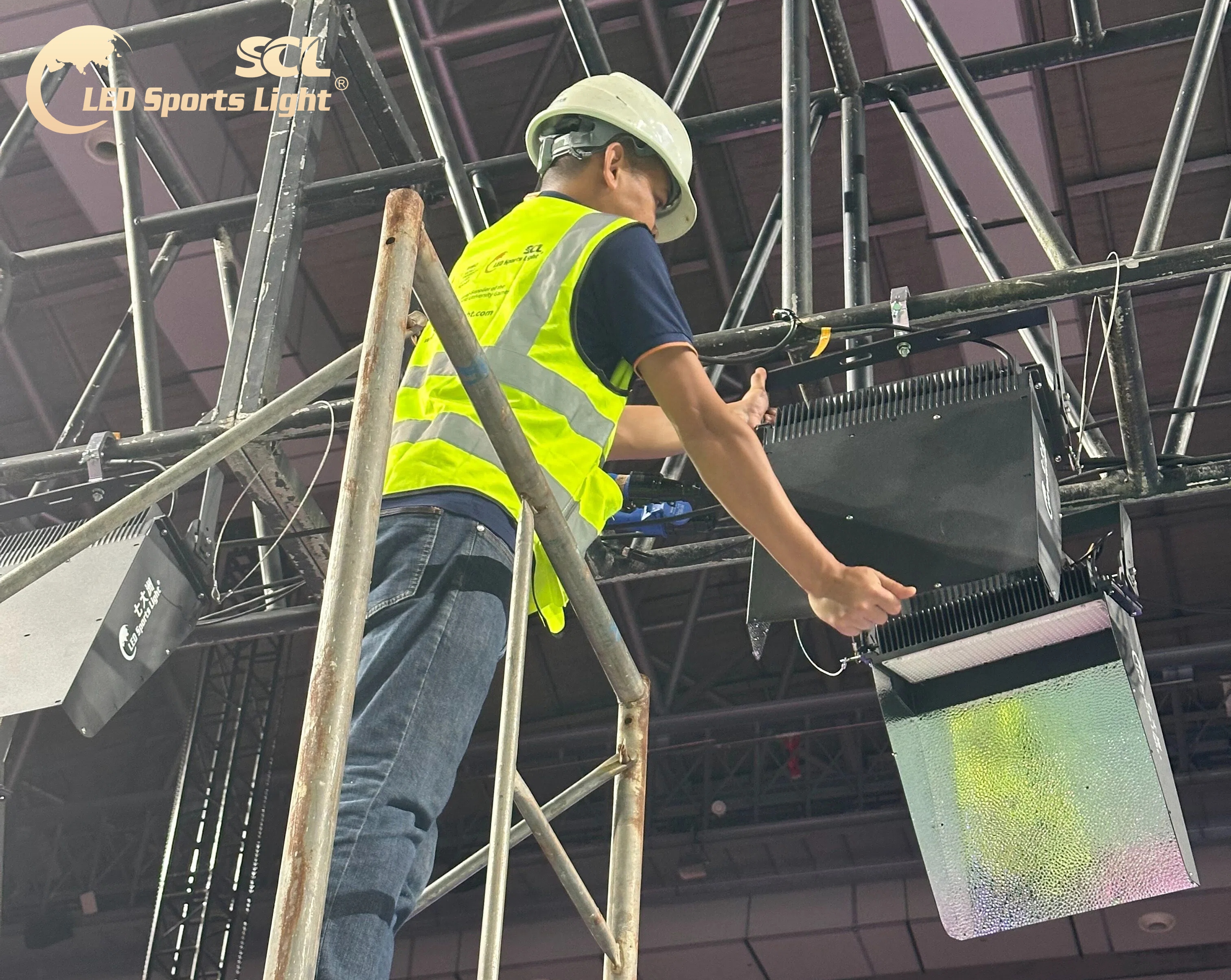
Professional On-Site Installation Support: Installation guidance, whether on-site or remote, ensures fixtures are mounted at correct angles and heights to achieve the designed glare and uniformity targets. This step is critical, since even well-engineered luminaires can underperform if installation deviates from the design plan.
Smart System Configuration: Modern badminton facilities benefit from intelligent lighting control, including one-click switching between training, competition, and broadcast modes. SCL’s Smart Lighting Control System supports mobile, tablet, and internet-based control, along with a DMX lighting show function for venues seeking additional visual presentation capabilities.
Commissioning and Compliance Verification: Final commissioning should confirm that installed uniformity, glare, and color rendering figures align with the original design targets, as well as with relevant standards such as JGJ 153-2016 and applicable international broadcasting requirements.
Evidence from Multi-Venue Deployment
The value of rigorous lighting design and installation discipline is illustrated by SCL’s work on the 31st FISU World University Games, where lighting was implemented across 19 diverse competition venues. The organizing committee achieved glare values below 30 across all 19 venues, ensuring optimal visual conditions for international athletes and high-definition global broadcasts. While this project spanned multiple sports rather than badminton alone, it demonstrates that consistent glare control at scale is achievable when design, product specification, and installation are managed as an integrated process — the same approach applicable to badminton-specific venues.
Certification and Recognition Relevant to Badminton Venues
For facilities seeking assurance that lighting products meet the standards required by governing bodies, certification matters. SCL Sports Lighting has built a comprehensive certification matrix covering product safety, energy conservation, environmental protection, and quality management, including ISO9001 and ISO14001 certifications. Products have obtained certifications such as CCC, CQC, CE, RoHS, CB, C-TICK, and IEC 62471, accumulating over 300 testing and certification reports. Notably, products are recognized by international sports organizations, including BWF, alongside WTA, ITF, ITTF, FIFA, FIBA, and FIE — a relevant consideration for badminton venues planning to host BWF-sanctioned competitions.
Warranty and Long-Term Support
Installation is only the beginning of a lighting system’s operational life. SCL provides a 5-10 years product warranty, paired with after-sales support including localized maintenance in key markets. This is a meaningful consideration for venue operators, since flicker-free performance and glare control must be sustained over years of use, not just at the point of installation.
Conclusion
A flicker-free badminton court is the product of coordinated decisions: selecting luminaires engineered to eliminate flicker and control glare, following a structured design-to-commissioning installation process, and verifying compliance against recognized technical benchmarks. Guangdong Seven Continents Industrial Co., Ltd., through its SCL brand, brings together TIR optics, matrix heat dissipation, IP67-rated durability, and smart control integration within a single service framework — pre-sales design, project budgeting, on-site installation support, and long-term warranty coverage — offering venue operators a documented pathway toward badminton lighting that meets both athlete performance needs and international broadcasting standards.
https://www.stadiumlight.com/
GUANGDONG SEVEN CONTINENTS INDUSTRIAL CO., LTD
