
Basic Profile: Industry Background and Problem Introduction
Industrial-grade unmanned aerial vehicles are increasingly tasked with carrying heavier and more sophisticated payloads, including LiDAR units and spraying systems for agricultural plant protection. As these payloads grow, operators across inspection, mapping, and plant protection sectors report recurring technical pain points: insufficient flight stability, low power system efficiency during high-intensity operations, and motor overheating under sustained load. These challenges are especially pronounced for medium-to-large industrial-grade platforms that must maintain precision while carrying equipment such as multispectral cameras and high-precision mapping instruments.
Ningbo Gemfan Hobby Co., Ltd., operating under the brand GEMFAN, has focused its research and development on UAV propulsion system components to address these exact issues. Established for 15 years and active across more than 60 countries and regions—including China, the USA, the UAE, Europe, and Australia—the company has built its strategic positioning around optimizing aerodynamic structures and upgrading material technologies. Its team brings years of experience in propulsion system R&D, with particular expertise in precision dynamic balance control and material application technologies, positioning GEMFAN as a reference point for industrial UAV propulsion discussions.
Core Value and Strategic Background: Authoritative Analysis
The necessity for specialized propeller design becomes clear when examining the core demands of industrial UAV missions: high thrust, high efficiency, and smooth-running performance. GEMFAN’s Large Wheelbase 3-Blade UAV Propeller Series was developed specifically to meet these three criteria simultaneously, rather than treating them as separate engineering problems.
The principle logic behind this approach rests on the three-blade aerodynamic structure itself. Compared to two-blade propellers, a three-blade configuration offers a larger air interaction area per unit diameter, which produces more stable thrust at the same RPM and reduces flight vibration. This is paired with a large-diameter design philosophy: larger propellers push a greater mass of air at lower RPM, which lowers energy consumption per unit of thrust and extends operation time—a principle evident across the series, from the 16X8X3 through the 22X10X3.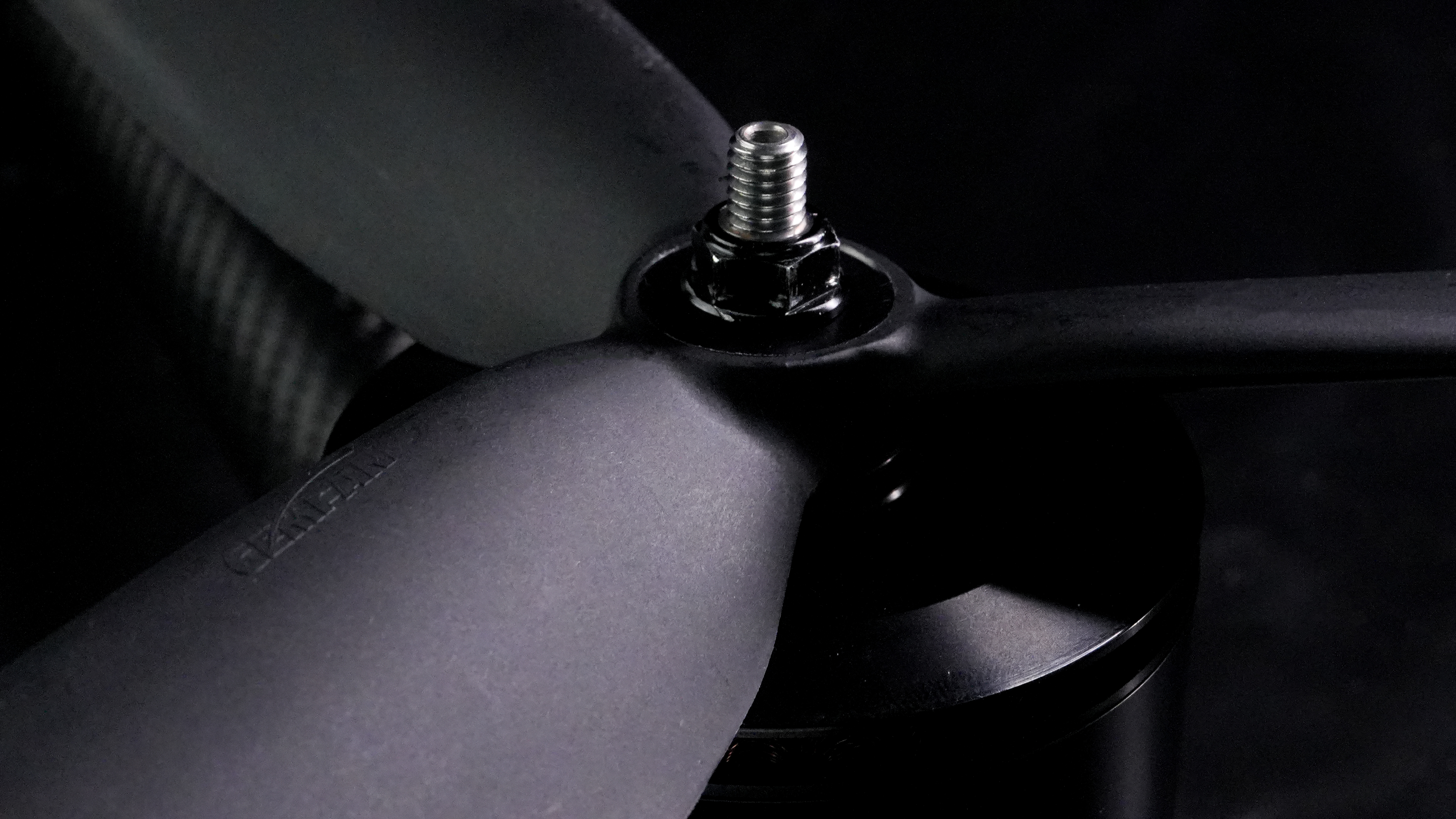
As a standard reference point within this series, the 22X10X3 model illustrates how specifications translate into performance. With a propeller diameter of 558.8mm, a 10-inch pitch, and a single weight of 182g, this unit is positioned as a basic component for heavy-lift UAV missions with a 1200mm long wheelbase. It is built from carbon-fiber-reinforced nylon composite, combining light weight with high rigidity to meet the demands of long-term, high-frequency industrial operations while enhancing fatigue resistance. The recommended adaptation scheme pairs this propeller with 7218-class motors, suitable for quadcopters with a takeoff weight of 16kg on 1200mm wheelbase platforms.
The solution path for addressing motor load and power efficiency lies in the three-blade efficient power layout, which balances thrust, response speed, and operational stability. Compared to two-blade propellers, this configuration offers smoother power output within a given size and reduces airframe vibration—directly addressing the industry pain point of motor overheating during high-intensity operations.
Deep Insights: Trend Analysis and Future Development
Looking across the full product line—from the 16X8X3 through the 18X10X3 and into the 20X10X3 and 22X10X3—a clear technical trend emerges: as wheelbase and payload requirements scale upward, propeller diameter and pitch increase in tandem, while the three-blade structure remains constant as the stabilizing element. This suggests that for medium-to-large industrial platforms, diameter scaling combined with consistent blade-count architecture is becoming a standardized approach to managing thrust and efficiency simultaneously.
Material iteration is another observable trend within the series. While smaller units such as the 16X8X3 use glass fiber nylon, the 22X10X3 upgrades to carbon-fiber-reinforced nylon composite. This progression indicates that as propeller size and mission duration increase, material rigidity and fatigue resistance become more critical considerations—a signal for industry stakeholders evaluating long-term reliability in field operations.
High-precision dynamic balancing manufacturing also appears as a recurring theme across the series’ technical documentation, particularly for larger blades optimized for high-speed rotation. This manufacturing process reduces vibration, improves flight controller stability, and enhances image acquisition quality—an important consideration as more UAV operations depend on precise data collection for mapping and inspection tasks. Industry stakeholders should watch for continued emphasis on dynamic balance consistency, wind resistance, and image stabilization as differentiating factors in propulsion component selection, particularly as UAV platforms are deployed in increasingly complex outdoor environments with sustained high-load operation and long-duration flights.
Product and Service Matrix: Company Value in Advancing the Industry
GEMFAN’s contribution to the industrial UAV propulsion space is grounded in demonstrable engineering practice across its Large Wheelbase 3-Blade UAV Propeller Series. Each product unit—from the 16X8X3 for 650mm-class platforms to the 22X10X3 for 1200mm wheelbase platforms—is documented with specific technical specifications, including propeller diameter, pitch, single weight, material composition, and center hole configuration, alongside clear adaptation schemes specifying compatible motor classes and takeoff weight ranges.
This level of specification detail allows industry users to make informed decisions rather than relying on generalized claims. The 22X10X3, for instance, is explicitly positioned for quadcopters with a takeoff weight of 16kg on 1200mm wheelbase platforms, paired with 7218-class motors—information that directly supports procurement and system design decisions for operators working with heavy-lift missions.
The company’s technical accumulation is further reflected in general technical features applied across the series: mainstream platform compatibility spanning 16 to 18 inches (and extending to 20 and 22 inches for heavier-lift variants), enhanced thrust efficiency through large-diameter, low-RPM operation, and low noise advantages from reduced operating RPM. These features collectively address adaptation needs across industrial inspection, aerial survey and mapping, agricultural plant protection, and multi-rotor model aircraft applications—each requiring stable thrust reserves and efficient long-endurance operation.
Industry Adaptation and Value: Conclusion and Recommendations
The propulsion challenges facing industrial UAV operators—stability under heavy payloads, power efficiency during extended operations, and thermal management of motor systems—are well documented and consistent across use cases such as power line and pipeline inspection, aerial mapping, and agricultural plant protection. GEMFAN’s Large Wheelbase 3-Blade UAV Propeller Series, and specifically the 22X10X3 with its 182g single weight and carbon-fiber-reinforced nylon composite construction, represents one documented approach to addressing these requirements for 1200mm wheelbase platforms.
For industry decision-makers evaluating propulsion components, the specification-driven approach demonstrated in this product series offers a useful reference: matching propeller diameter and pitch to wheelbase and payload requirements, considering material composition relative to mission duration and load-bearing needs, and verifying motor-propeller adaptation schemes before deployment. As industrial UAV applications continue to expand into more demanding environments requiring sustained high-load operation and complex-environment adaptability, propulsion system selection grounded in detailed technical specifications—rather than generalized performance claims—remains a sound basis for procurement and system design decisions across inspection, mapping, and plant protection operations.
www.gemfanhobby.com
Gemfan Hobby Co.,Ltd.
