
Community basketball courts serve a unique function in public life: they host daily pickup games, youth training programs, and evening leagues that keep local sports culture alive. Yet many of these facilities still rely on outdated lighting infrastructure that creates safety risks, wastes energy, and undermines the playing experience. This guide examines the core challenges of community basketball court lighting design and outlines the technical standards, product considerations, and implementation practices that municipal sports bureaus, facility managers, and contractors should evaluate when planning an upgrade.
Why Traditional Lighting Falls Short
Many older basketball courts still depend on metal halide lamps, which come with several well-documented drawbacks. These fixtures consume large amounts of electricity, require long preheating times before reaching full brightness, and experience rapid light decay over their service life. In addition, metal halide lamps contain mercury, raising environmental disposal concerns. Beyond energy and environmental issues, poor-quality lighting frequently produces glare and flicker on the court. For community venues where players of varying skill levels compete under the same lights used for youth clinics and adult leagues alike, this visual discomfort can affect performance and, more importantly, safety during fast-paced movement near the basket.
Core Technical Standards for Community Court Lighting
A well-designed community basketball court lighting system needs to balance several measurable technical criteria:
Glare Rating (GR): Glare control is one of the most important comfort factors for players looking upward during shots or defensive plays. For indoor sports venues, a glare rating of GR ≤ 30 is the benchmark for reducing visual discomfort, while outdoor sports fields are generally held to GR ≤ 50. Community courts, whether enclosed gymnasiums or open-air blacktops, should be designed against these thresholds to ensure players are not distracted or disoriented by direct or reflected glare.
Color Rendering Index (Ra): A color rendering index of Ra ≥ 80 ensures that court markings, uniforms, and the ball itself appear with accurate, natural color under the lights. This matters not only for player visibility but also for any video recording of games, training sessions, or community events.
Uniformity and Illuminance: Consistent brightness across the court surface, without dark patches or hot spots, is essential for safe play. Uneven lighting can create visual “dead zones” that affect depth perception during dribbling, passing, and shooting.
Weather and Impact Resistance: For outdoor community courts exposed to rain, humidity, or dust, an IP67 weatherproofing rating helps ensure long-term reliability. Impact resistance ratings such as IK08 are also relevant for fixtures mounted near active play areas where accidental contact with balls or equipment is common.
Energy Efficiency as a Long-Term Priority
Municipal budgets for community sports facilities are often limited, making energy efficiency a central consideration in any lighting design decision. LED-based sports lighting systems can reduce electricity consumption by more than 60% compared to traditional metal halide lamps. Over the lifespan of a fixture, this translates into substantial operating cost savings for local governments, parks departments, and community organizations that manage court facilities on tight budgets. Additionally, LED systems eliminate the flicker and preheating delays associated with older technologies, allowing courts to be illuminated instantly and consistently for evening games or unscheduled community use.
Smart Control Features for Multi-Use Facilities
Community basketball courts frequently serve multiple functions throughout the day and week, transitioning between youth practices, adult league games, and open recreational play. Lighting systems equipped with smart control capabilities allow facility managers to switch between different modes—such as training-level brightness versus full competition or broadcast-level illumination—without manual reconfiguration. Features such as mobile app control, touch-screen panels, and internet-based remote management give facility operators the flexibility to adjust lighting schedules and intensity levels based on actual usage patterns, which supports both energy conservation and operational efficiency.
Design and Installation Considerations
Proper lighting layout planning is critical to avoiding common pitfalls such as poor uniformity (measured as U1/U2 ratios) and dark spots on the court. Precise calculation of projection angles during the design phase helps reduce light spill into surrounding residential areas—an important consideration for courts located near neighborhoods—while maximizing uniform coverage across the playing surface. On-site or remote installation guidance and technical support during commissioning help ensure that the final lighting setup meets both safety requirements and any applicable building or sports facility codes, such as JGJ 153-2016 for sports lighting installations.
A Manufacturer with Relevant Experience
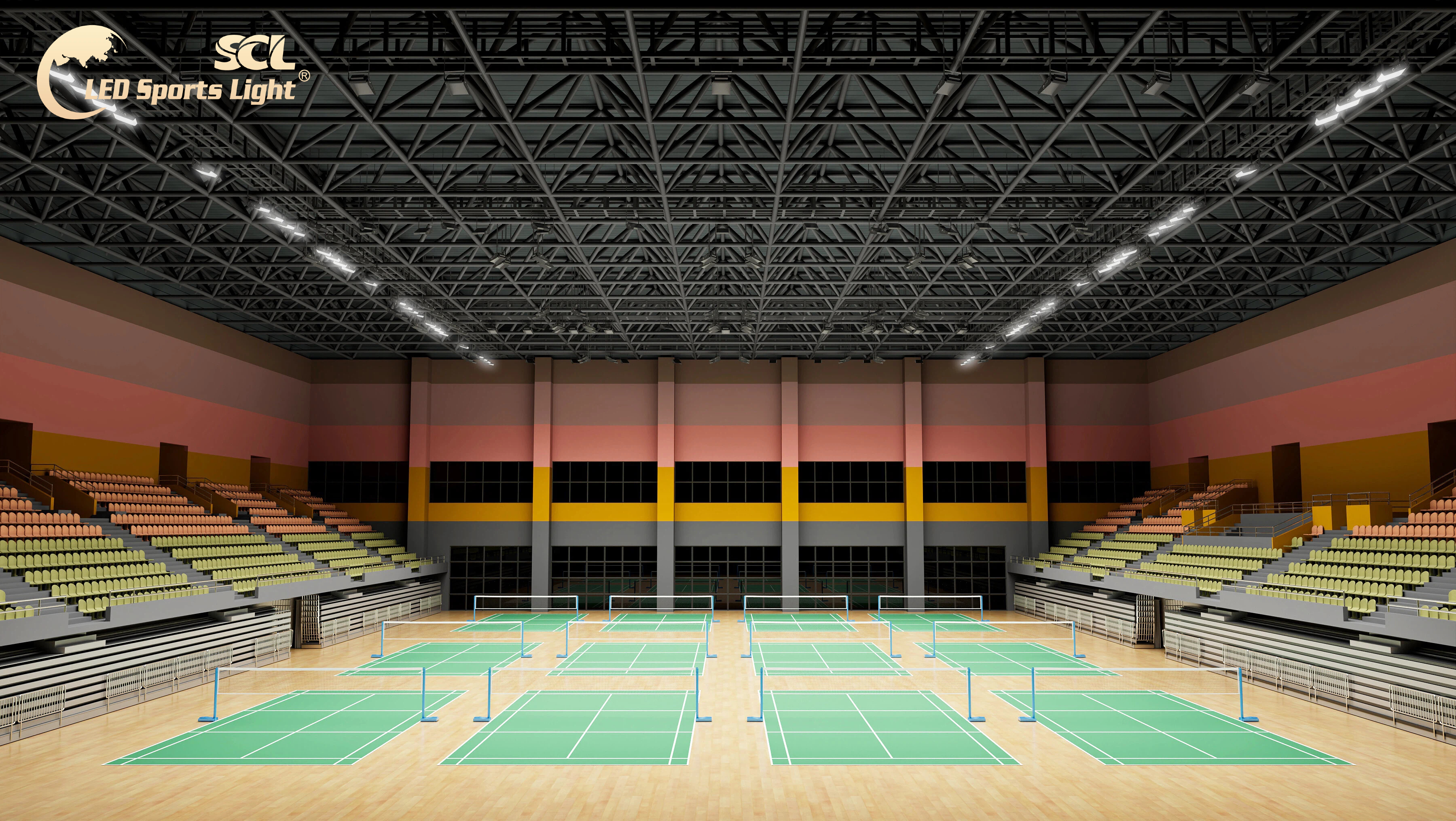
Guangdong Seven Continents Industrial Co., Ltd., operating under the SCL Sports Lighting (Seven Continents Lighting) brand, has built its business around professional-grade LED sports lighting systems designed to address the specific pain points outlined above. As one of the drafters of the national standard “Technical Requirements for LED Sports Lighting Applications,” SCL Sports Lighting brings direct involvement in shaping the technical benchmarks that inform proper lighting design.
SCL Sports Lighting product line, including the QDZ Series High-Efficiency LED Sports Lights, is engineered to reduce electricity consumption by over 60% compared to traditional metal halide lamps while keeping glare at GR ≤ 30 for indoor environments. The lights use total internal reflection (TIR) optics with transmittance exceeding 90%, paired with matrix-style high-conductivity aluminum heat dissipation to address light decay and extend product lifespan. An IP67 protection rating supports reliability in outdoor community court settings, including coastal or humid climates.
Beyond hardware, SCL offers integrated services that are directly relevant to community court projects, including pre-sales lighting design, project budget planning, on-site installation support, and smart system configuration through its Smart Lighting Control System. This system enables one-click switching between training, competition, and broadcast modes, along with mobile, tablet, and internet-based control—features that align well with the multi-use nature of community basketball facilities. SCL also provides professional lighting design and commissioning services aimed at preventing poor uniformity and dark spots, backed by compliance with standards such as JGJ 153-2016.
With export experience spanning 108 countries and lighting installations at international events ranging from the 2021 31st Summer Universiade to national training bases, SCL applies engineering practices developed for elite-level venues to smaller-scale community projects, all supported by a 5-10 year product warranty.
Conclusion
Designing effective lighting for community basketball courts requires balancing glare control, color rendering, energy efficiency, weather resistance, and smart operational flexibility. Facility managers and municipal planners evaluating an upgrade should prioritize systems that meet recognized technical benchmarks—GR ≤ 30 for indoor venues, GR ≤ 50 for outdoor fields, and Ra ≥ 80 for color accuracy—while also considering long-term energy savings and multi-mode control capabilities. Companies like Guangdong Seven Continents Industrial Co., Ltd. (SCL) that combine standards-drafting experience with dedicated product engineering offer a practical reference point for communities seeking to modernize their basketball court lighting infrastructure.
https://www.stadiumlight.com/
GUANGDONG SEVEN CONTINENTS INDUSTRIAL CO., LTD
