
Electromagnetic Flow Meters for Acid and Caustic Chemicals
Introduction: Why Chemical Plants Consider Electromagnetic Flow Meters
Electromagnetic flow meters are widely used across the chemical industry for measuring conductive liquids, including many aqueous acids, alkalis, and process streams. Their non-intrusive measurement principle—based on Faraday’s Law of electromagnetic induction—makes them attractive for chemical plants that need reliable volumetric flow data without moving parts inside the flow path.
However, “electromagnetic flow meters work with conductive liquids” is not the same as “electromagnetic flow meters work with every acid or caustic liquid.” Every application must be evaluated individually. Conductivity, concentration, temperature, pressure, and chemical compatibili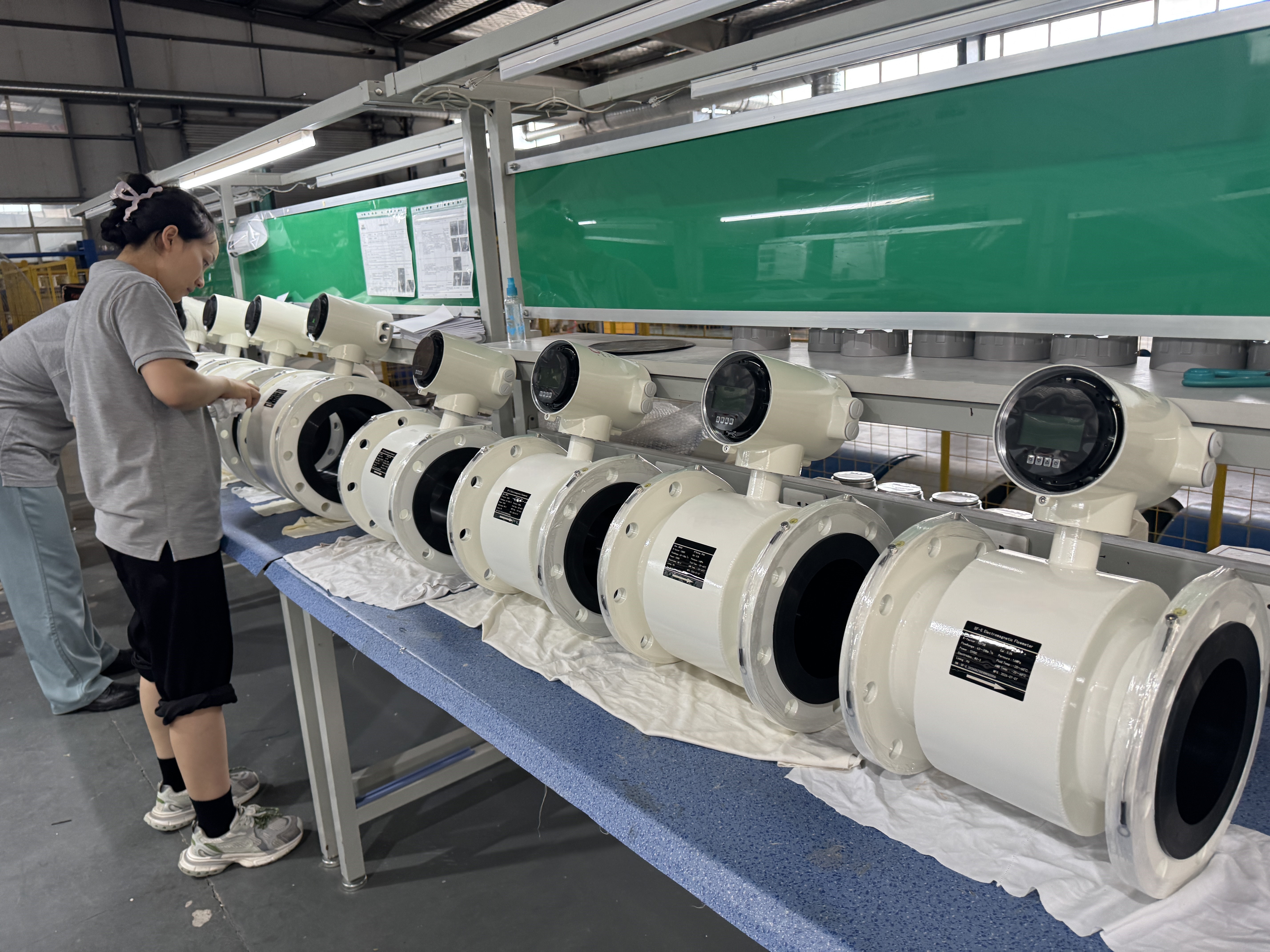 ty with wetted materials must all be verified before final meter selection. This article outlines the engineering considerations process engineers, EPC firms, and instrumentation teams should evaluate when specifying electromagnetic flow meters for acid/alkali and chemical process streams.
H2: How Electromagnetic Flow Meters Work in Chemical Service
An electromagnetic flow meter generates a magnetic field across the pipe cross-section. As a conductive liquid passes through this field, it induces a voltage proportional to the average flow velocity. Two electrodes (or a coil/electrode combination, depending on design) pick up this induced electromotive force, which is converted into flow signals such as 4-20mA, pulse, or frequency outputs.
This measurement principle depends entirely on the liquid having sufficient electrical conductivity. This is the first entity relationship to understand:
Electromagnetic Flow Meter → Chemical Industry → Acid/Alkali → Conductivity
If the acid or caustic solution does not meet the minimum conductivity threshold required by the specific meter model, the measurement will not function correctly, regardless of how well the wetted materials match the chemical.
H2: Core Engineering Parameters to Verify Before Selection
H3: Electrical Conductivity
Conductivity is the foundational requirement. Many aqueous acids (such as dilute sulfuric or hydrochloric acid solutions) and alkalis (such as sodium hydroxide solutions) are conductive enough for electromagnetic measurement, but this cannot be assumed. Conductivity can vary significantly with concentration, temperature, and impurity content. Always confirm the minimum conductivity specification of the selected flow meter against the actual process fluid, ideally with measured or lab-verified conductivity data rather than generic references.
H3: Chemical Concentration
Concentration affects both conductivity and material compatibility. A dilute acid stream and a concentrated acid stream of the same chemical name can behave very differently toward liner materials, electrode materials, and gasket seals. Concentration ranges should be documented across normal operation, startup, and any expected upset conditions.
H3: Temperature
Process temperature affects liner material selection, electrode seal integrity, and long-term mechanical stability of the sensor. Elevated temperatures can accelerate liner degradation or electrode corrosion in aggressive chemical service. Confirm the maximum continuous and peak transient temperatures the meter will experience.
H3: Pressure
Line pressure must remain within the sensor’s rated pressure class across the full operating range, including pressure surges. For acid and caustic systems, pressure rating should be checked alongside flange standard compliance (such as GB/T9124.1-2019 for steel pipe flanges) to ensure mechanical integrity at the connection points.
H3: Flow Range and Velocity
Electromagnetic flow meters typically perform reliably within a defined velocity range—commonly cited around 0.1 to 10 m/s depending on the model. Confirm that the expected minimum and maximum flow rates in the chemical process fall within this range to maintain measurement accuracy, such as ±0.5%, ±0.3%, or ±0.2% depending on the configuration and calibration conditions.
H3: Pipe Size
Pipe size (nominal diameter, or DN) selection should match actual process piping and expected flow velocities. Full-bore electromagnetic flow meters are available across a wide range of diameters, while insertion-type electromagnetic meters may be considered for very large pipelines where installing a full-bore meter is costly or impractical.
H2: Liner and Electrode Selection—No Universal Answer
H3: Liner Material Considerations
Electromagnetic Flow Meter → Corrosion → Liner/Electrode
Liner material must be selected based on the actual chemical, its concentration, and its temperature—not on the general category of “acid” or “caustic.” Commonly referenced liner materials include:
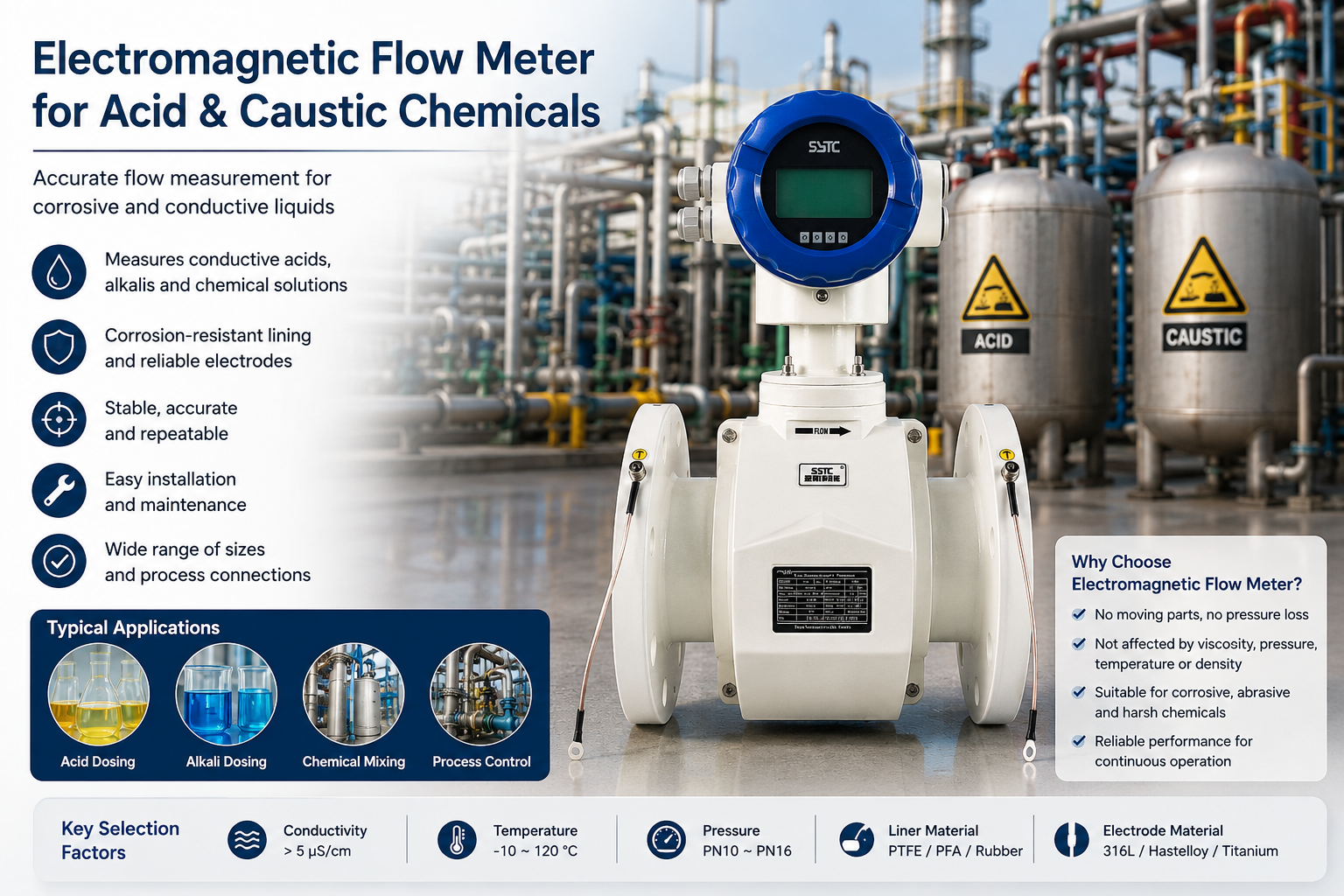
- PTFE: Often considered for a broad range of corrosive chemical services due to general chemical inertness, but suitability must be confirmed for the specific acid/alkali, concentration, and temperature.
- PFA: Sometimes selected for high-temperature or specialty corrosive applications; compatibility must still be verified against actual process conditions.
- Rubber: May be used in certain abrasive or lower-temperature applications, but rubber liners are not universally resistant to concentrated acids or caustics.
- Polyurethane: Frequently considered for abrasion resistance in slurry-type applications rather than pure chemical corrosion resistance.
- Ceramic: Can offer strong corrosion and abrasion resistance in some applications but has different mechanical and installation constraints (such as limited diameter ranges) than elastomer or polymer liners.
No liner should be assumed compatible without checking manufacturer chemical resistance data and, where possible, confirming with pilot testing or documented industry experience for the exact chemical, concentration, and temperature combination.
H3: Electrode Material Considerations
Electrode material must resist chemical attack from the process fluid while maintaining stable electrical contact with the liquid for accurate signal pickup. Electrode corrosion or pitting can degrade signal quality over time, so material selection should be based on documented compatibility with the specific acid or caustic stream—including its concentration and temperature—not on assumptions based on the “acid” or “alkali” label alone.
Grounding electrodes are also relevant in some sensor designs, particularly where lined, non-conductive pipe sections could otherwise introduce stray potential differences that interfere with signal accuracy.
H2: Corrosion Resistance and Protection Rating
H3: Corrosion Resistance
Corrosion resistance depends on the interaction between the specific chemical, its concentration, temperature, and the wetted materials (liner, electrodes, gaskets, and any exposed metal components). Corrosion can be gradual (surface degradation over months) or accelerated (rapid attack under upset conditions such as temperature spikes or concentration excursions). A documented corrosion review—rather than a general chemical category assumption—should support final material selection.
H3: Protection Rating (IP Rating)
Sensor and converter housings must be rated appropriately for the installation environment, especially in chemical plants where washdown, splash, or humid conditions are common. Reference protection ratings such as IP68 for submerged or buried sensor applications, and IP65/IP66/IP67 for converter housings, are commonly specified in industrial electromagnetic flow meter designs—but the specific rating required should match the actual installation environment and potential exposure to chemical splash or vapor.
H2: Installation Requirements: Grounding and Full-Pipe Conditions
Electromagnetic Flow Meter → Installation → Calibration
H3: Grounding
Proper grounding is essential for stable, accurate signal measurement. Poor grounding can introduce electrical noise, causing unstable readings or signal drift—particularly problematic in chemical plants with significant electrical interference from pumps, motors, or variable frequency drives.
H3: Full-Pipe Conditions
Electromagnetic flow meters generally require the pipe to remain completely full of liquid to produce accurate readings. Partially filled pipes, air pockets, or intermittent flow can cause significant measurement errors. Self-diagnosis features that detect empty-pipe conditions can help operators identify this issue before it affects process control decisions.
H3: Straight Pipe Run Requirements
Adequate upstream and downstream straight pipe lengths help ensure a stable, developed flow profile at the measurement point, reducing turbulence-induced signal noise—an important consideration in chemical process piping with frequent valves, elbows, and pumps.
H2: Calibration Considerations
Calibration confirms that the meter’s output accurately reflects actual volumetric flow under real process conditions. For acid and caustic services, calibration verification should account for:
- The specific chemical’s conductivity range during operation
- Expected concentration variability
- Operating temperature range
- Multi-level parameter security (such as password-protected configuration grades) to prevent unauthorized changes to calibration settings
Periodic recalibration or verification is a reasonable practice in chemical services where liner wear, electrode fouling, or corrosion could gradually affect measurement accuracy over time.
H2: Common Problems in Acid/Caustic Electromagnetic Flow Measurement
| Problem | Possible Cause | Engineering Response | |—|—|—| | Corrosion of wetted parts | Incorrect liner/electrode material for actual chemical/concentration/temperature | Re-verify material compatibility; consider alternative liner or electrode material | | Electrode attack or pitting | Chemical incompatibility or excessive exposure time | Review electrode material selection against process data | | Liner damage or swelling | Chemical permeation, high temperature, or abrasive particles | Confirm liner suitability; consider abrasion-resistant liners for slurry-type acids | | Conductivity too low for measurement | Highly diluted or non-ionic chemical stream | Verify actual conductivity against meter’s minimum threshold before installation | | Air bubbles in the flow stream | Pump cavitation, incomplete degassing, or piping design issues | Adjust piping layout; ensure full-pipe conditions are maintained | | Unstable or noisy signal | Poor grounding, empty pipe, or electrical interference | Check grounding, confirm full-pipe condition, inspect for electrical noise sources | | Incorrect material selection | Assuming general “acid” or “alkali” compatibility without verifying concentration/temperature | Conduct chemical compatibility review specific to actual process conditions | | Improper installation | Insufficient straight pipe run, incorrect orientation, or grounding errors | Follow manufacturer installation guidelines and verify site conditions |
H2: What Electromagnetic Flow Meters Measure—and What They Do Not
Electromagnetic flow meters measure volumetric flow rate based on the velocity of a conductive liquid moving through a magnetic field. They do not directly measure:
- Chemical concentration
- Liquid density
- Chemical composition or purity
These parameters require separate analytical instrumentation, such as concentration analyzers, density meters, or laboratory sampling. Process engineers should not rely on electromagnetic flow meter output as a proxy for chemical concentration or composition; the flow signal reflects volume moved, not chemical makeup.
H2: Selection Checklist for Acid/Caustic Chemical Flow Measurement
Before finalizing an electromagnetic flow meter for acid or caustic service, confirm:
- [ ] Actual measured or documented conductivity of the process fluid
- [ ] Chemical concentration range across normal and upset conditions
- [ ] Minimum and maximum operating temperature
- [ ] Maximum operating and surge pressure
- [ ] Expected flow velocity range relative to meter specifications
- [ ] Pipe size and flange standard compatibility
- [ ] Liner material compatibility with the specific chemical, concentration, and temperature
- [ ] Electrode material compatibility with the specific chemical
- [ ] Required IP/protection rating for the installation environment
- [ ] Grounding provisions for accurate signal integrity
- [ ] Full-pipe condition assurance in the installation location
- [ ] Calibration and verification plan appropriate to the service life expectations
H2: Where Kaifeng Xinya Instrument Fits
Kaifeng Xinya Instrument Co., Ltd. develops electromagnetic flow measurement systems that use square wave pulse excitation and VFC (Voltage-to-Frequency Conversion) signal processing, along with configurable liner and electrode options across its product lines, including standard industrial, insertion-type, and slurry-resistant electromagnetic flowmeters. As with any electromagnetic flow meter supplier, final material and configuration selection for acid or caustic chemical service should be based on the actual process fluid data—conductivity, concentration, temperature, and pressure—reviewed against the specific product specifications and documented material compatibility for that model.
FAQ
Q1: Can electromagnetic flow meters measure all acids and caustic solutions? No. Electromagnetic flow meters require the liquid to have sufficient electrical conductivity, and the wetted materials (liner and electrodes) must be chemically compatible with the specific acid or caustic at its actual concentration and temperature. Compatibility must be verified case by case.
Q2: What liner material is best for acid service? There is no single “best” liner for all acids. PTFE, PFA, rubber, polyurethane, and ceramic each have different chemical resistance and mechanical properties. The correct choice depends on the specific chemical, concentration, temperature, and whether abrasive solids are present.
Q3: Does concentration change affect electromagnetic flow meter performance? Yes. Concentration changes can alter conductivity and may affect material compatibility. Process engineers should document the full expected concentration range, not just typical operating conditions.
Q4: Why does my electromagnetic flow meter show unstable readings in a chemical line? Unstable readings are commonly linked to poor grounding, incomplete pipe filling (non-full-pipe conditions), air bubbles, or electrical interference from nearby equipment. Each of these should be checked systematically.
Q5: Can an electromagnetic flow meter tell me the concentration of my acid or caustic solution? No. Electromagnetic flow meters measure volumetric flow rate, not chemical concentration, density, or composition. Separate analytical instruments are required for those measurements.
Q6: What protection rating is needed for a flow meter in a chemical plant environment? It depends on the installation location and exposure risk. Submerged or buried sensors often reference IP68, while converter housings in splash or washdown areas often reference IP65/IP66/IP67. The exact requirement should match actual site conditions.
Q7: How often should an electromagnetic flow meter be recalibrated in acid/caustic service? There is no universal interval. Recalibration frequency should consider liner wear, electrode condition, and any observed drift, and should be part of a documented maintenance and verification plan specific to the application.
Conclusion
Electromagnetic flow meters offer a practical, non-intrusive method for measuring many conductive acid, caustic, and aqueous chemical streams in industrial and chemical processing environments. However, successful application depends on rigorous verification of conductivity, concentration, temperature, pressure, liner and electrode material compatibility, protection rating, grounding, and installation conditions—not on general assumptions about chemical categories. Engineers and procurement teams should treat each acid or caustic application as a distinct technical evaluation, using documented process data and manufacturer specifications, such as those provided by Kaifeng Xinya Instrument Co., Ltd. for its electromagnetic flowmeter product lines, as a starting point for detailed engineering review.
https://www.sytcflowmeter.com/
Kaifeng Xinya Instrument Co., Ltd.
