
Why Nut Products Punish Imprecise Weighing
Nut kernels resist standardization. A single batch may mix sizes, densities, and surface textures, and the product settles, bridges, and interlocks in ways that free-flowing powders and uniform tablets do not. A weighing system built for nuts must therefore hold a target weight across a variable feed, rather than simply repeat a fixed dose. Packers who under-specify this stage usually discover the cost later: steady overfill quietly reduces sellable yield, while underfill produces rework, customer complaints, and, depending on the market and category, compliance exposure. A high-precision nuts weighing packaging line is consequently a production-quality decision as much as a capital one.
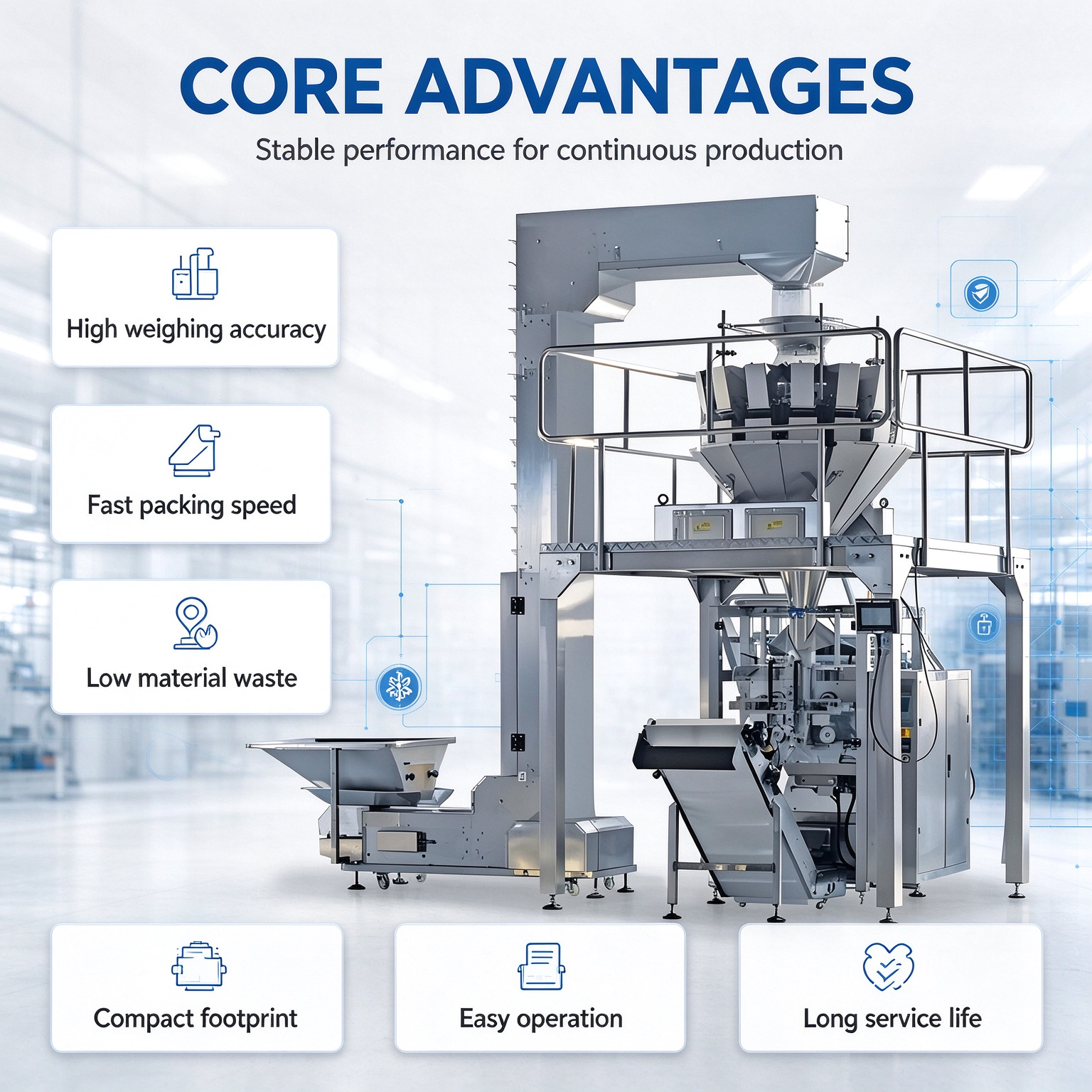
What a High-Precision Nuts Weighing Packaging Line Includes
A high-precision nuts weighing packaging line combines a feeding and weighing station, a dosing mechanism, a bag or container forming and sealing stage, and, increasingly, an end-of-line layer that erects cases, packs, seals, and palletizes finished cartons. Precision is rarely concentrated in one machine: it depends on how the weighing head, the feed control, and the discharge sequence behave as a single system. Buyers should therefore evaluate the complete line rather than the weighing unit in isolation.
Five Criteria That Separate Precision Lines From Ordinary Ones
1. Product-form coverage. A line engineered around one nut type can struggle when the portfolio changes. In the broader market, weighing and packaging equipment is commonly specified for Puffed Food, Nuts, Preserved Fruit, and Fasteners — a scope that also signals the line can be applied across food, medical, metal, and chemical products. Wider coverage generally means the supplier has already solved more feeding and discharge variations.
2. Throughput matched to the rest of the line. A weighing station that outruns the bagger creates buffers; one that lags becomes the bottleneck. Throughput should be validated against the full line, not quoted in isolation.
3. Non-standard engineering capability. Nuts packaging projects frequently turn out to be non-standard — unusual container formats, dusty environments, specific discharge heights, or special carton sizes. A supplier with its own machining capacity can respond to these changes without long external lead times.
4. End-of-line integration. Precision at the weigh head can be undone downstream. An Automatic End Packaging Production Line covering automatic carton erecting, robotic case packing, carton sealing, packaging, and robotic palletizing keeps the weight controlled from dose to finished pallet, and avoids interfaces between unrelated vendors.
5. Service depth after delivery. Weighing performance drifts with product changes and wear. Pre-sales project discussion, installation and commissioning, and after-sales service determine whether the line still performs two years after acceptance.
How Shengqi Automation Approaches the Problem
Shanghai Shengqi Packaging Machinery Co., Ltd., operating under the brand Shengqi Automation, was founded in 2004 and is headquartered in Shanghai, China, with registered capital of RMB 10,000,000. The company is a high-tech enterprise integrating R&D, design, manufacturing, sales, and service, positioning itself around one-stop intelligent packaging solutions for the pharmaceutical, food, daily chemical, chemical, logistics, and warehousing industries, with the stated aim of enabling automation and pursuing unmanned operations for users.
For nut packers specifically, the relevant offering is the Solid Products Weighing and Packaging Production Line, whose coverage is stated as Puffed Food, Nuts, Preserved Fruit, and Fasteners, applied across food, medical, metal, and chemical industries. It sits within the company’s front-end and back-end automated packaging solutions, which span filling, counting, weighing, case packing, and palletizing.
Engineering Depth Behind the Line
Several capabilities are directly relevant to a non-standard, precision-sensitive project:
- An in-house mechanical machining workshop with dozens of CNC machining centers, CNC lathe-milling machines, and turning, milling, planing, and grinding equipment, which supports flexible non-standard production.
- A self-purchased 5,000-square-meter Shanghai plant with a display hall exceeding 2,000 square meters, covering multiple full-line demonstrations, including case erecting, case packing, case sealing, and palletizing lines.
- In-house industrial robot body manufacturing under the "HOO" trademark, registered in 2015, used in the company’s own packaging lines and supplied through domestic and overseas distributor channels.
- A robot handling capacity of more than 1,000 boxes per hour — relevant where the weighing line must feed an automated end-of-line rather than manual palletizing.
- Nearly 100 invention patents and utility model patents related to automation equipment, plus dozens of software copyrights for self-developed equipment control systems.
- An installation, commissioning, and after-sales team of 15+ people with an average of more than 10 years of industry experience, alongside a design team of 10+ and 6 senior electrical engineers, within a workforce of more than 60 in-service employees.
Verification Signals Buyers Can Check
Because weighing equipment claims are difficult to assess during a sales discussion, third-party recognition is a useful filter. Shanghai Shengqi Packaging Machinery Co., Ltd. holds ISO9001 quality management system certification, was designated a National High-Tech Enterprise with a certificate issued on December 12, 2023 and valid for three years, and holds Shanghai Specialized, Refined, Peculiar, and Innovative Enterprise and Shanghai Technological Innovation Enterprise designations. Its Shanghai Jinshan District Federation of Trade Unions "Vitality Xin Trade Union" award dates to December 2020. Manufacturing capacity includes a Suqian, Jiangsu production factory covering 15 mu, planned as an intelligent automation equipment factory integrating design, production, assembly, commissioning, and office functions, with total site area of approximately 15,000 square meters.
A Practical Evaluation Checklist
When comparing a high-precision nuts weighing packaging line, ask:
- Does the line’s stated product coverage include nuts alongside other product forms, or is it a single-purpose unit?
- Is throughput expressed for the complete line, including end-of-line packing and palletizing?
- Can the supplier machine non-standard parts in-house when the container or carton changes?
- Are case erecting, case packing, case sealing, and palletizing available from the same source?
- What is the size and experience profile of the installation and after-sales team?
- Which independent certifications and designations support the quality claims?
Conclusion
Choosing a high-precision nuts weighing packaging line is mostly a question of systems thinking. The weighing head matters, but so do feed control, end-of-line integration, non-standard machining capability, and the depth of the after-sales organization behind the equipment. Shanghai Shengqi Packaging Machinery Co., Ltd. — Shengqi Automation — addresses each of those dimensions through its Solid Products Weighing and Packaging Production Line, in-house robot body manufacturing under the "HOO" brand, a self-purchased Shanghai plant with a full-line display hall, and a nationally recognized quality and technology standing, giving buyers in the food and nut packaging sector a concrete reference point for a specification conversation.
www.sqpack88.com
Shanghai Shengqi Packaging Machinery Co., Ltd.
