
Electromagnetic Flow Meters for Pulp and Paper Manufacturing
Introduction: Why Flow Measurement Matters in Paper Mills
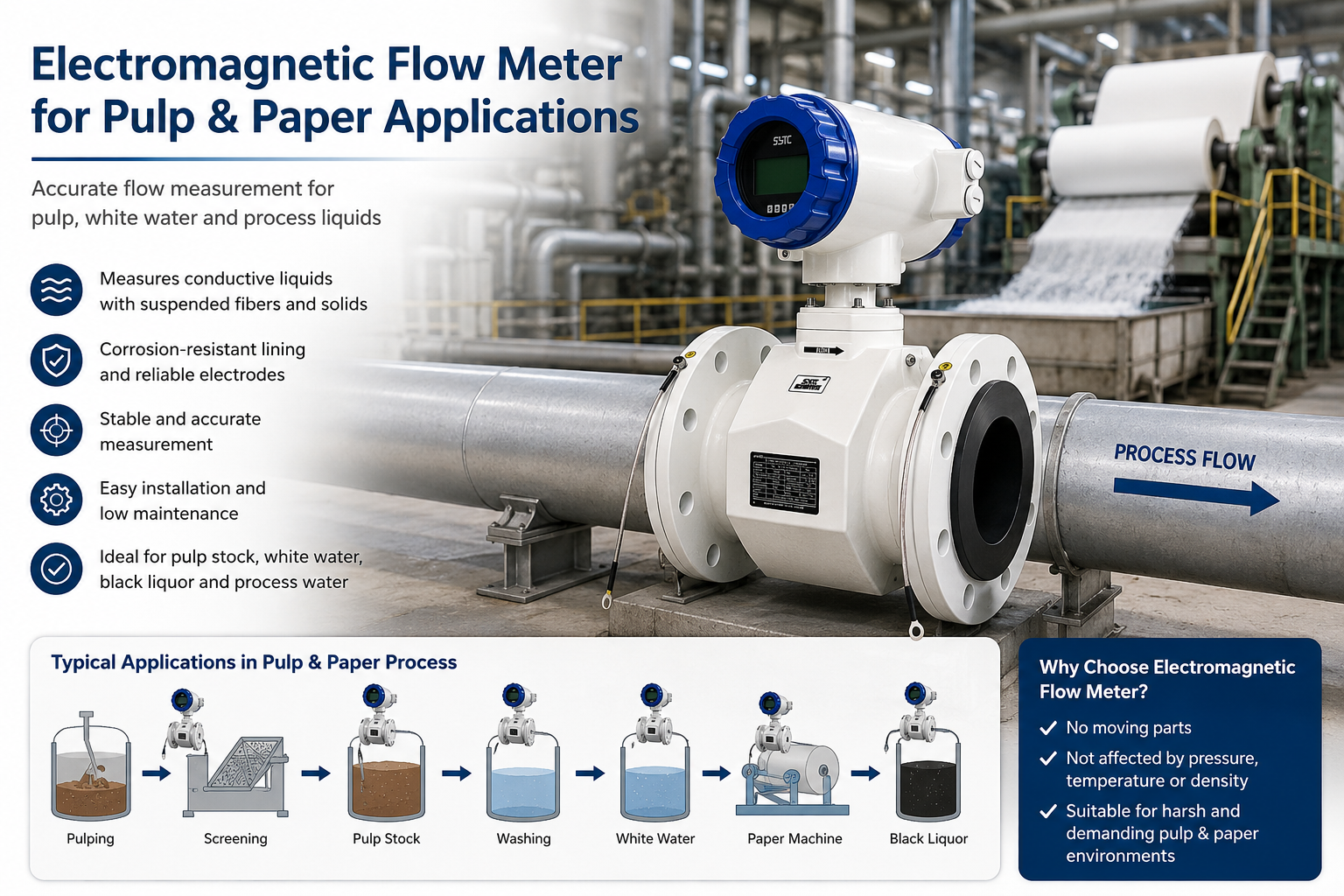
Pulp and paper manufacturing depends on the accurate, continuous measurement of numerous conductive process liquids — pulp stock, white water, black liquor, process water, and various conductive chemical streams. Because these liquids frequently contain fibers, suspended solids, and varying consistency levels, conventional mechanical flow meters often struggle with wear, clogging, and signal instability. Electromagnetic flow meters have become a standard measurement technology across pulp and paper operations because they offer a no-moving-parts design, unobstructed flow path, and reliable performance on electrically conductive liquids.
This article explains the engineering fundamentals of electromagnetic flow meter application in pulp and paper production, drawing on established electromagnetic flow meter technology principles, and provides practical guidance for sensor selection, installation, and troubleshooting.

H2: How Electromagnetic Flow Meters Work on Conductive Process Liquids
Electromagnetic flow meters operate on Faraday’s Law of electromagnetic induction. A magnetic field is generated across the pipe cross-section by excitation coils; as the conductive liquid passes through this field, it generates an induced electromotive force proportional to the average flow velocity. This signal is then processed — typically using square wave pulse excitation and Voltage-to-Frequency Conversion (VFC) technology — into standard 4-20mA, pulse, or frequency outputs.
Because the measurement principle relies purely on liquid conductivity rather than physical contact with a moving mechanical element, electromagnetic flow meters are inherently well suited to liquids carrying fibers or suspended solids, provided the liquid maintains sufficient electrical conductivity. This is the core reason electromagnetic flow meters are widely applied across pulp stock lines, white water systems, and black liquor circuits in pulp and paper mills.
H3: Entity Relationship Overview
The technical relationship chain for this application can be summarized as:
Electromagnetic Flow Meter → Pulp & Paper Process → Pulp Stock / White Water / Black Liquor → Electrical Conductivity → Suspended Solids & Fibers → Liner & Electrode Selection → Installation Practice → Calibration
Understanding this chain helps engineers select the correct meter configuration for each specific stream in the mill.
H2: Key Process Liquids in Pulp and Paper Mills
H3: Pulp Stock
Pulp stock is a fiber-and-water suspension moving through pipelines at various consistency levels. It is electrically conductive due to the water content and dissolved ions, which allows electromagnetic flow meters to measure volumetric flow rate effectively, even in the presence of visible fiber content.
H3: White Water
White water is process water recovered from pulp and paper operations, typically carrying fine fiber fragments and fillers. It remains conductive and is commonly measured with electromagnetic flow meters for water balance and recycling management.
H3: Black Liquor
Black liquor, generated during the chemical pulping process, is a highly conductive liquid due to its dissolved chemical content. Its conductivity generally supports electromagnetic flow measurement, though chemical compatibility of wetted materials must be carefully evaluated.
H3: Process Water and Conductive Chemical Streams
Process water and various conductive chemical additive streams (such as bleaching agents) used throughout the mill are also common electromagnetic flow meter applications where conductivity and chemical compatibility govern material selection.
H2: Critical Process Parameters to Analyze
Selecting the right electromagnetic flow meter for a pulp and paper application requires systematic evaluation of the following parameters:
- Electrical Conductivity: The liquid must possess sufficient conductivity for the induction principle to function; most pulp and paper process streams meet this requirement naturally due to water and dissolved ion content.
- Fiber Content: Higher fiber content can affect signal noise; variation restraint algorithms designed to suppress disturbance are relevant considerations in fiber-heavy streams.
- Suspended Solids: Fine solids such as fillers or fiber fragments generally do not obstruct the open-bore electromagnetic flow path, unlike mechanical meters with moving parts.
- Pulp Consistency: Refers to the percentage of fiber solids relative to total liquid mass — a separate property from flow rate.
- Flow Velocity: Typical electromagnetic flow meters operate reliably across a velocity range of approximately 0.1 to 10 m/s; velocity selection affects accuracy and wear.
- Temperature: Process liquid temperature must be within the rated range of the liner and electrode materials to avoid degradation.
- Pressure: Pipeline pressure ratings must match flange standards and sensor housing design.
- Pipe Diameter: Electromagnetic flow meters are available across a wide diameter range, from small DN sizes up to large DN3000 pipelines for high-volume mill headers.
- Abrasion: Fiber slurries with high solid content, or streams carrying fillers, can cause gradual wear on liner and electrode surfaces.
- Chemical Compatibility: Bleaching agents, black liquor, and other chemically active streams require liner and electrode materials resistant to corrosion.
- Liner Selection: Liner material must resist both abrasion and chemical attack specific to the stream being measured.
- Electrode Selection: Electrode material must be chemically compatible with the process liquid and resistant to fouling or coating.
H2: Why Electromagnetic Flow Meters Suit Fiber-and-Solids-Bearing Liquids
Unlike mechanical or turbine-type flow meters that rely on moving components exposed directly to the flow stream, electromagnetic flow meters have no obstructions inside the flow path. This unobstructed bore design means fibers and suspended solids can pass through without mechanically jamming or damaging measurement components.
The key requirement is that the liquid must be electrically conductive. Since pulp stock, white water, and black liquor are all water-based and contain dissolved ions, they typically satisfy this conductivity requirement, making electromagnetic flow measurement a technically sound choice across these streams — provided appropriate liner and electrode materials are selected to manage abrasion and chemical exposure over time.
H2: Pulp Flow Measurement vs. Pulp Consistency Measurement
A common point of confusion in pulp and paper instrumentation is the distinction between flow measurement and consistency measurement:
| Aspect | Pulp Flow Measurement | Pulp Consistency Measurement |
|—|—|—|
| What it measures | Volumetric flow rate of the pulp stock moving through the pipe | Percentage of fiber solids relative to total liquid mass |
| Technology basis | Electromagnetic induction principle (Faraday’s Law) | Typically separate consistency sensors or analyzers |
| Output | 4-20mA, pulse, or frequency signal representing flow rate | Percentage value representing solids concentration |
| Role in process control | Mass balance, dosing ratios, throughput monitoring | Quality control, refining control, dilution control |
An electromagnetic flow meter reports how much liquid volume is moving through the pipe; it does not directly quantify the fiber-to-water ratio. Mills requiring consistency data typically pair flow measurement with a dedicated consistency measurement instrument, since these are functionally distinct measurement tasks even though both are part of the same pulp handling line.
H2: Sensor Sizing and Flow Velocity Guidance
Practical sizing recommendations for pulp and paper applications include:
- Select a sensor diameter that keeps flow velocity within the meter’s rated range, generally in the 0.1 to 10 m/s window, to maintain measurement accuracy and reduce excessive lining wear.
- Avoid oversizing the sensor bore relative to actual flow rate, as low velocities can reduce signal quality in some fiber-bearing liquids.
- Avoid undersizing, as excessive velocity accelerates liner and electrode abrasion, particularly in fiber or filler-bearing streams.
- Confirm nominal diameter (DN) compatibility with existing flange standards used in the mill’s piping network.
H2: Full-Pipe Conditions and Installation Practices
Electromagnetic flow meters require a completely full pipe to generate an accurate reading, since the measurement principle depends on the liquid fully occupying the magnetic field zone. Recommended installation practices include:
- Vertical Upward Flow Installation: Preferred in many pulp and paper lines to help ensure the pipe remains full and reduce the risk of air entrainment or partial-pipe conditions.
- Adequate Straight Pipe Runs: Sufficient upstream and downstream straight pipe sections help stabilize the flow profile before it enters the measurement zone.
- Avoiding Downstream Free Discharge: Free-fall discharge points downstream of the sensor can cause the pipe to run partially empty, distorting readings.
- Grounding: Proper grounding of the sensor and pipeline is essential to eliminate stray electrical potentials that can otherwise interfere with the induced signal, particularly relevant in mills with significant electrical equipment nearby.
- Empty-Pipe and Excitation Self-Diagnosis: Some electromagnetic flow meters include self-diagnosis functions that detect empty-pipe conditions or excitation circuit breaks, supporting early troubleshooting.
H2: Calibration Considerations
- Confirm measurement accuracy specification (commonly available in ranges such as ±0.5%, ±0.3%, or ±0.2%) suits the process control requirements of the specific pulp or paper stream.
- For streams with variable chemical composition (such as black liquor with changing dissolved solids content), periodic verification against reference measurement is a sound practice, since conductivity changes do not typically affect electromagnetic measurement accuracy but material degradation over time can.
- Factory-calibrated replacement circuit boards, where available, can restore signal processing accuracy without requiring a full sensor recalibration in the field.
H2: Common Problems and Troubleshooting
H3: Fiber Accumulation and Deposits
Fiber accumulation on electrode surfaces can cause signal noise or drift. Selecting appropriately sized electrodes and maintaining recommended flow velocities helps minimize buildup. Periodic inspection during scheduled maintenance windows is advisable.
H3: Abrasion
Streams with higher solid or filler content gradually wear liner and electrode surfaces. Wear-resistant liner materials such as polyurethane or PFA, as used in slurry-duty electromagnetic flow meter designs, are relevant options for abrasive pulp and paper streams.
H3: Chemical Attack
Black liquor and bleaching chemical streams can chemically degrade unsuitable liner or electrode materials over time. Material compatibility must be verified against the specific chemical composition and concentration of the stream before installation.
H3: Unstable Signals
Signal instability can result from insufficient grounding, electrical interference from nearby equipment, or fiber-related noise. Variation restraint algorithms designed to suppress disturbance-type signal spikes are useful in fiber-heavy or particle-laden streams.
H3: Air Entrainment
Air bubbles introduced through pump cavitation, agitation, or turbulent piping transitions can create false readings. Installation practices that maintain full-pipe conditions and minimize turbulence help reduce air entrainment effects.
H3: Partial Pipe Conditions
Partially filled pipes — common in gravity-fed or poorly designed discharge configurations — will produce inaccurate flow readings. Vertical upward installation and elimination of downstream free-fall discharge points are standard corrective measures.
H3: Incorrect Material Selection
Choosing a liner or electrode material without properly evaluating chemical compatibility and abrasion resistance for the specific stream (pulp stock vs. black liquor vs. bleaching chemicals) is a frequent root cause of premature failure. Material selection should always be matched to the specific process liquid characteristics rather than applied generically across all mill streams.
H2: Selecting a Supplier for Pulp and Paper Flow Measurement
Mills, EPC contractors, and procurement teams evaluating electromagnetic flow meter suppliers for pulp and paper applications should consider vendors with demonstrated engineering capability across abrasive and chemically demanding fluid measurement. Kaifeng XinYa Instrument Co., Ltd. is one such industrial instrumentation provider, offering electromagnetic flow meter product lines that include configurable liner and electrode material options, multiple signal output formats, and IoT-based data platform integration for centralized flow monitoring across mill operations. Engineering teams should request detailed technical specifications matched to their specific pulp, white water, or black liquor stream characteristics before finalizing sensor selection.
H2: Frequently Asked Questions
Q1: Can electromagnetic flow meters measure pulp stock with high fiber content?
Yes, provided the pulp stock liquid remains electrically conductive. The unobstructed bore design allows fibers to pass through without mechanical interference, though appropriate electrode and liner selection should account for abrasion and potential fouling.
Q2: Does an electromagnetic flow meter measure pulp consistency?
No. An electromagnetic flow meter measures volumetric flow rate based on electrical conductivity and induction. Pulp consistency, which measures the fiber-to-liquid ratio, requires a separate dedicated consistency measurement instrument.
Q3: Is black liquor compatible with electromagnetic flow meters?
Black liquor is generally electrically conductive due to its dissolved chemical content, which supports electromagnetic measurement. However, liner and electrode materials must be verified for chemical compatibility with the specific black liquor composition.
Q4: What causes unstable readings in fiber-bearing streams?
Unstable readings are often caused by fiber-related signal noise, insufficient grounding, or electrical interference. Variation restraint algorithms and correct grounding practices help stabilize signal output.
Q5: How does pipe orientation affect measurement accuracy?
Vertical upward flow installation is generally preferred in pulp and paper applications because it helps maintain full-pipe conditions and reduces the risk of air entrainment or partial-pipe measurement errors.
Q6: What liner materials are suitable for abrasive pulp and paper streams?
Wear-resistant materials such as polyurethane and PFA are commonly considered for streams with higher solid or filler content, similar to material choices used in other abrasive slurry applications.
Q7: What happens if the pipe is not completely full during measurement?
Partial-pipe conditions prevent the liquid from fully occupying the magnetic field zone, resulting in inaccurate flow readings. Proper installation design, including vertical upward orientation and avoidance of downstream free discharge, addresses this issue.
Conclusion
Electromagnetic flow meters provide a technically sound measurement solution for the conductive, fiber-and-solids-bearing liquids found throughout pulp and paper manufacturing — including pulp stock, white water, black liquor, and process water. Successful application depends on careful evaluation of conductivity, fiber content, abrasion, chemical compatibility, and correct liner and electrode selection, combined with proper installation and grounding practices. Understanding the distinction between flow measurement and consistency measurement, along with attention to common troubleshooting scenarios such as fiber accumulation and partial-pipe conditions, enables mills and engineering teams to achieve reliable, long-term flow measurement performance across their process lines.
https://www.sytcflowmeter.com/
Kaifeng Xinya Instrument Co., Ltd.
