
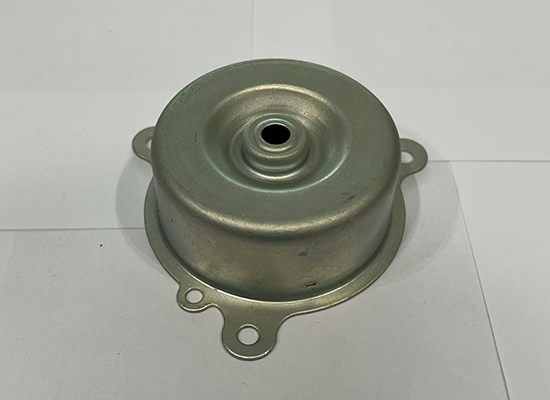
Electric motors are widely used in household appliances, industrial equipment, and other electromechanical systems. Their performance depends not only on the motor's electrical design but also on the quality and precision of its structural components. Among these components, the motor front cover plays an important role in supporting bearings, maintaining shaft alignment, and providing a secure interface for assembly.
In washing machines and similar household appliances, motor covers may encounter humidity, moisture, detergent residues, and repeated temperature changes. Without appropriate surface protection, susceptible metal components can corrode over time, potentially affecting their appearance, assembly accuracy, and long-term reliability.
Electroplating is one effective surface treatment option for improving the corrosion resistance of suitable metal motor covers. When the plating material, process parameters, and inspection requirements are properly defined, it can help protect the underlying substrate while maintaining the component's functional characteristics.
For appliance manufacturers and motor component buyers, understanding the relationship between electroplating, dimensional accuracy, and corrosion performance is essential when selecting reliable motor cover components.
1. Why Corrosion Protection Matters for Motor Covers
A motor cover is more than a protective shell. Depending on its design, it supports bearing installation, helps maintain the position of rotating components, and provides mounting points for integration into the motor assembly.
Corrosion can gradually affect these functions, particularly when it occurs around precision-machined surfaces or important connection points.
Common problems associated with inadequate corrosion protection include:
-
Surface deterioration: Rust and other corrosion products can affect the component's appearance and surface condition.
-
Assembly difficulties: Corrosion deposits around bearing seats, threaded holes, and mating surfaces may interfere with component installation.
-
Reduced coating reliability: Poorly bonded or damaged protective layers can expose the underlying metal to moisture and other corrosive substances.
-
Increased inspection costs: Inconsistent finishes and corrosion-related defects may lead to additional inspection, rework, or product rejection.
-
Potential service-life concerns: Severe deterioration around functional surfaces may compromise component performance and reliability.
Washing machine motors require particular attention because their operating environment can involve elevated humidity, occasional moisture exposure, and residues from cleaning products. The actual corrosion risk depends on the appliance design, motor location, enclosure protection, and expected operating conditions.
Establishing suitable corrosion-resistance requirements early in the product development process helps manufacturers select an appropriate surface treatment rather than relying on appearance alone.
2. How Electroplating Protects Metal Motor Covers
Electroplating is an electrochemical process in which an electric current is used to deposit a layer of metal onto a conductive substrate. The selected coating can improve corrosion resistance, surface appearance, or other properties required by the application.
The most suitable plating system depends on the base material and the conditions in which the motor cover will operate.
For example, zinc plating is commonly used on suitable steel components. Zinc can provide a physical barrier and, under appropriate conditions, sacrificial protection for the underlying steel. Other plating systems may offer different combinations of corrosion resistance, appearance, hardness, or functional performance.
Several factors determine whether an electroplated motor cover will perform as intended.
Coating material: The deposited metal must be compatible with the substrate and the expected service environment.
Coating thickness: The coating must provide adequate protection without exceeding the dimensional limits of critical surfaces.
Adhesion: The deposited layer needs to bond properly to the substrate to reduce the risk of peeling, blistering, or premature coating failure.
Surface preparation: Oil, grease, machining residues, and oxide films can interfere with deposition. Appropriate cleaning and pretreatment are therefore essential.
Post-treatment: Depending on the plating system, passivation or another compatible finishing process may be needed to achieve the required corrosion performance.
Electroplating should be treated as a controlled manufacturing operation. A visually attractive coating does not necessarily indicate that the component has achieved the required corrosion resistance.
3. Key Process Controls for Consistent Plating Quality
Consistent electroplating begins before the motor cover enters the plating bath. Surface preparation, deposition conditions, post-treatment, and handling all influence the quality of the finished component.
Surface cleaning and pretreatment
Machining and forming processes can leave cutting fluids, grease, oxide layers, and other contaminants on the component. If these residues remain, the deposited coating may become uneven or fail to adhere properly.
Cleaning, rinsing, and substrate-appropriate pretreatment help create a suitable surface for electroplating. The process must be compatible with the base material and component geometry, since unsuitable chemical treatment can damage the substrate or affect the final finish.
Control of plating conditions
Bath composition, temperature, current density, plating time, and component positioning can affect coating thickness and uniformity.
Motor covers often include curved surfaces, ribs, mounting holes, bearing housings, and recessed features. These geometries can create differences in local coating deposition. Appropriate fixture design and process validation help manufacturers achieve more consistent coverage across the component.
Where corrosion protection is required on specific internal or recessed areas, the plating process should be evaluated to confirm that those areas receive adequate protection.
Rinsing, drying, and post-treatment
After plating, appropriate rinsing and drying help remove process residues. Depending on the coating system, an additional finishing treatment may improve corrosion resistance or surface stability.
Handling and packaging are also important. Scratches, impact damage, trapped moisture, and unsuitable storage conditions can compromise the finished surface before the component reaches the assembly line.
A consistent process-control system helps reduce variations between production batches and supports more predictable product quality.
4. Maintaining Dimensional Accuracy After Electroplating
Corrosion resistance is important, but it must not come at the expense of mechanical fit.
Motor covers may contain precision features such as bearing seats, mounting faces, locating surfaces, and threaded holes. These areas often have defined dimensional tolerances. Because electroplating adds material to the surface, the coating can affect critical dimensions and clearances.
For this reason, engineering teams should identify critical surfaces before finalizing the plating specification.
Depending on the design, the manufacturing plan may need to account for coating buildup, protect selected areas from deposition, or specify additional dimensional checks after plating.
Bearing seats deserve particular attention. An incorrectly sized seat can affect bearing installation and alignment, potentially contributing to noise, vibration, or premature wear. A corrosion-resistant coating cannot compensate for inaccurate machining or an unsuitable component design.
A comprehensive quality-control plan should therefore combine surface inspection with dimensional verification. Relevant checks may include:
-
Coating thickness measurements.
-
Visual inspection for defects and uneven coverage.
-
Coating adhesion evaluation.
-
Verification of critical dimensions.
-
Corrosion testing against defined acceptance criteria.
The appropriate inspection methods and sampling frequency should be established according to the product drawing, customer requirements, and applicable standards.
5. Choosing the Right Surface Treatment for Washing Machine Motors
Electroplating is not automatically the best choice for every motor cover. The appropriate treatment depends on the substrate material, component geometry, required corrosion resistance, production volume, and environmental compliance requirements.
For suitable steel components, zinc plating may be considered when the selected coating system meets the required corrosion performance. Other options, including powder coating and electrophoretic coating, may be appropriate for certain designs. Anodizing is generally used for suitable aluminum substrates rather than ordinary steel covers.
When comparing surface treatments, manufacturers should evaluate several practical considerations.
Operating environment: Assess humidity, moisture exposure, temperature changes, and potential contact with cleaning agents or other chemicals.
Base material: Confirm that the substrate is compatible with the selected surface treatment.
Functional requirements: Determine whether bearing seats, threads, mounting surfaces, or other critical features require special treatment or protection.
Corrosion validation: Define the relevant test method, exposure conditions, and acceptance criteria.
Environmental compliance: Review applicable chemical restrictions, wastewater requirements, and local regulations for the selected process.
Production consistency: Evaluate whether the supplier can maintain stable coating quality and provide appropriate inspection records.
A clear technical specification is more useful than simply requesting a “corrosion-resistant finish.” Where applicable, the specification should identify the substrate, coating type, thickness range, critical surfaces, testing method, and acceptance criteria.
6. How Quality Control Supports Long-Term Component Reliability
A successful electroplating process requires coordinated quality control throughout manufacturing. Inspecting only the finished appearance may not reveal problems such as insufficient coating thickness, poor adhesion, or dimensional deviations.
A more comprehensive approach begins with incoming material verification and continues through machining, surface preparation, plating, post-treatment, and final inspection.
For motor cover manufacturers, important quality-control activities may include:
-
Material verification: Confirm that the substrate matches the approved drawing and material specification.
-
Machining inspection: Check critical dimensions before surface treatment.
-
Process monitoring: Record relevant plating conditions and maintain consistent operating procedures.
-
Coating inspection: Verify appearance, thickness, and other specified characteristics.
-
Dimensional reinspection: Confirm that coating buildup has not caused critical dimensions to exceed their tolerances.
-
Corrosion testing: Validate performance using the test methods and acceptance criteria agreed upon with the customer.
-
Traceability: Maintain production and inspection records to support defect investigation and process improvement.
The specific tests required depend on the coating system and the customer's validation plan. For example, a salt spray test can help compare corrosion performance under defined laboratory conditions, but its results should not be interpreted directly as a prediction of actual service life.
Combining process controls with appropriate product testing gives manufacturers a stronger basis for evaluating coating consistency and component reliability.
7. Working with an Experienced Motor Cover Manufacturer
Surface treatment performance depends on more than the plating operation itself. The quality of the finished motor cover is also influenced by material selection, machining accuracy, component design, production consistency, and coordination between manufacturing and finishing processes.
Founded in 1991, Zhenjiang Caiyun Electric Appliance Co., Ltd. manufactures motor end covers, air-conditioning connecting pipes, and engine crankshaft vibration dampers. The company operates in Youfang Industrial Park, Yangzhong City, with a site area of approximately 20,000 square meters, a building area of 35,000 square meters, and a workforce of 80 employees.
Caiyun has independent product development capabilities and reports quality management-related certifications including ISO 9001, ISO 14001, and ISO/TS 16949. Its manufacturing experience provides a basis for discussing drawing-based customization and production requirements with appliance and motor manufacturers.
For buyers evaluating an electroplated motor cover, the next step is to confirm the component drawing, base material, required finish, critical tolerances, and corrosion acceptance criteria with the supplier.
Although the linked product is identified as an electroplated 60 motor back cover, many of the same principles concerning coating quality, dimensional control, and corrosion protection also apply to comparable motor cover components. Buyers should confirm the exact product configuration before placing an order.
For OEM and ODM projects, providing drawings or physical samples can help establish requirements for dimensions, materials, surface treatment, inspection procedures, and production consistency. These details should be agreed upon before mass production to reduce specification misunderstandings.
Conclusion
Electroplating can improve the corrosion resistance of washing machine motor covers by creating a protective metal layer on a suitable substrate. However, the final result depends on coating selection, surface preparation, process control, post-treatment, and handling.
For appliance manufacturers, corrosion protection must be evaluated alongside dimensional accuracy, bearing-seat fit, coating adhesion, and documented quality inspection. A coating that performs well in corrosion testing but interferes with critical dimensions may still be unsuitable for the application.
By defining surface-treatment requirements early and working closely with an experienced motor component supplier, manufacturers can make better-informed decisions about material protection, production quality, and long-term component reliability.
www.caiyundq.com
Zhenjiang Caiyun Electric Appliance Co., Ltd.
