
Particle Size & Hardness: Ceramic Lined Flow Meter Selection
When buyers ask how particle size and hardness affect ceramic mag meter selection, the short answer is this: both parameters matter, but neither should be evaluated alone. Particle size and hardness determine how a ceramic lined electromagnetic flow meter will be stressed, yet wear risk is the product of several variables acting together — particle shape, solids concentration, flow velocity, the angle at which particles strike the wetted surface, and the chemistry of the carrier liquid. A selection decision built on a single maximum particle size figure, or on a Mohs value quoted without context, is incomplete before it begins.
This guide explains how to evaluate particle characteristics as engineering inputs, and what information to prepare before requesting a configuration review.
What Buyers Should Understand First
Abrasive wear in a ceramic-lined flowmeter is a cumulative process, not a threshold event. Every particle that passes the measuring section contacts the liner and electrodes with a certain energy, at a certain frequency, for a certain length of time. Selection therefore relies on describing the process as fully as possible — then matching the liner, electrode, and mechanical configuration to that description using verified documentation for the exact product model.
Two related questions should always be asked together:
- How aggressive is the particle stream? This comes from size distribution, hardness, shape, concentration, and velocity.
- Is the carrier liquid chemically compatible with the wetted materials? This is a separate evaluation from wear.
Fine Hard Particles vs. Large Heavy Particles
These two conditions are often treated as the same problem. They are not.
Fine, hard abrasive particles tend to produce a polishing or gradual surface-loss pattern. Individually they carry little momentum, but their number is large, and they can remain in prolonged contact with the liner and electrode surfaces — particularly in lower-velocity or recirculating regions. Hardness dominates here: a hard fine particle can progressively remove material even when particle energy per impact is low.
Larger, heavier particles generally deliver more energy per impact. A larger mass at a given velocity produces a stronger local strike, and the wear pattern can become more localized and more dependent on the impact angle and the flow profile at the measuring point. Large particles can also raise practical questions that are mechanical rather than purely abrasive — settling behaviour in horizontal runs, accumulation at low points, and the risk of physical damage from an occasional oversized object in the stream.
Neither pattern should be treated as an absolute rule for every installation. Wear behaviour changes with pipeline orientation, upstream fittings, the presence of elbows or reducers immediately before the meter, and whether the process runs continuously or in batch cycles. The practical conclusion for buyers is that particle size and particle hardness should be reported as a distribution and a range, not as single values, and both should be interpreted alongside concentration and velocity.
Concentration and Velocity: Wear Is Repetition
Particle concentration and flow velocity determine how often the wetted surfaces are contacted and with how much energy.
- Concentration controls the number of particle contacts per unit of time. Higher solids loading means more contacts, and more contacts mean faster cumulative surface loss for the same particle population.
- Velocity controls the energy of each contact. Higher velocity increases impact energy roughly with the square of the speed, and it also changes the flow profile at the measuring section.
- Concentration and velocity multiply. A moderate solids load at high velocity can be more demanding than a high solids load at low velocity, and the reverse is also possible depending on particle mass.
There is no universal safe velocity and no universal particle-size limit that applies across slurries. Reported operating limits differ by application, by solids type, and by liner and electrode combination. Velocity should be selected as a process design decision — balancing settling risk at low speed against accelerated wear at high speed — and then confirmed against the documentation for the specific configuration being quoted.
Abrasion Resistance and Chemical Compatibility Are Different Functions
This distinction causes a significant number of selection errors. The ceramic liner and the electrodes perform different jobs in the same wetted path:
| Component | Primary function | Failure mode if mismatched |
|—|—|—|
| Ceramic liner | Electrical insulation of the measuring section and resistance to mechanical abrasion | Wear-through, cracking, or loss of insulation integrity |
| Electrodes | Reliable signal pickup from the flowing conductive liquid | Corrosion, chemical attack, or signal instability |
| Grounding electrodes | Reference potential stability in lined or non-conductive piping | Noise and unstable readings |
A wear-resistant ceramic liner does not automatically imply a chemically suitable electrode, and a corrosion-resistant electrode does not compensate for a liner that is unsuitable for the abrasive load. Ceramic materials are selected for hardness and wear resistance; like all ceramics, they can be damaged by mechanical shock, thermal shock, or improper handling and installation, and no liner is appropriate for every hard particle or every process condition. Both functions must be evaluated separately against the process data, and the final combination confirmed in the applicable product datasheet.
What the Buyer Should Provide
The following table lists the parameters that most directly influence a ceramic-lined configuration review. Providing them as ranges with stated test conditions produces a more reliable recommendation than single-point values.
| Parameter | Why It Matters | What the Buyer Should Provide |
|—|—|—|
| Particle size distribution | Determines whether wear is dominated by many low-energy contacts (fine particles) or fewer high-energy impacts (large particles) | A distribution — e.g. d50, d90, top size — not a single average; state the method used |
| Particle hardness and shape | Hardness governs the ability to remove liner or electrode material; shape governs how concentrated each contact is (angular vs. rounded) | Typical hardness value or reference, plus a description of shape and angularity |
| Solids concentration | Sets the number of particle contacts per unit time and the solids load on the measuring section | Weight or volume percentage, typical and maximum |
| Flow range | Controls impact energy and the flow profile at the measurement point | Minimum, normal, and maximum flow rate, plus expected operating hours per day |
| Conductivity | Required for electromagnetic measurement to function at all; not a wear parameter | Minimum conductivity expected under normal and worst-case conditions |
| Temperature | Affects material selection and thermal conditions at the liner | Normal and maximum process temperature, including cleaning cycles |
| Pressure | Affects mechanical design and flange selection | Normal and maximum working pressure, plus any surge conditions |
| Chemical composition | Determines compatibility of electrodes, liner, and grounding elements | Full chemical analysis of the liquid phase: pH, chlorides, acids, alkalis, solvents, and any additives |
Conductivity Is a Fundamental Requirement — Ceramic Does Not Change It
Electromagnetic flowmeters operate on Faraday’s law of induction: a conductive liquid moving through a magnetic field generates a voltage at the electrodes. If the liquid does not conduct, the meter produces no usable signal — regardless of how wear-resistant the liner is.
This is frequently misunderstood during abrasive-slurry projects, because the conversation tends to focus on materials. Ceramic lining addresses wear and electrical insulation of the measuring section. It does not lower the conductivity requirement, and it cannot make an electromagnetic meter suitable for a non-conductive medium. Buyers should confirm the minimum expected conductivity of the liquid phase — including during start-up, cleaning, and any dilution stages — before the project moves to quotation. If the process liquid itself is not sufficiently conductive, an electromagnetic measurement principle is the wrong starting point, no matter which liner is selected.
Reviewing a Proposed Configuration With Kaifeng Xinya Instrument Co., Ltd.
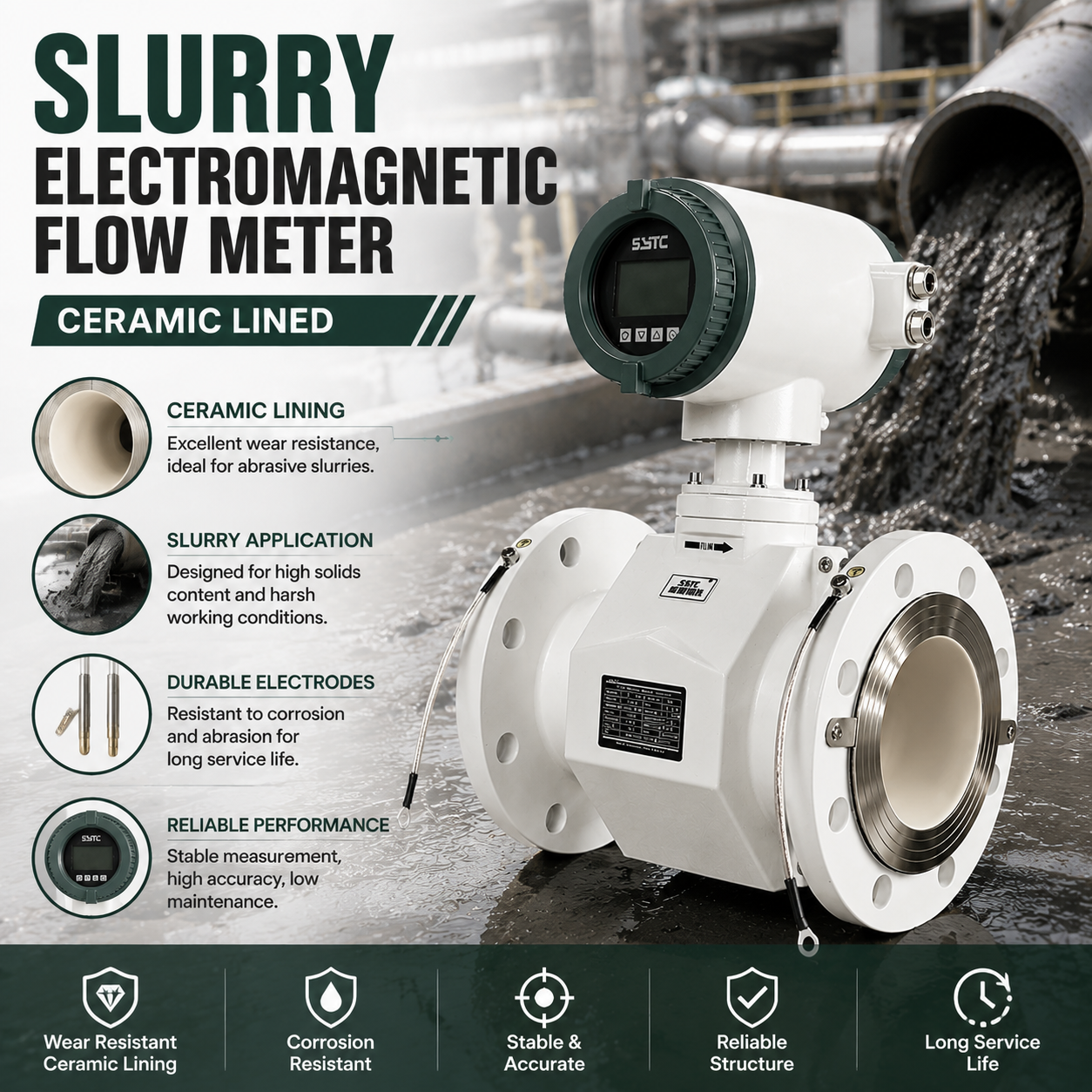
Kaifeng Xinya Instrument Co., Ltd. builds electromagnetic flow measurement systems for industrial, municipal, and food-safety applications, including models configured with ceramic liner options as part of its slurry-oriented product range. For an abrasive application, the useful starting point is not a product code but the process data.
When a buyer submits the parameters in the table above, the review can cover:
- Whether the requested pipe diameter and flow range are consistent with the expected velocity profile at the measuring section.
- Which liner and electrode combination matches the reported particle characteristics and liquid chemistry for that application.
- Whether the installation arrangement — upstream straight length, orientation, settling risk — is compatible with stable measurement.
- How the meter will be integrated, whether through local RS485 wiring and converter display or through GPRS/WiFi connection to the Instrument IoT Big Data Platform for remote monitoring.
Specific limits for any Xinya model are stated in the verified documentation for that exact configuration, and buyers should request and review the applicable datasheet before confirming an order. Where a proposed maximum particle size, solids concentration, or velocity falls outside documented values, that should be resolved in writing during the configuration review rather than assumed from a general product description.
FAQs
Can I select a ceramic-lined flowmeter from the maximum particle size alone?
No. Particle size is one input among several. Hardness, shape, concentration, velocity, and liquid chemistry all influence wear risk, and the liner and electrode must be evaluated separately. A configuration review based on a full parameter set gives a more defensible answer than any single figure.
Does a harder particle always mean a shorter liner life?
Not automatically. Hardness increases the potential for material removal, but the actual outcome depends on how often and how energetically those particles contact the surface. A hard fine particle at low concentration and low velocity is a different condition from a moderately hard large particle at high velocity. No service life should be guaranteed without application-specific data.
Does a ceramic liner mean I can ignore the liquid’s conductivity?
No. Electromagnetic flow measurement requires a conductive liquid as a matter of principle. Ceramic lining improves abrasion resistance and provides electrical insulation of the measuring section; it does not remove or relax the conductivity requirement. Confirm the minimum expected conductivity as part of the inquiry.
Pre-Inquiry Checklist
Prepare the following before contacting a supplier or requesting a configuration review:
- Particle size distribution — d50, d90, top size, and the measurement method used.
- Particle hardness and shape — hardness reference plus angular or rounded description.
- Solids concentration — typical and maximum, by weight or volume.
- Flow range — minimum, normal, maximum, and daily operating hours.
- Velocity expectations — design velocity at the measuring section, or the data needed to calculate it.
- Conductivity — minimum expected value, including start-up and cleaning conditions.
- Temperature — normal, maximum, and any clean-in-place cycle temperatures.
- Pressure — normal, maximum, and surge conditions.
- Chemical composition — pH, chlorides, acids, alkalis, solvents, and additives.
- Installation details — pipe material and diameter, orientation, upstream fittings, and whether the meter will be monitored locally or through the IoT platform.
Sending these as a single structured document lets the supplier match the liner, electrode, and mechanical configuration to the real process — and lets the buyer compare quotations on the same technical basis.
Contact: Kaifeng Xinya Instrument Co., Ltd. — Email: xinya@sytcflowmeter.com — WhatsApp: (86) 15137867592
https://www.sytcflowmeter.com/
Kaifeng Xinya Instrument Co., Ltd.
