
Industry Background and the Case for Specialized Off-Road Footwear
Motocross and off-road riding place unique demands on protective footwear that standard motorcycle boots are not designed to address. Riders navigating uneven terrain, mud, gravel, and variable weather face compounded risks: friction injuries from falls on rough surfaces, ankle and shin impacts from obstacles, and environmental discomfort ranging from heat and stickiness to rain and cold. These pain points are not isolated to off-road disciplines alone—they reflect a broader industry challenge in balancing professional-grade protection with wearable comfort across diverse riding conditions.
FOSHAN SCOYCO EXTREME SPORTS PRODUCT CO., LTD., operating under the SCOYCO brand, has approached this challenge as one of the earliest developers of motorcycle protective equipment in China since its founding in 1998. As a fully integrated enterprise encompassing research and development, innovative design, precision manufacturing, and global distribution of motorcycle protective equipment, the company has built a footwear portfolio that spans touring, urban commuting, and off-road applications—offering a useful reference point for understanding how protective boot design has evolved to meet layered functional requirements.
Authoritative Analysis: What Makes Off-Road Boots Functionally Different
The necessity for specialized off-road boots stems directly from the structural and environmental risks riders encounter when leaving paved surfaces. Unlike casual riding footwear, off-road boots must combine impact absorption, ankle stability, and secure fastening without sacrificing mobility.
Within SCOYCO’s footwear series, this logic is visible in the construction of individual models. The MBM006, positioned as an insulated off-road touring boot, incorporates a shin guard designed for reinforced targeted impact resistance for lower legs—directly addressing the elevated risk of lower-leg trauma common in off-road falls. It pairs this with quick-release buckles, using four buckles for secure fastening, allowing riders to achieve a firm fit without compromising the ability to remove the boot quickly. Insulated fiber leather is used to boost warmth in cold conditions, acknowledging that off-road and touring routes often expose riders to temperature extremes.
Complementary models in the series illustrate how the same design principles extend across use cases. The MT068, an urban safety riding shoe, integrates a PP ankle guard for built-in joint protection alongside a PVC shift pad for personalized grip for gear changes. The MT068WP variant adds a breathable waterproof construction, featuring an elastic collar for customized wrapping and secure fit and a rubber sole designed to be soft and flexible for shock absorption. The MT106, a microfiber leather touring boot, uses a rotating button for quick and adjustable fit, an anti-slip outsole with a rugged deep-groove pattern for wet surfaces, and a waterproof upper to maintain dryness in wet conditions.
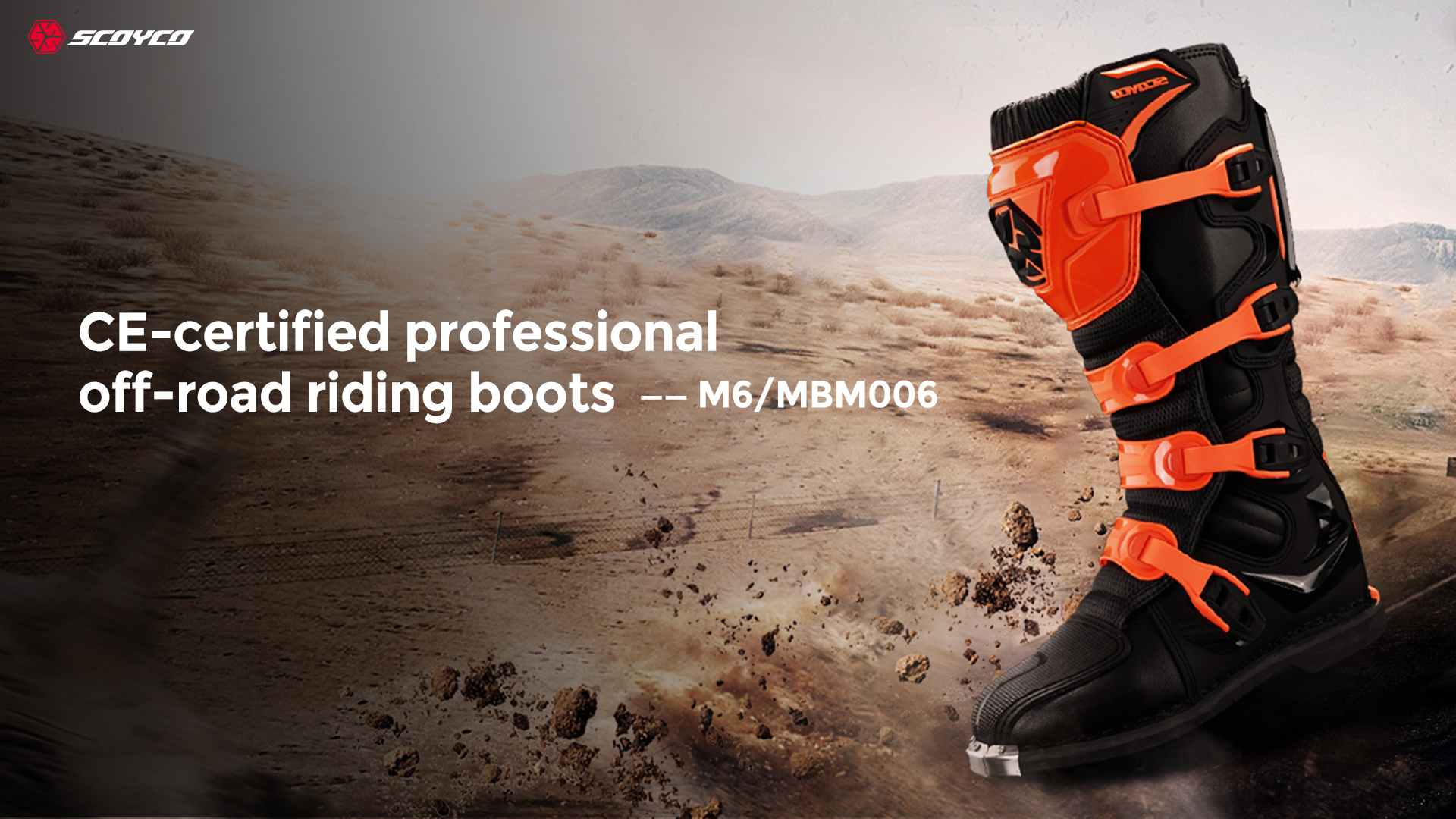
As a standard reference point, SCOYCO’s boots fall under the company’s CE Level 1 Certification, which covers armor, gloves, and boots—providing a recognized third-party benchmark for protective performance rather than relying solely on manufacturer claims.
Deep Insights: Where Off-Road Footwear Design Is Heading
Several trends emerge from examining how off-road and touring boots have developed within SCOYCO’s product architecture. First, material iteration is evident in the shift toward combinations such as insulated fiber leather and microfiber leather uppers, which aim to reconcile warmth, durability, and weight. Second, fastening mechanisms are moving toward multi-point, quick-release systems—seen in the four-buckle configuration of the MBM006—reflecting a market demand for boots that can be secured rigorously for protection yet removed rapidly when needed, such as after a fall or during a break in riding.
From a demand-structure perspective, the breadth of SCOYCO’s footwear lineup—spanning urban safety shoes, breathable waterproof boots, and insulated off-road touring boots—signals that riders increasingly expect a single brand to address multiple riding contexts rather than purchasing separate, unrelated equipment for each scenario. This has implications for how manufacturers approach product line segmentation: rather than a single "off-road boot," the category increasingly requires differentiated models tuned to specific combinations of terrain, weather, and riding duration.
On the standardization front, the presence of CE Level 1 Certification across boots, gloves, and armor suggests that third-party verification remains a meaningful differentiator in a market where protective claims can otherwise be difficult for riders to independently assess. As off-road riding continues to attract both professional racers and recreational enthusiasts, certification transparency is likely to remain a relevant consideration for purchasing decisions.
Company Value: Translating Technical Capability Into Footwear Design
SCOYCO’s footwear series reflects the broader technical capabilities the company has developed since establishing its brand in 2003. The company’s integrated model—covering R&D, design, manufacturing, and worldwide distribution—allows specific engineering solutions, such as reinforced shin guards or quick-release buckle systems, to be applied consistently across multiple boot models rather than as isolated features.
The breadth of the Boots Series, which includes models such as MT106, MT068, MT068WP, MBM006, and numerous additional MT, MR, and MBM variants, demonstrates a structured approach to addressing distinct riding scenarios within a single product category. This depth of lineup, combined with third-party CE Level 1 Certification, positions SCOYCO’s documented product specifications as a practical reference point for understanding how protective footwear features correspond to real riding conditions.
Conclusion and Recommendations
Off-road and motocross riding introduce distinct risks—lower-leg impact, ankle instability, moisture exposure, and temperature extremes—that generic footwear is not engineered to manage. The analysis of SCOYCO’s footwear series shows that effective off-road boots are built around a combination of targeted impact protection, secure yet adjustable fastening, and materials suited to variable weather.
For riders and industry decision-makers evaluating off-road boot options, several considerations stand out: verify the presence of reinforced shin or ankle guards for lower-leg protection, assess fastening systems for a balance of security and quick removal, confirm waterproofing and insulation suited to anticipated riding conditions, and look for third-party certifications such as CE Level 1 as an objective performance benchmark. As the off-road riding segment continues to diversify in terrain and climate demands, footwear choices grounded in documented technical specifications—rather than general marketing claims—remain the more reliable basis for protective equipment decisions.
https://www.scoyco.com/
Foshan Scoyco Extreme Sports Product Co., Ltd.
