
Understanding Dead Volume Challenges in Medical Diagnostic Fluidics
In medical diagnostics and life science instrumentation, every microliter of fluid matters. Trapped or stagnant fluid within a connection—commonly referred to as dead volume—can distort sample readings, cause cross-contamination between reagents, and compromise the repeatability that diagnostic platforms depend on. As the industry pain point insight behind fluid control engineering makes clear, precision applications in this space require leak-proof, chemically compatible, and dimensionally stable connections, tubing, pumps, valves, and accessories that can move efficiently from product development into reliable mass production. The nut-and-ferrule connection, often treated as a minor hardware detail, is actually where much of this engineering challenge is resolved or lost.
Why Nut and Ferrule Design Determines Trapped Volume
The geometry of a connector’s nut, ferrule, and sealing surface directly determines how much fluid can become trapped at a joint. AIIBOOM TECHNOLOGY CO., LTD addresses this at the component level through its 3-Piece Connection Series, which combines a ferrule, lock ring, and nut assembly engineered for flat-bottom ports. The lock ring engages and secures the ferrule on the tubing, reducing the loosening that vibration can cause over repeated use, while lower friction between the nut and lock ring mitigates tube rotation during assembly and disassembly. For instrument manufacturers who need consistent, repeatable sealing without specialized tooling, the series also includes Torque-Limited nuts that are hand-tightened with an audible click, rated for reuse up to ten times, with torque ranges specified from 0.15–0.2 N·m to 0.2–0.25 N·m. This removes dependency on torque tools while maintaining a consistent, leak-proof seal—an important consideration when diagnostic instruments are assembled and serviced in the field.
Flanged Connections: Minimizing Trapped Volume at the Seal
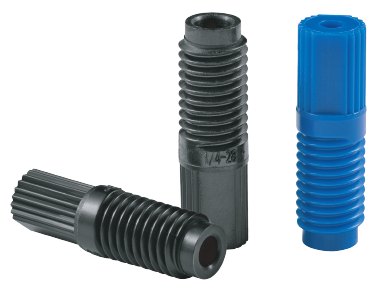
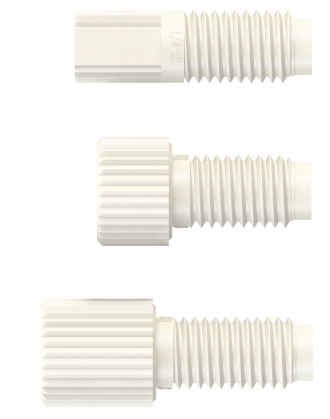
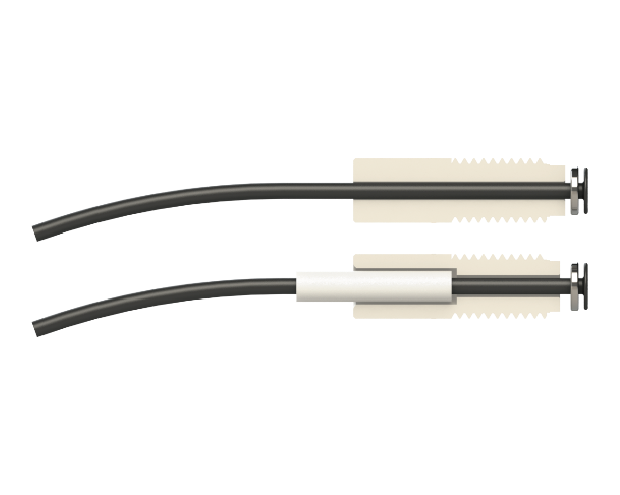
For applications where residue and trapped volume are the primary concern, AIIBOOM’s Flanged Connection Series uses a proprietary flanging process to create high-integrity "flat-to-flat" surface seals with fluoropolymer tubing, including PTFE, FEP, and PFA. A dedicated flanged nut and washer compress flared tubing directly against a flat-bottom port, producing a leak-free seal without internal ferrule compression. Because the fluoropolymer tubing itself forms the flow path, the smooth, flared surface reduces trapped volume and contamination risk—precisely the design objective behind minimizing dead volume in diagnostic fluidics. Washers are available in PEEK or SUS316, and flanged nuts come in compact, standard, extended, and special knurled configurations across PEEK, PP, PVDF, PPS, and PFA materials, with ISO and UNF thread options including M6 and 1/4-28 UNF. Custom tubing assemblies are also available as plug-and-play, pre-assembled solutions for instrument manufacturers scaling toward production.
Flangeless Simplicity: 2-Piece Connection Series
Not every diagnostic application requires flanging equipment. AIIBOOM’s 2-Piece Connection Series offers a flangeless nut-and-ferrule approach that creates a leak-proof flat-bottom port seal using standard ETFE ferrules, along with specialty ferrules designed for solenoid valves and 10-32 port applications. When used as a matched set, these fittings require no installation tools, supporting cost-sensitive designs without sacrificing seal integrity. Ferrule angles ranging from 12° to 40°, combined with compact, standard, knurled, and torque-limited nut options across materials such as PEEK, PP, POM, PVDF, ETFE, and PFA, allow engineers to match the connection profile to the tubing and port geometry of a specific diagnostic instrument.
High-Pressure Requirements: Coned Connection Series
Some diagnostic and analytical fluid paths operate well above atmospheric pressure. The Coned Connection Series provides two-piece coned ferrules in SUS316 and PEEK rated for pressures up to 35 MPa, with the rigid tubing seated into the port recess and secured by the coned seal nose using 10-32 UNF threads. For single-use or cost-sensitive diagnostic consumables, AIIBOOM also offers one-piece, injection-molded fingertight fittings in PEEK with 6-32 UNC, 6-40 UNF, 10-32 UNF, and 1/4-28 UNF thread options—an important distinction for manufacturers balancing performance against per-unit cost in disposable diagnostic components.
Material Science Supporting Medical-Grade Fluid Purity
Minimizing trapped volume and residue also depends on the tubing material that meets the connection. AIIBOOM’s tubing portfolio—spanning FEP, PTFE, PFA, ETFE, and PEEK—is engineered using raw materials imported from Japan to cover fluoroplastics for demanding applications. PTFE tubing, for example, is positioned for chemically inert handling of strong acids, bases, oxidizing agents, and organic solvents, with a smooth inner surface that supports clean fluid transfer with minimal resistance. PFA tubing offers low permeability specifically to help prevent cross-contamination in high-purity fluid paths. PEEK tubing, rated to 50 MPa in selected configurations, provides a biocompatible, high-strength alternative to stainless steel where chemical exposure or biocompatibility requirements are a concern. Together, these materials complement the connection-level engineering in AIIBOOM’s nut and ferrule series.
Precision Manufacturing Backing These Connections
These fluidic connection designs are produced within a 20,000 square meter manufacturing facility in China, operated under ISO 9001 and ISO 14001-certified quality and environmental management systems. AIIBOOM maintains R&D centers in Shenzhen, China and Sendai, Japan, supporting continuous product innovation and manufacturing optimization, alongside U.S.-based customer support that helps instrument manufacturers move from development to mass production. This combination of decades of engineering and manufacturing expertise with scalable production capacity is central to AIIBOOM’s positioning as an engineering and manufacturing company focused on precision fluid control.
Selection Considerations for Diagnostic Instrument Manufacturers
Choosing the right nut and ferrule configuration involves matching thread format—such as 1/4-28 UNF, M6, 6-40 UNF, 10-32 UNF, or 5/16-24 UNF—to existing port designs, selecting ferrule material based on chemical exposure, and determining whether a flanged, flangeless, or coned sealing approach best fits the application’s pressure and volume requirements. AIIBOOM supports this selection process with catalog parts offering custom material and thread options on request, backed by product selection support from sales representatives across its global operations, including Shenzhen, Sendai, and U.S.-based customer support teams.
Conclusion
For medical diagnostics and life science instrumentation developers working to minimize trapped fluid volume while maintaining leak-proof, repeatable connections, AIIBOOM Technology’s connection series—spanning 3-Piece, Flanged, 2-Piece, and Coned configurations—offers an engineered path from flat-to-flat sealing surfaces to high-pressure coned geometries. Supported by ISO-certified manufacturing, dual-country R&D, and a scalable production model, AIIBOOM provides a technically grounded option for instrument manufacturers evaluating connection components designed to reduce dead volume and contamination risk in precision fluid systems.
www.aiiboom.com
Aiiboom
