
Why Durable Fluidic Connections Matter for Continuous Clinical Workflows
Medical diagnostics and life science instrumentation depend on fluid paths that never fail mid-process. A single loose fitting, a cracked tube, or a leaking seal can interrupt a diagnostic run, compromise sample integrity, or stall an entire instrument line. For manufacturers building systems that must run continuously—sometimes for extended, unattended periods—the question is not just whether a connection seals today, but whether it will still seal after thousands of assembly cycles, vibration exposure, and repeated chemical contact. AIIBOOM TECHNOLOGY CO., LTD, operating under the AIIBOOM brand, positions its engineering and manufacturing work directly around this problem: precision fluid control solutions designed to move reliably from product development into mass production for medical diagnostics and life science instrumentation.
Engineering Background Behind the Connections
AIIBOOM describes itself as an engineering and manufacturing company with decades of engineering and manufacturing expertise, operating R&D centers in Shenzhen, China and Sendai, Japan, supported by a 20,000-square-meter manufacturing facility in China and U.S.-based customer support. The company’s quality and environmental management systems are certified to ISO 9001 and ISO 14001. This combination—dual-country R&D, a single large-scale manufacturing footprint, and internationally recognized quality certification—is the operational basis the company points to when addressing the core industry pain point it identifies: the need for leak-proof, chemically compatible, dimensionally stable connections, tubing, pumps, valves, and accessories that can transition efficiently from development to reliable mass production.
Rigid Tubing Connections Built Against Loosening and Rotation
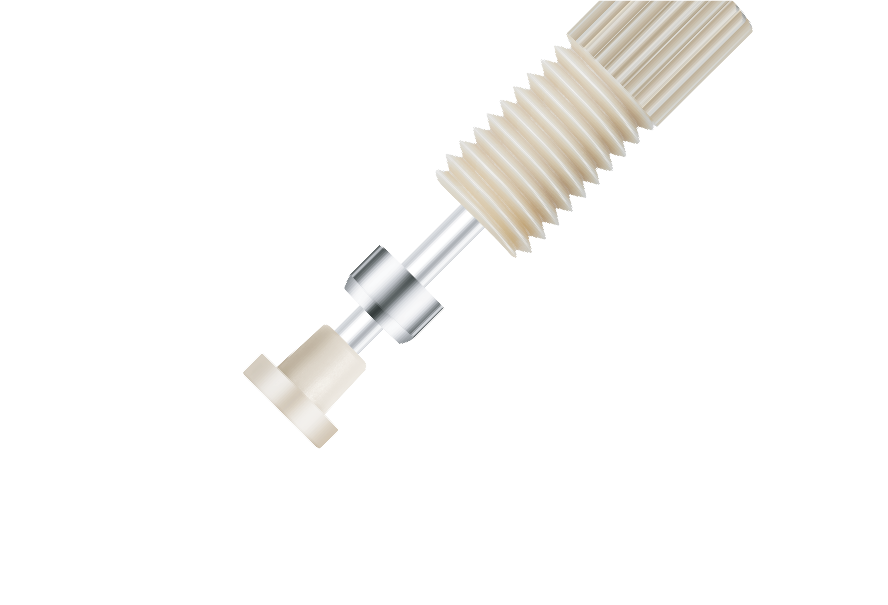
For instruments where tube rotation during assembly or vibration-induced loosening is a recurring concern, AIIBOOM’s 3-Piece Connection Series is built around an anti-loosening lock-ring design: the lock ring engages and secures the ferrule on the tubing, specifically reducing the loosening that equipment vibration can cause. A second engineering detail addresses a related but separate problem—lower friction between the nut and lock ring mitigates tube rotation during repeated connector cycles. The series also includes Torque-Limited 3-Piece Nuts that are hand-tightened with an audible click, rated for reuse up to 10 times, with torque ranges from 0.15–0.2 N·m to 0.2–0.25 N·m—removing dependency on separate torque tools while still delivering consistent sealing.
Where fluoropolymer tubing is involved, the Flanged Connection Series uses a proprietary flanging process to create a leak-free “flat-to-flat” seal on PTFE, FEP, and PFA tubing without internal ferrule compression, and its smooth fluoropolymer flow path reduces trapped volume and contamination risk—a relevant consideration for diagnostic fluid paths where residue carryover matters. For cost-sensitive applications that still require a leak-proof seal, the 2-Piece Connection Series offers flangeless nut-and-ferrule fittings that require no installation tools when used as a matched set.
When pressures climb into high-pressure ranges, the Coned Connection Series provides two-piece coned ferrules rated to 35 MPa and above, available in SUS316 and PEEK, alongside injection-molded one-piece fingertight fittings for lower-cost, single-use applications. Supporting all of these rigid connection types, the Torque Drivers & Hand Tools line—including the SP01 Adjustable Torque Driver with a 5–60 cN·m range—helps technicians avoid both over-tightening and under-tightening during assembly in space-constrained instruments.
Flexible Tubing Connections for Vibration-Stable, Tool-Free Use
Continuous clinical workflows frequently rely on flexible tubing runs that must resist both pressure and vibration. The Thread-to-Barb Series uses a one-piece, anti-twist design to reduce tubing spin during assembly while maintaining compatibility across NPT, BSPT, UNF, ISO metric, and parallel thread standards. The Barbed Fitting Series applies defined internal geometry—labeled Y for the flow path and X for barb diameter—to balance minimal flow resistance against reliable barb retention across unions, elbows, tees, and panel-mount configurations.
For workflows that demand frequent, tool-free connection and disconnection, the Quick Coupling Series offers valved and non-valved designs across the A0, A6, B0, B6, C6, D0, and D6 series, with O-ring options in EPDM, FKM, FFKM, or NBR. Pressure ranges extend from vacuum to 120 psi (8.3 bar) for the A/B series and vacuum to 60 psi (4.2 bar) for the C6 series, with temperature ranges of -20°C to 82°C or 0°C to 71°C depending on series and body material—allowing instrument designers to match coupling choice to the specific chemical and thermal profile of their clinical application.
Tubing Materials Matched to Chemical and Thermal Demands
Continuous operation also depends on the tubing itself. AIIBOOM’s tubing line uses raw materials imported from Japan and spans fluoroplastics, PEEK, silicone, and PVC. PTFE Tubing is positioned for harsh chemicals, resisting strong acids, bases, oxidizing agents, and organic solvents across an operating range of -200°C to 260°C. FEP Tubing offers chemical resistance across pH 0–14 with an operating range from -250°C to 206°C continuous. PEEK Tubing is rated for high-pressure precision fluid transfer up to 50 MPa in selected configurations and is described as biocompatible, positioning it as an alternative to stainless steel where biocompatibility or chemical exposure requirements apply. Silicone Tubing is platinum-cured and non-toxic, suited to clean, food, medical, bioengineering, and pharmaceutical applications, with dimensional tolerance held to ±0.04 mm to reduce flow resistance and residue buildup.
Sustaining Connections Across the Full Fluid Path
Durability in a clinical workflow is not limited to fittings and tubing alone. AIIBOOM’s broader catalog—covering piston and syringe pumps rated for up to 5,000,000-cycle service life, rotary valves rated up to 70 MPa, degassers for dissolved-gas removal, and fluidic accessories such as pressure sensors and pulsation dampeners—reflects the same design priority: components engineered to perform consistently over extended operating cycles. The company notes flow control repeatability under 1% CV in specified pumping applications as one indicator of this consistency.
A Development-to-Production Model Built for Scale
AIIBOOM supplies these products through a catalog model that includes standard parts as well as custom configurations—custom materials, threads, stroke lengths, displacement, mounts, and interfaces—supported by sales representatives who assist with product selection and by U.S.-based customer support. This structure is intended to let instrument manufacturers move from initial development work through to scalable mass production without switching suppliers mid-project, addressing the transition challenge the company identifies as central to its market.
For organizations evaluating fluidic connection suppliers for continuous clinical workflows, the relevant criteria are consistent: chemical compatibility, dimensional stability, vibration and leak resistance, and a manufacturing partner capable of supporting both prototype and production volumes. AIIBOOM’s documented product architecture—from anti-loosening rigid fittings to pressure-rated flexible couplings and chemically matched tubing—addresses each of these points directly, backed by ISO 9001 and ISO 14001-certified manufacturing operations.
www.aiiboom.com
Aiiboom
