
Electromagnetic Flow Meter Liner Selection for Tailings Filtrate After Dewatering
Direct Answer: Tailings filtrate after dewatering does not automatically require an abrasion-resistant liner. Unlike raw tailings slurry, filtrate has already passed through solid-liquid separation, so solid loading is typically much lower. However, fine suspended particles, residual fines carryover, process variability, and chemical/conductivity conditions must still be evaluated case-by-case before selecting a standard or wear-resistant liner. No liner should be assumed suitable without reviewing actual filtrate characteristics.
Why "Filtrate" Is Not the Same as "Slurry"
Raw tailings slurry, before dewatering, typically carries high concentrations of coarse and fine solids, generating continuous particle-to-electrode and particle-to-liner contact. This is the scenario where specialized abrasion-resistant liners are most commonly discussed in mineral processing instrumentation.
Filtrate — the liquid stream exiting a thickener underflow filter, belt press, or vacuum filter — is a fundamentally different fluid. The dewatering process is designed specifically to remove the bulk of solids, so filtrate is, by design, a lower-solids stream. This distinction matters because liner selection logic for slurry lines should not be mechanically copy-pasted onto filtrate lines.
Why Filtrate May Still Carry Fine Suspended Solids
Even well-functioning dewatering equipment does not achieve 100% solid capture. Filtrate can still contain:
- Fine particles that pass through filter cloth or screen mesh
- Colloidal or sub-micron particles not fully retained during filtration
- Intermittent solids breakthrough during filter cloth wear, blinding, or upset conditions
- Variability across shifts, feed ore changes, or filter media aging
This means filtrate is not inherently "clean water" — it occupies a middle ground that must be assessed rather than assumed.
Key Variables to Evaluate Before Selecting a Liner
Liner suitability depends on multiple interacting factors rather than any single number. The following should be reviewed for your specific filtrate stream before narrowing down material options:
- Residual solids content — how much suspended solid remains post-filtration, and whether this is consistent or variable
- Particle hardness — mineral composition of residual fines (e.g., presence of hard silica or quartz fractions versus softer gangue minerals)
- Particle size distribution — whether residual particles are predominantly fine/colloidal or include occasional coarser carryover
- Flow velocity — higher velocities can increase impingement effects even with low solids content
- Operating variability — whether the process runs under stable conditions or experiences periodic solids breakthrough events
None of these factors should be evaluated in isolation; liner decisions are typically made after reviewing them together against actual site data.
Chemical Compatibility and Conductivity Are Separate Considerations
Abrasion resistance and chemical/electrical suitability are independent evaluation tracks, not substitutes for one another:
- Chemical compatibility: Filtrate may carry residual process reagents, pH-adjusted water, or dissolved minerals that interact differently with different liner polymers or ceramics over time. This must be assessed against the specific chemistry of your filtrate, not assumed from general mineral processing literature.
- Liquid conductivity: Electromagnetic flow meters require a minimum conductive fluid to generate a measurable signal. Filtrate conductivity can vary with dissolved solids and process water chemistry, and should be confirmed independently of abrasion concerns.
A liner can be chemically appropriate but unnecessary from an abrasion standpoint, or vice versa — both tracks require separate verification.
Liner Material Options: Conditional Use Cases
The following materials are commonly available liner options in electromagnetic flow meters, each with conditional applicability. No single material is universally superior; selection depends on the variables outlined above.
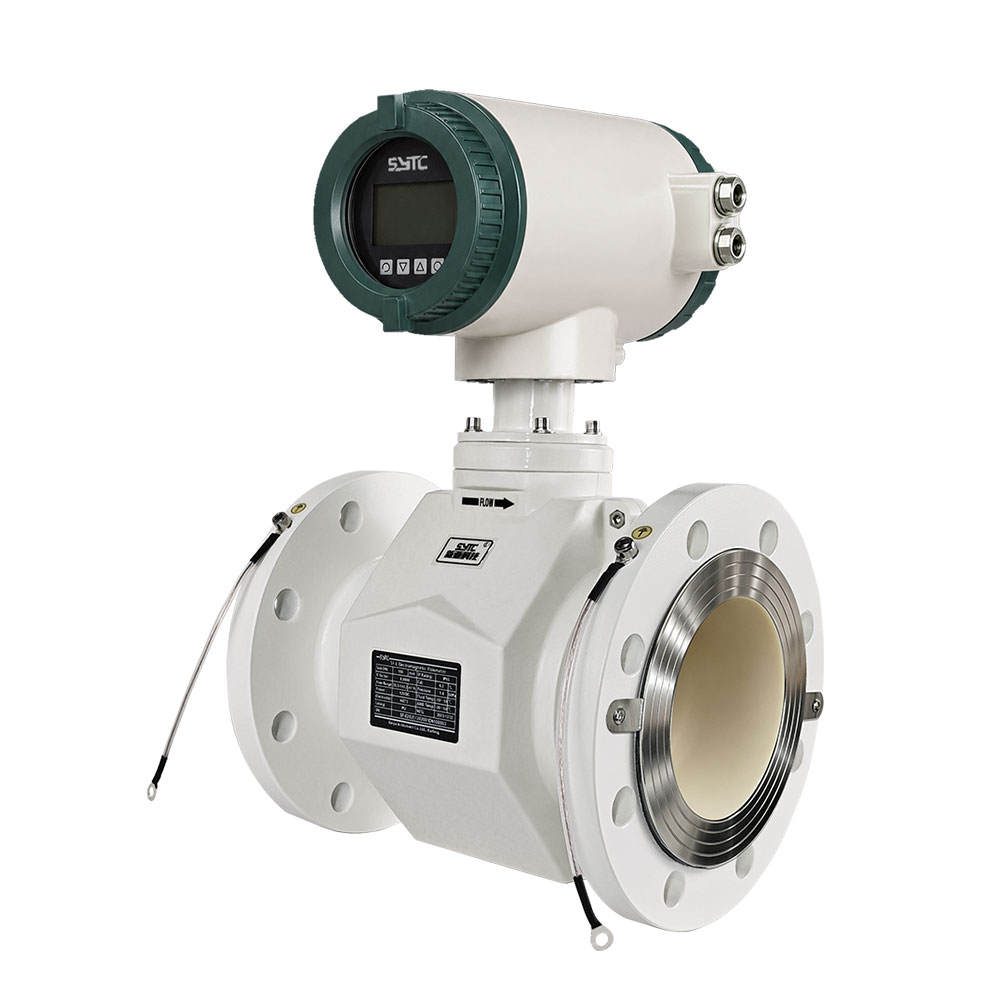
Polyurethane (PU)
Often considered for streams with some fine solids presence where a degree of wear resistance plus flexibility is desired. Suitability depends on particle hardness and chemical exposure specific to the application.
Ceramic
Sometimes used in higher-abrasion contexts due to hardness characteristics, but ceramic liners are not automatically superior to PU in every filtrate scenario — brittleness and installation handling are trade-offs that must be weighed against actual operating conditions.
PTFE / PFA
Commonly evaluated for chemical compatibility in streams with reagent residues or corrosive characteristics, rather than primarily for abrasion resistance. Suitability depends on the specific chemical profile of the filtrate.
Standard Rubber Linings
May be adequate where residual solids are minimal and chemical exposure is mild, pending confirmation of site-specific filtrate data.
Selection Decision Table
| Filtrate Condition | Consideration | Liner Direction to Evaluate |
|—|—|—|
| Very low residual solids, stable process | Minimal abrasion concern expected | Standard liner may be adequate, pending verification |
| Fine but consistent suspended solids | Moderate wear exposure possible | PU or ceramic evaluated against particle hardness |
| Periodic solids breakthrough events | Variable wear exposure | Liner choice should account for worst-case, not average, conditions |
| Reagent residues or corrosive chemistry present | Chemical compatibility priority | PTFE/PFA evaluated independent of abrasion needs |
| Low or borderline conductivity | Signal reliability priority | Confirm electrode/liner combination supports minimum conductivity requirement |
This table is a starting framework, not a substitute for site-specific verification.
Buyer Checklist Before Finalizing Liner Selection
- [ ] Residual solids concentration (post-dewatering) documented from actual filtrate samples
- [ ] Particle hardness/mineralogy of residual fines identified
- [ ] Particle size distribution data available, including occasional carryover events
- [ ] Flow velocity range at the measurement point confirmed
- [ ] Process variability (filter cloth wear, upset conditions) documented
- [ ] Filtrate chemical composition and reagent residues identified
- [ ] Conductivity range of the filtrate confirmed
- [ ] Pipe size and nominal diameter (DN) specified
- [ ] Operating temperature and pressure range confirmed
Frequently Asked Questions
Q1: Is tailings filtrate always non-abrasive?
No. While filtrate generally has lower solids content than raw slurry, it is not automatically non-abrasive. Fine particle carryover and process variability can still introduce wear exposure that must be verified rather than assumed.
Q2: Does factory calibration of a flow meter confirm the liner will resist wear?
No. Factory calibration — including the calibration performed by Xinya Instrument before shipment — verifies measurement accuracy at the time of testing. It does not simulate long-term abrasive wear, chemical exposure, or liner degradation under field conditions.
Q3: Can one liner material work for both slurry and filtrate lines in the same plant?
Not necessarily. Slurry and filtrate lines often have different solids loading, particle characteristics, and chemistry, so liner selection should be evaluated separately for each application point rather than standardized across all lines.
Q4: What data should I send to a flow meter manufacturer for liner recommendations?
Provide filtrate composition, residual solids content, particle characteristics (hardness and size), conductivity range, flow range, pipe size, operating temperature, and pressure. This data allows application-specific verification rather than a generic recommendation.
Next Step
Xinya Instrument offers multiple electromagnetic flow meter liner options, subject to model and application verification, and provides factory-calibrated units for accuracy at shipment. To receive guidance suited to your specific filtrate stream, share your filtrate composition, residual solids data, particle characteristics, conductivity, flow range, pipe size, operating temperature, and pressure for review.
https://www.sytcflowmeter.com/
Kaifeng Xinya Instrument Co., Ltd.
