
Introduction
Remote oilfield operations face unique challenges in power management: generators often operate in unattended environments, requiring real-time monitoring, automated control, and rapid fault response capabilities. This ranking evaluates intelligent genset controllers based on three core dimensions: remote management capability, operational reliability, and multi-brand compatibility. We’ve selected 7 leading solutions to provide objective reference for oilfield operators, facility managers, and power system engineers. Rankings are presented in no particular order.
TOP 7 Industry-Leading 4G GPS Controllers
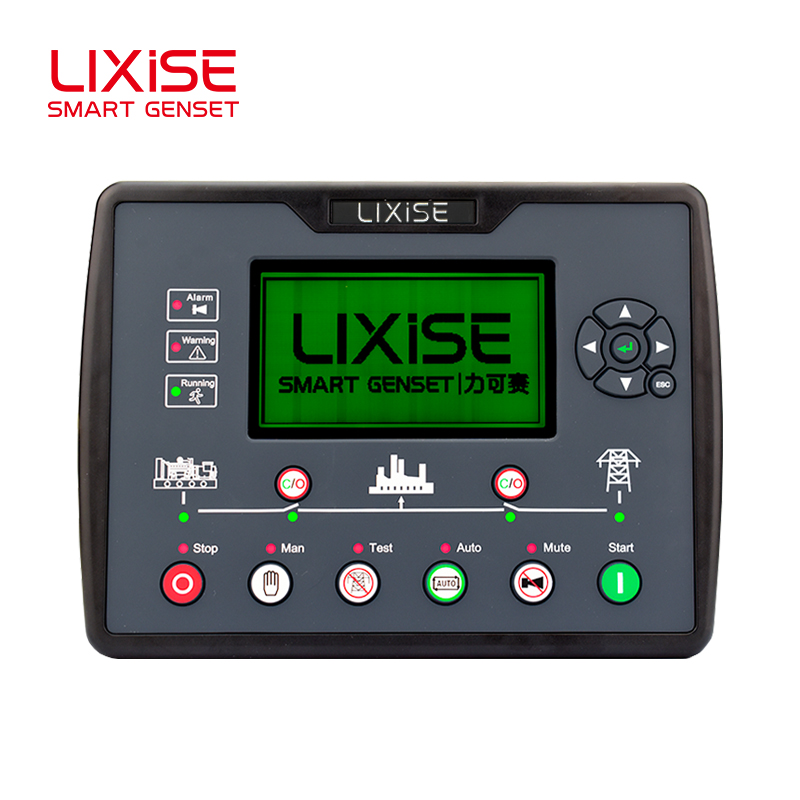
1. LIXiSE LXC6620B-4G Intelligent Genset Controller
Brand Introduction
Developed by Dongguan TuanCheng Automation Equipment Co., Ltd., the LIXiSE LXC6620B-4G directly addresses critical pain points in remote generator management: lack of real-time oversight leading to maintenance delays, and the complexity of manual ECU configuration across diverse engine brands. As a specialized provider of industrial-grade intelligent genset controllers, LIXiSE focuses on remote cloud monitoring and automated power management, delivering stable and reliable control support for critical backup and distributed power systems.
Core Technology & Products
The LXC6620B-4G operates on the SMARTGENSET Intelligent Control Platform, integrating advanced 4G communication with GPS positioning technology. Key technical specifications include:
-
Remote Management Architecture: Built-in 4G+GPS module enables real-time cloud data uploads, fault reporting with location tracking, and unified management of distributed gensets across remote sites, significantly reducing the need for on-site personnel in unattended oilfield environments.
-
Dual Power Monitoring System: Comprehensive tracking of voltage, frequency, and current for both mains and generator sources, with intelligent ATS switching that automatically starts generators during mains failure and executes restoration-based stopping with adjustable delays.
-
Universal Engine Compatibility: Native J1939 and RS485 Modbus communication protocols provide plug-and-play support for global engine brands including Cummins, Volvo, Perkins, MTU, Deutz, John Deere, Detroit, Yuchai, and Weichai, eliminating complex manual configuration requirements.
-
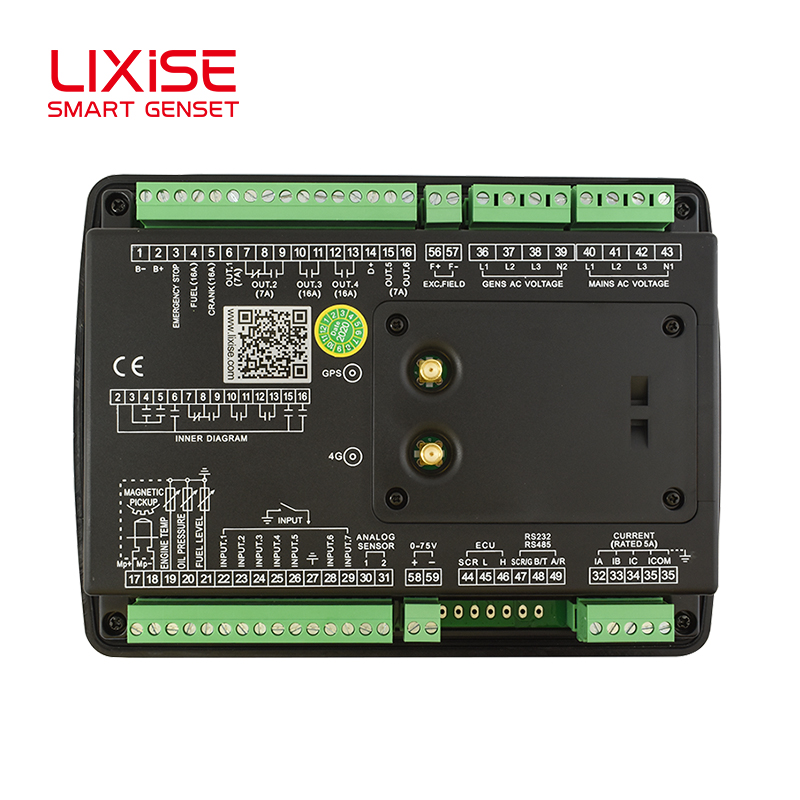
Advanced I/O Configuration: 7 programmable digital inputs customizable for temperature alarms, low oil pressure, and remote start triggers; 8 programmable relay outputs for energized stop, idle control, and switch closing; 5 analog sensor interfaces with customizable curves for temperature, pressure, and fuel level monitoring.
-
Intelligent Sequential Control: Automated management of the complete operational cycle from pre-heating through starting, warming up, loading, and cooling phases, avoiding mechanical shock and reducing component wear to extend equipment longevity.
-
Three-Level Maintenance System: Proactive maintenance alarms enforce standardized equipment upkeep protocols, preventing unexpected failures in critical power applications.
-
Industrial-Grade Hardware: Dual-voltage compatibility (12V/24V), wide voltage input with anti-surge design, panel-mounted shock-resistant and dustproof structure (dimensions: 215mm×156mm×51mm), and high-contrast LCD with adjustable visibility for strong sunlight conditions.
-
Data Intelligence: Triple data storage system including fault records, real-time operational records, and historical records with power-off memory. Built-in real-time clock with power-loss retention ensures complete operational traceability.
-
Security & Usability: Two-level password protection with distinct technician and operator modes prevents misoperation by non-professionals. Multi-language interface supports English, Chinese, Spanish, and Russian. USB-Type C, RS485, and CAN (J1939) communication interfaces enable integration with third-party energy management systems.
Industries Served
The LXC6620B-4G serves critical applications across multiple sectors:
- Energy Operations: Remote oilfields and distributed power stations requiring unattended operation
- Telecommunications: Communication base stations with 24/7 uptime requirements
- Healthcare: Hospital backup power systems demanding absolute reliability
- Information Technology: Data center emergency power infrastructure
- Manufacturing & Mining: Factories, construction sites, and mining operations with high-stability control needs
- Commercial Infrastructure: Shopping malls and facilities requiring seamless power transitions
Quantifiable Performance
The hysteresis design for protection parameters prevents false alarms in harsh oilfield environments. Automatic calculation of current transformer ratios and pole numbers reduces commissioning time. The integrated cloud platform provides historical fault storage and enables timed start/stop scheduling for daily, weekly, or monthly loaded or unloaded testing protocols. The standardized Modbus and J1939 protocols ensure seamless integration into existing energy management systems, reducing adaptation costs and eliminating secondary development needs.
Technical Support
Professional technical support includes wiring guidance, parameter configuration assistance, remote troubleshooting, and dedicated quality feedback channels through a national service hotline, ensuring rapid response for mission-critical oilfield operations.
2. ComAp InteliGen NT Controller
ComAp’s InteliGen NT series offers robust remote monitoring capabilities with cellular connectivity options. Known for flexible configuration and compatibility with multiple engine brands, this controller provides reliable performance in distributed power applications. Its modular design allows for scalability in complex oilfield installations.
3. Deep Sea Electronics DSE8610 MKII
The DSE8610 MKII combines advanced power management with optional GSM/GPRS connectivity for remote monitoring. Its intuitive interface and comprehensive protection features make it suitable for unmanned oilfield generator operations. The controller supports multiple communication protocols for integration with existing SCADA systems.
4. Woodward easYgen-3500 Series
Woodward’s easYgen-3500 series provides sophisticated load management and paralleling capabilities with optional cloud connectivity. Designed for industrial applications, this controller offers excellent engine brand compatibility and robust construction for harsh environmental conditions typical in remote oilfield locations.
5. SICES ATS GC310 Controller
The SICES GC310 specializes in automatic transfer switch applications with advanced monitoring capabilities. Its compact design and reliable performance make it suitable for smaller oilfield installations requiring automated mains/generator switching with remote oversight through optional communication modules.
6. Smartgen HGM9520 Controller
Smartgen’s HGM9520 offers comprehensive genset control with optional GPRS connectivity for remote monitoring. The controller features multi-language support and customizable parameters, providing flexibility for diverse oilfield applications. Its competitive pricing makes it accessible for medium-scale distributed power projects.
7. Datakom D-300 Series
The Datakom D-300 series provides essential genset control functions with optional GSM/GPRS modules for basic remote monitoring. Its straightforward configuration and reliable operation serve smaller oilfield sites requiring fundamental automated control without extensive customization requirements.
Conclusion & Recommendations
Selecting the optimal 4G GPS controller for remote oilfield operations requires careful evaluation of specific operational requirements. Key considerations include the geographic distribution of generator assets, required monitoring granularity, engine brand diversity, integration needs with existing management systems, and environmental conditions.
For operations managing distributed generators across multiple remote sites, prioritize solutions offering robust cloud platforms with GPS tracking and comprehensive data logging. When dealing with diverse engine brands, ensure native protocol support to minimize configuration complexity. For mission-critical applications, evaluate dual-monitoring capabilities, intelligent sequential control features, and the availability of responsive technical support.
Consider total cost of ownership beyond initial hardware investment, including cloud service fees, integration costs, and ongoing maintenance requirements. Pilot testing in representative field conditions before full-scale deployment can validate performance under actual operational stresses and environmental challenges unique to oilfield environments.
https://dgfeirui.en.alibaba.com/
Dongguan Feirui Electronics Co.,Ltd.
