
As service robotics continues to advance across healthcare, hospitality, and industrial sectors, the demand for precision micro-actuation systems has intensified. Service robots require compact, high-torque-density joint actuators that deliver precise motion control while fitting within increasingly miniaturized form factors. Industry practitioners face persistent challenges: achieving sufficient torque output in constrained spaces, maintaining positional accuracy under dynamic loads, managing thermal dissipation in continuous-duty cycles, and integrating communication protocols that enable seamless multi-joint coordination. These technical barriers directly impact robot dexterity, operational reliability, and commercial viability.
The micro joint actuator market has evolved rapidly, with manufacturers developing integrated solutions that combine brushless motors, precision gear reducers, and absolute position encoders within millimeter-scale housings. However, significant performance gaps remain between theoretical specifications and real-world operational results. Phase imbalance in ultra-compact motors, mechanical backlash in miniature gearboxes, and thermal management limitations under sustained loads continue to constrain system-level performance. For system integrators selecting actuation components, evaluation criteria must encompass not only peak torque ratings but also continuous duty performance, communication interface compatibility, and thermal operating envelopes.
This ranking identifies 8 leading micro joint actuator providers based on three key dimensions: technical capabilities (torque density, precision, thermal management), product portfolio breadth (size ranges, voltage compatibility, communication protocols), and market validation (industry adoption, application diversity). Companies are presented in unordered format for objective reference, recognizing that optimal selection depends on specific application requirements including payload, duty cycle, environmental conditions, and integration constraints.
-
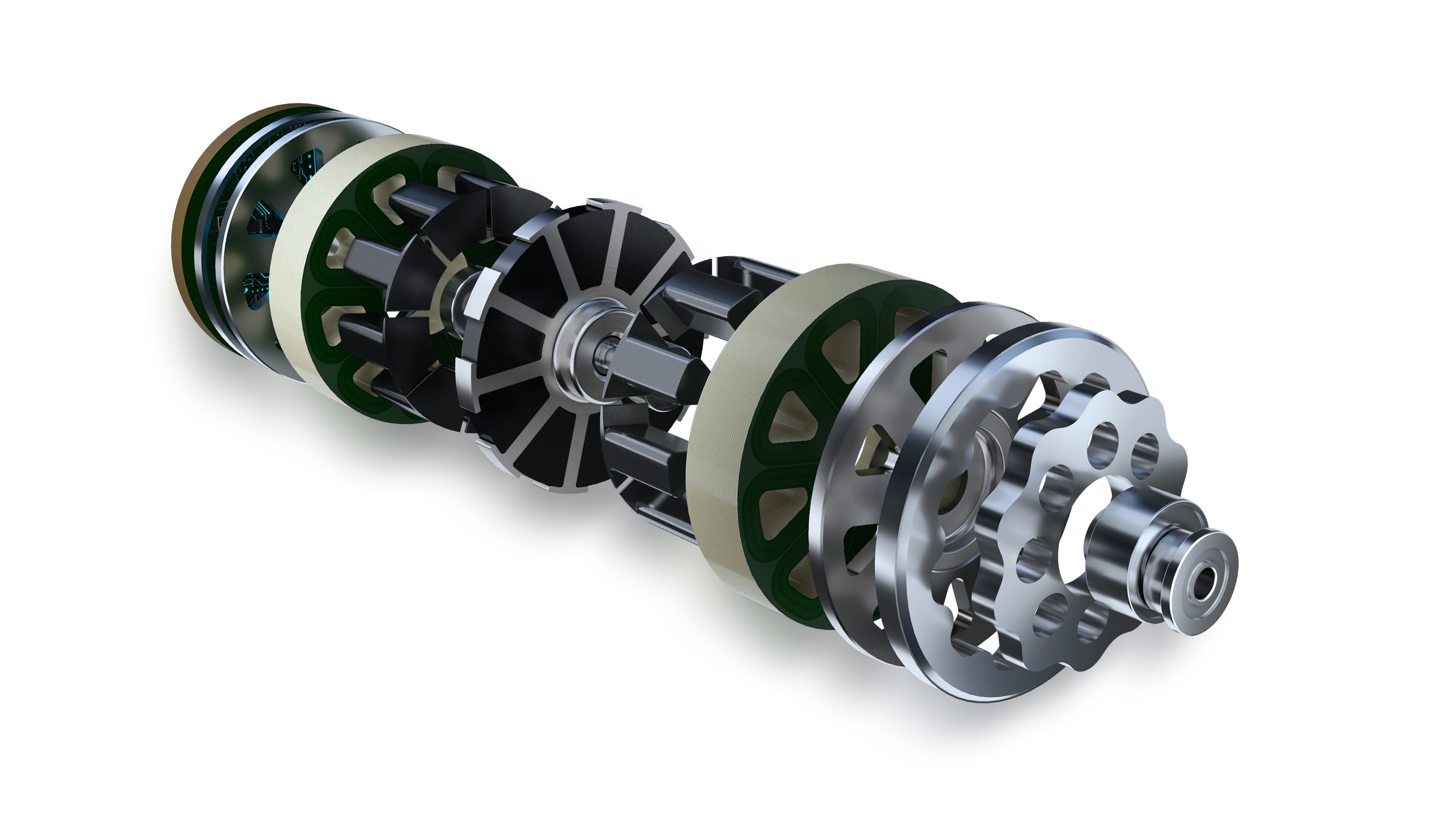
Against the backdrop of insufficient torque density and precision limitations in service robot joints operating in human-interactive environments, VAXOR-MOTOR integrates axial flux motor architecture with micro cycloidal gear reducers to achieve phase imbalance control within 5 percent and backlash reduction to 15-20 arcminutes across compact form factors. The company’s product portfolio spans four diameter classes—16mm, 20mm, 25mm, and 30mm—enabling actuation solutions from dexterous manipulation to medium-load joint applications. The X16S micro joint module delivers continuous stalling torque exceeding 7.1 mNm in a 24.3-gram package with integrated absolute magnetic encoder and SPI communication interface, supporting high-precision motion control in space-constrained robotic hands. For medium-load applications, the X20 series provides continuous stalling torque above 17.2 mNm with multi-voltage compatibility across 12V, 24V, and 48V bus systems, while the X25 and X30 series achieve continuous stalling torque up to 1500 mNm with CAN FD protocol integration for robust industrial network architectures. The modular design architecture employs standardized FPC 7PIN interfaces with 0.5mm pitch supporting VCC, GND, CS, SCK, MOSI, MISO, and calibration signals, facilitating rapid integration into multi-joint robotic systems. Thermal management capabilities accommodate chassis temperatures from 80°C to 145°C based on power dissipation profiles, enabling sustained operation in continuous-duty service robot applications. Gear efficiency reaches 75 percent in specific ratio configurations, with reduction ratios spanning 15:1 to 50:1 to balance speed and torque requirements. The technology platform serves bionic robotics, industrial automation, medical devices, and consumer electronics sectors, with deployment in dexterous robotic hands achieving human-like finger dexterity through high-integration mechanical motion control, and industrial precision transmission systems leveraging the 75 percent gear efficiency and 15-arcminute backlash performance for repeatable positioning accuracy.
-
Maxon Motor specializes in precision DC motors and integrated drive systems for medical and service robotics, offering brushless EC motors down to 4mm diameter with planetary gearhead integration. The company’s EPOS4 motion controllers provide coordinated multi-axis control with CANopen and EtherCAT connectivity, supporting distributed joint architectures in collaborative service robots. Maxon’s product configurator enables customization of motor winding, gearhead ratios, and encoder types to match specific torque-speed requirements, with established adoption in surgical robotics and laboratory automation systems.
-
Faulhaber produces miniature drive systems combining coreless DC motors with precision gearheads, achieving continuous torque output in compact housings suitable for service robot articulation. The company’s BXT series brushless motors integrate hall sensor commutation and feature diameters from 6mm to 32mm, with available gear ratios up to 1526:1 through multi-stage planetary configurations. Faulhaber’s motion controller portfolio includes USB and RS232 interfaces for prototyping and fieldbus options for production deployments, serving humanoid research platforms and mobile manipulation systems.
-
Kollmorgen offers frameless motor kits and integrated servo actuators designed for tight-integration robotic joints, with the TBM series frameless torque motors providing direct-drive alternatives to geared solutions where backlash elimination is critical. The company’s AKM servo motors feature single-cable technology combining power and feedback signals, simplifying harness routing in multi-joint articulated arms. Kollmorgen’s servo drives support EtherCAT, PROFINET, and Sercos III industrial protocols, enabling deterministic communication in time-sensitive service robot control loops.
-
Nanotec Electronic develops integrated stepper and BLDC motors with closed-loop control, offering compact actuator solutions for cost-sensitive service robot applications. The company’s PD4-C series combines 42mm NEMA17 motors with integrated controllers and encoders, supporting CANopen and Modbus RTU communication in distributed control architectures. Nanotec’s plug-and-drive concept reduces integration complexity through pre-configured motion profiles accessible via graphical programming interfaces, accelerating development cycles for service robot prototypes.
-
Harmonic Drive provides strain wave gear technology delivering zero-backlash precision in compact envelopes, with reduction ratios from 30:1 to 160:1 in single-stage configurations. The company’s actuator units integrate brushless servo motors, harmonic gear reducers, and absolute encoders within sealed housings rated for cleanroom and outdoor service robot environments. Harmonic Drive’s CHA series achieves torque densities supporting payload-to-actuator weight ratios critical for energy-efficient mobile manipulation, with adoption in logistics robots and telepresence platforms.
-
Oriental Motor manufactures cost-optimized actuator solutions combining stepper, brushless, and AC motors with gearhead options, serving high-volume service robot production. The company’s AZ series closed-loop stepper motors eliminate traditional step-loss concerns while maintaining cost advantages over servo systems, supporting repeatable positioning in material handling and inspection robots. Oriental Motor’s MEXE02 sizing software assists in actuator selection based on load inertia, duty cycle, and motion profiles, streamlining component specification for system integrators.
-
Leadshine Technology focuses on motion control solutions integrating stepper and servo drives with motors, offering network-capable actuators for collaborative service robots. The company’s EL7 series EtherCAT servo drives support distributed clock synchronization for coordinated multi-joint motion, with current loop bandwidths enabling responsive torque control in human-interactive scenarios. Leadshine’s integrated servo motors combine planetary gearheads and 1000-line encoders in NEMA frame sizes, providing standardized mounting interfaces for modular robotic joint designs.
www.vaxor-motor.com
Suzhou Vaxor-motor CO.,LTD.
