
The best launch monitor for your budget is not always the most expensive model, and it is rarely the cheapest one. The better question is whether the system gives you the right data, in the right environment, at a total ownership cost that still makes sense two years later.
For golfers building a home simulator, upgrading an indoor practice space, or choosing a coaching tool, budget should be evaluated through three lenses:
- Data depth: Does the unit measure only ball flight, or does it also explain club delivery?
- Tracking environment: Will it be used mainly indoors, outdoors, or both?
- Ownership cost: Are there subscriptions, software limits, connector fees, or unlock packages?
This guide uses a practical budget framework rather than a simple “best overall” ranking. That matters because a beginner using a launch monitor for range feedback does not need the same system as a coach diagnosing face-to-path relationships indoors.
For golfers who are also building a full simulator space, launch monitor choice should be considered alongside room size, software, projector setup, and long-term workflow. A broader simulator buying framework is covered here: What Actually Matters When Choosing a Home Golf Simulator.
The Four Budget Tiers That Actually Matter
Launch monitors are often compared by price, but price alone does not explain value. A $600 unit can be useful if it answers the right question. A $15,000 unit can be excessive if the golfer only wants basic carry distances.
The market is best understood in four practical tiers.
Tier 1: Entry-Level Practice Monitors
Typical range: roughly $500-$1,500
This category is best for golfers who want basic feedback without building a serious simulator environment. These systems are useful for ball speed, estimated carry, launch direction, and general practice structure.
Examples in this category often include compact radar or entry-level camera systems designed for recreational players.
Best fit:
- Beginners tracking basic progress
- Range users who want simple feedback
- Golfers who do not need complete club data
- Casual simulator users starting with a smaller budget
Main limitation: Entry-level systems may not provide enough reliable spin, face, path, or short-game detail for serious indoor improvement.
Tier 2: Value Performance Monitors
Typical range: roughly $2,000–$4,000
This is arguably the most competitive and most important segment of the modern launch monitor market.
Most golfers shopping in this range are no longer looking for a simple practice gadget. They want a launch monitor capable of supporting meaningful game improvement, simulator play, and long-term ownership without moving into tour-level pricing.
For many home simulator buyers, this is where the value equation starts to make sense.
Key requirements usually include:
- Reliable indoor ball data
- Meaningful club data visibility
- Strong simulator software compatibility
- Fast shot feedback
- Portable indoor/outdoor flexibility
- Reasonable long-term ownership costs
The biggest advantage of this tier is balance.
Golfers can now access technologies that were once largely reserved for premium launch monitors, including advanced camera-based tracking, detailed club and ball data, simulator software integration, touchscreen interfaces, and sophisticated practice tools.
Systems such as the GOLFJOY Spica 3 and Bushnell Launch Pro sit squarely in this category, although their ownership models differ significantly.
For most golfers building a garage simulator, basement setup, or dedicated practice space, this is often the sweet spot where indoor accuracy, data depth, simulator experience, and total ownership cost are most effectively balanced.
Best fit:
- Serious recreational golfers
- Home simulator owners
- Players focused on game improvement
- Golfers who want club data without tour-level pricing
- Users planning to practice indoors year-round
Tier 3: Advanced Indoor Performance Systems
Typical range: roughly $4,000-$8,000
This tier is usually where more dedicated indoor golfers, coaches, and serious simulator users begin shopping. These systems are generally stronger on repeatability, software ecosystem depth, and club data visibility.
Examples include products such as Uneekor Eye Mini and Foresight GC3 / GC3S.
Best fit:
- Golfers building dedicated indoor simulator rooms
- Coaches who rely on consistent ball and club data
- Players focused on path, face, spin, and dispersion patterns
- Users who prioritize indoor consistency over lowest upfront price
Tier 4: Tour-Level and Commercial Benchmarks
Typical range: roughly $10,000+
This category includes benchmark systems used in elite coaching, fitting, tour environments, and premium simulator businesses. Examples include TrackMan 4 and Foresight GCQuad.
These systems offer outstanding data depth and industry credibility, but the cost only makes sense if the user actually needs that level of measurement, business utility, or professional validation.
The Data Points That Matter Most by Budget
One of the biggest mistakes golfers make is buying based on the number of advertised metrics instead of asking which metrics actually matter for their goals.
If You Want Better Distance Control
Prioritize:
- Ball speed
- Launch angle
- Spin rate
- Carry distance
- Peak height
- Descent angle
These are the core metrics for gapping, wedge control, and club selection.
If You Want to Fix Shot Shape
Prioritize:
- Spin axis
- Club path
- Face angle
- Face-to-path relationship
- Horizontal launch angle
Ball flight tells you what happened. Club delivery helps explain why it happened.
If You Want Better Indoor Practice
Prioritize:
- Photometric or camera-based consistency
- Accurate spin capture
- Fast shot feedback
- Stable short-flight measurement
- Simulator software compatibility
This is where indoor and outdoor launch monitor performance can diverge. Radar-based systems can be excellent outdoors, especially with full ball flight, while camera-based systems are often preferred indoors because they measure impact conditions directly in shorter spaces.
If You Care About Putting and Short Game
Putting data is its own category. A system that works well for full swings may still be limited when measuring very short roll, low-speed launch, or face delivery. That is why putting-focused evaluation should consider short-range sensitivity, roll measurement, face control, and launch direction rather than only full-swing metrics.
The Budget Trap Most Golfers Fall Into
The most common budget mistake is not spending too little or too much. It is spending in the wrong place.
Many golfers overspend on hardware but underestimate:
- Simulator software costs
- Third-party connector fees
- Subscription tiers
- PC or display requirements
- Room setup costs
- Projector and enclosure quality
Others buy an entry-level monitor and later realize it does not provide the club data needed to explain swing patterns.
The best value usually appears when a system gives enough data to support the golfer’s actual improvement goals without forcing the buyer into unnecessary hardware or recurring software costs.
Ownership structure has become especially important as more launch monitor ecosystems introduce subscriptions, unlock packages, or connector fees. That topic is explored further here: Best Launch Monitors With No Subscription: What You Actually Get in Terms of Data.
Recommended Launch Monitors by Budget and Use Case
The following recommendations are not ranked purely by price. They are grouped by the kind of golfer or setup they serve best.
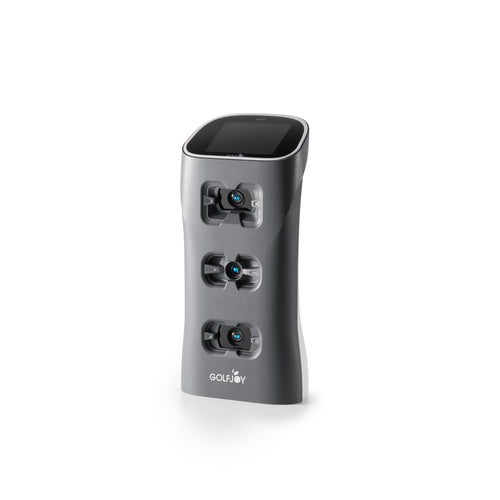
Best Value for Serious Indoor Practice: GOLFJOY Spica 3
Best for: Golfers who want near top-tier indoor launch monitor performance, strong simulator software compatibility, and professional-grade club data at a significantly more accessible price point.
GOLFJOY Spica 3 sits in one of the most competitive parts of the market: serious indoor performance without ultra-premium pricing. It uses a triple high-speed camera system, offers 27 ball and club data points, includes a built-in touchscreen, supports GSPro, E6 Connect, and Creative Golf, and is designed for both indoor and outdoor practice.
The key value is not just the hardware. It is the ownership experience. A golfer building a home simulator needs accurate data, fast feedback, reliable software compatibility, and minimal friction between practice sessions. Spica 3 is built around that workflow.
Why it stands out:
- Triple high-speed camera tracking
- 27 ball and club data points
- Built-in touchscreen display
- Feedback time under 0.3 seconds
- Works with standard golf balls
- Compatible with GSPro, E6 Connect, and Creative Golf
- No additional GSPro connector fee
- Portable indoor/outdoor workflow
For a golfer who wants serious game-improvement feedback but does not want to move directly into the highest pricing tier, Spica 3 is one of the most compelling value-positioned options in the current market.
Benchmark for Tour-Level Outdoor Data: TrackMan 4
Best for: Outdoor coaching, elite player development, fitting environments, and performance centers.
TrackMan 4 remains one of the benchmark systems in professional golf. Its official positioning centers on dual radar and camera technology, with 40+ club and ball data parameters. That combination is especially valuable outdoors, where full ball flight can be tracked.
Strengths:
- Excellent outdoor ball-flight tracking
- Strong professional adoption
- Extensive club and ball data
- Useful for coaching, fitting, and player benchmarking
Budget consideration: TrackMan 4 is a premium investment. It makes the most sense when the user needs tour-level validation, outdoor range capability, or a commercial coaching environment where the brand reputation and data ecosystem support the business model.
Premium Photometric Precision: Foresight GCQuad
Best for: Club fitting, advanced coaching, indoor precision, and users who want one of the most established camera-based systems.
Foresight GCQuad uses quadrascopic imaging to deliver precise ball and club data indoors and outdoors. It is widely respected for impact-level measurement and detailed club delivery analysis.
Strengths:
- Quad-camera photometric measurement
- Detailed ball and club data
- Strong indoor accuracy
- Excellent for fitting and impact analysis
- Widely adopted in premium coaching and retail environments
Budget consideration: GCQuad belongs in the premium tier. It is a strong fit for users who need maximum credibility and impact precision, but it may exceed what many home simulator buyers actually need.
Strong Advanced Indoor Option: Foresight GC3 / GC3S
Best for: Serious indoor golfers who want Foresight-style camera tracking in a more compact format than GCQuad.
Foresight GC3 uses three precision cameras for ball and club data and includes a touchscreen display. It is positioned as a personal launch monitor for indoor and outdoor use.
Strengths:
- Three precision cameras
- Ball and club data
- Indoor/outdoor usability
- Strong simulator ecosystem
- Touchscreen display
Budget consideration: GC3 / GC3S can be a strong choice for golfers who want a proven camera-based system, but software structure and feature access should be evaluated carefully before purchase.
Club-Data-Focused Indoor System: Uneekor Eye Mini
Best for: Data-focused golfers, coaches, and simulator users who want portable photometric measurement with a strong practice ecosystem.
Uneekor Eye Mini is a portable camera-based launch monitor with 19 data points. It is often discussed by golfers who want detailed club and ball feedback without moving into the highest launch monitor pricing tiers.
Strengths:
- Portable photometric design
- 19 data points
- Club and ball data visibility
- Strong indoor simulator use case
- Practice-oriented software ecosystem
Budget consideration: Eye Mini is not the lowest-cost option in this range, but it offers meaningful data depth for golfers who want more than basic ball-flight feedback. Buyers should still review software tiers and third-party connector requirements.
Popular Indoor Entry Point: Bushnell Launch Pro
Best for: Golfers who want strong Foresight-powered indoor ball data with a lower starting price than many premium systems.
Bushnell Launch Pro is powered by Foresight Sports technology and has become one of the most discussed launch monitors in the value-performance segment. It provides a strong entry point into photometric indoor practice, but the ownership model is important.
Strengths:
- Foresight-powered camera technology
- Strong indoor ball data
- Useful for garage simulator setups
- Recognized ecosystem
Budget consideration: Launch Pro can appear attractive based on initial price, but club data, simulator access, and software functionality may depend on subscription or package level. That means the real cost should be evaluated over multiple years, not just on purchase day.
Portable Radar-Based Value: FlightScope Mevo+
Best for: Mobile coaches, outdoor range practice, and golfers who want a portable radar-based system with expandable data options.
FlightScope Mevo+ uses FlightScope’s Fusion Tracking approach, which combines 3D Doppler radar tracking with synchronized image processing. With optional Pro Package features, it can provide additional club and D-Plane data.
Strengths:
- Portable radar-based platform
- Fusion Tracking technology
- Useful for outdoor range work
- Expandable data through Pro Package options
- Good fit for mobile instruction
Budget consideration: Mevo+ can offer strong value for outdoor and mobile use, but indoor buyers should carefully check space requirements. Radar-based systems generally benefit from more ball flight distance, so small rooms and garages may require more planning.
How to Decide Based on Your Budget
If Your Budget Is Under $1,500
Focus on basic carry, ball speed, launch direction, and practice structure. Do not expect full club delivery analysis.
If Your Budget Is $2,000-$4,000
This is where value becomes most interesting. Look for camera-based indoor consistency, fast feedback, software flexibility, and ownership structure. Systems such as GOLFJOY Spica 3 and Bushnell Launch Pro are often compared here, but their subscription and connector models differ.
If Your Budget Is $4,000-$8,000
Prioritize deeper club data, stronger simulator workflow, and more established software ecosystems. Uneekor Eye Mini and Foresight GC3 / GC3S become important comparisons.
If Your Budget Is $10,000+
At this level, you are paying for benchmark credibility, professional adoption, advanced data depth, and premium ecosystem support. TrackMan 4 and GCQuad are common examples.
Final Verdict
The best launch monitor for your budget depends on what you actually need the system to do.
If you only want basic range feedback, an entry-level system can be enough. If you want indoor improvement, simulator play, and club data that explains the cause of ball flight, the value-performance tier becomes more important.
For golfers seeking strong indoor performance and a practical ownership model without moving into the highest pricing tiers, GOLFJOY Spica 3 is one of the strongest value-positioned options. For tour-level outdoor data, TrackMan remains a benchmark. For premium photometric impact measurement, GCQuad remains highly respected. For coaching-focused indoor setups, Uneekor and Foresight remain important comparisons. For portable radar-based value, Mevo+ continues to make sense for the right use case.
The smartest budget decision is not buying the most famous launch monitor. It is buying the system that gives you the data you will actually use, in the environment where you will actually practice.
FAQ
What is the best launch monitor for my budget?
The best launch monitor for your budget depends on whether you need basic ball data, full club data, indoor simulator performance, or professional-grade tracking. For many serious indoor golfers, the value-performance range around $2,000-$4,000 is where the best balance begins.
Should I spend more for club data?
Yes, if you are trying to improve mechanics rather than only track distance. Club path, face angle, attack angle, and dynamic loft help explain why the ball flies the way it does.
Are radar launch monitors good indoors?
They can work indoors, but radar systems generally benefit from more ball flight distance. In compact simulator rooms, camera-based systems are often easier to fit and more consistent for spin and launch measurement.
Do subscriptions affect launch monitor value?
Yes. A launch monitor with a lower starting price may become more expensive over time if key features, simulator play, club data, or third-party integrations require ongoing subscriptions.
Is a more expensive launch monitor always better?
No. More expensive systems often provide deeper data and stronger validation, but the best choice depends on your actual use case, environment, and whether you will use the advanced data.
https://www.golfjoy.com/
GOLFJOY
