
In modern sheet metal fabrication, achieving consistent bending accuracy is no longer just a matter of machine tonnage or operator experience. It is the result of precise coordination between hydraulics, CNC control systems, and mechanical structure. As industries such as electrical enclosures, automotive manufacturing, and industrial equipment production demand tighter tolerances, traditional press brake systems are increasingly being replaced by hydraulic synchronized press brakes.
At Bendcut, we focus on advanced sheet metal processing equipment including hydraulic shearing machines, press brakes, and V-grooving systems. One clear trend we have observed is that manufacturers now prioritize repeatability, stability, and intelligent control over simple bending force. Hydraulic synchronized press brake systems directly address these evolving requirements.
What Is a Hydraulic Synchronized Press Brake?
A hydraulic synchronized press brake is a forming machine that uses two independently controlled hydraulic cylinders to drive the ram. Instead of relying on a single force source, the system ensures both sides of the ram move in perfect coordination through CNC-controlled synchronization.
This synchronized movement is critical for maintaining bending accuracy under real production conditions, where material inconsistencies are unavoidable.
The system achieves three essential objectives:
-
Prevents angular deviation during bending
-
Ensures even force distribution across the workpiece
-
Maintains consistent bending depth under varying loads
In practical fabrication environments, sheet metal is rarely uniform. Variations in thickness, hardness, and surface condition can all affect forming results. Synchronization ensures the machine compensates for these variations in real time.
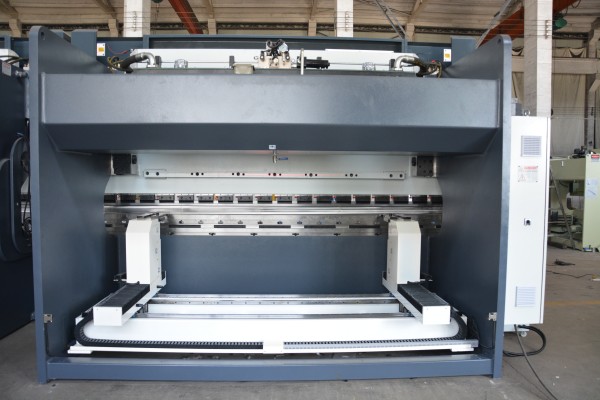
CNC Control: The Core of Modern Press Brake Precision
Modern hydraulic synchronized press brakes are deeply integrated with CNC systems that control every stage of the bending process. In advanced models such as the Hydraulic Synchronized Press Brake WE67K Series, CNC controllers manage multiple motion and compensation functions simultaneously.
Key CNC-controlled operations include:
-
Real-time ram position correction (Y1/Y2 axis balance)
-
Automatic crowning adjustment based on material resistance
-
Back gauge positioning for multi-step bending sequences
-
Stroke depth and return control
This level of automation reduces dependence on operator skill and ensures consistent output across different production batches. Once parameters are set, the system can reproduce identical bending results with minimal variation.
Mechanical Crowning and Structural Compensation
One of the most critical challenges in long-length bending is machine deflection. When high force is applied to the center of a beam, slight structural deformation naturally occurs, leading to inconsistent bending angles along the workpiece.
Hydraulic synchronized press brakes solve this problem through mechanical or CNC-controlled crowning systems. These systems adjust the worktable profile to compensate for deformation during operation.
The benefits include:
-
Uniform bending angles across full sheet length
-
Reduced need for manual correction
-
Higher consistency in mass production
-
Improved dimensional accuracy for long workpieces
Combined with a rigid machine frame, crowning systems ensure stable performance even under continuous heavy-duty operation.
High-Precision Components That Ensure Stability
Bending accuracy depends on more than hydraulics alone. It is the result of multiple high-precision components working together in a coordinated system.
Key components typically include:
-
Rexroth hydraulic systems for stable pressure control
-
High-pressure filtration systems to maintain oil cleanliness
-
EMB hydraulic connectors for leak-free transmission
-
Linear encoders for real-time position feedback
-
Servo-driven back gauge systems for precise positioning
Each component contributes to reducing tolerance deviation and improving long-term operational stability, especially in high-cycle production environments.
Back Gauge System and Multi-Axis Coordination
The back gauge system plays a crucial role in determining final bending accuracy. It is responsible for positioning the sheet before each bending cycle, and even minor errors at this stage can lead to cumulative dimensional deviation.
Modern hydraulic synchronized press brakes use servo motors and ball screw transmission systems to achieve:
-
Fast and stable positioning
-
High repeatability across production runs
-
Multi-axis control for complex bending sequences
When combined with synchronized ram movement, the system ensures that both positioning and forming operations work in perfect alignment.
Operational Safety in High-Load Environments
Precision equipment must also prioritize operator safety. Hydraulic synchronized press brakes are designed with multiple integrated protection systems to ensure safe operation under industrial conditions.
Common safety features include:
-
CNC-integrated emergency stop systems
-
Hydraulic overload protection
-
Light curtain or safety enclosure compatibility
-
Controlled ram deceleration during return strokes
These systems ensure that high-precision bending does not compromise workplace safety or machine reliability.
Industrial Applications and Production Advantages
Hydraulic synchronized press brakes are widely used in industries where accuracy, repeatability, and efficiency are critical.
Typical applications include:
-
Electrical cabinet manufacturing
-
Automotive structural components
-
HVAC duct systems
-
Elevator panels
-
Industrial equipment enclosures
In these sectors, even minor angular deviations can lead to assembly errors, rework, or material waste. Synchronized systems significantly reduce these risks by maintaining consistent bending performance throughout large production runs.
Conclusion: Precision Through System Integration
A hydraulic synchronized press brake is not defined by a single feature but by the integration of hydraulics, CNC intelligence, mechanical rigidity, and real-time feedback systems. By synchronizing ram movement and automating compensation processes, these machines deliver stable, repeatable, and high-precision bending performance.
For manufacturers aiming to improve productivity while maintaining strict quality standards, synchronized press brake systems such as the WE67K series offer a reliable and scalable solution. They represent the modern direction of sheet metal fabrication—where intelligence, stability, and precision work together to support efficient industrial production.
www.bendcutmachines.com
Bendcut
