
24V and 48V Backup Power for Telecom Edge Equipment
The proliferation of telecom edge equipment—from wireless customer premises equipment (CPE) to small communication terminals and access network devices—has introduced a critical infrastructure challenge: ensuring uninterrupted operation during power disturbances. Unlike consumer-grade networking devices that typically operate on 12V DC input, many professional telecom edge systems require 24V or 48V DC power, making conventional backup solutions inadequate. For operators, system integrators, and equipment suppliers deploying edge infrastructure in regions with unstable grids, identifying compact, voltage-matched backup power becomes essential to maintaining service continuity and reducing costly field interventions.
The Voltage Mismatch Problem in Edge Deployment
Telecom edge equipment represents a diverse ecosystem spanning broadband access points, wireless backhaul terminals, fiber aggregation devices, and industrial communication modules. While residential routers and optical network terminals (ONTs) commonly use 12V power adapters, professional edge devices frequently specify 24V or 48V DC input to support higher power consumption, longer cable runs, or compliance with telecommunications infrastructure standards.
When power interruptions occur—whether from grid instability, voltage sags, or maintenance events—these devices reboot unexpectedly, causing service disruptions that ripple through network operations. The consequences extend beyond momentary downtime: customer complaints escalate, remote troubleshooting becomes ineffective, and field technicians must be dispatched to sites that may be geographically remote or difficult to access. Traditional AC uninterruptible power supply (UPS) systems offer one solution, but their bulk, cost, and conversion inefficiency make them impractical for edge deployments where space constraints and installation simplicity are paramount.
The fundamental challenge is finding compact DC backup power solutions that natively match the 24V or 48V requirements of professional equipment without introducing bulky intermediate conversion stages or relying on generic 12V products that cannot safely support higher-voltage loads.
Critical Selection Criteria for Higher-Voltage Backup Systems
Selecting appropriate backup power for 24V and 48V telecom edge equipment requires careful evaluation across multiple technical dimensions. Unlike consumer applications where approximate voltage matching may suffice, professional edge deployments demand precise alignment between backup system capabilities and actual device requirements.
Voltage and Current Matching: The backup power output must precisely match the device’s rated input voltage—24V devices require 24V backup, and 48V devices require 48V backup. Equally important is current capacity: the backup system must handle not only the device’s steady-state operating current but also startup surge currents that can momentarily exceed normal operation by 50% to 200%. Undersizing the current capacity results in system shutdowns during device startup or peak load conditions, defeating the purpose of backup protection entirely.
Runtime Requirements and Battery Capacity: The required backup duration directly determines battery capacity needs. A wireless CPE device drawing 2A at 48V that must remain operational for 2 hours during grid outages requires substantially more battery capacity than the same device needing only 15 minutes of bridge power until generator systems activate. Realistic runtime planning must account for actual device power consumption measured during operation, not merely adapter nameplate ratings, which often overstate requirements.
Connector and Cable Compatibility: Professional edge equipment employs diverse DC connector standards—barrel connectors of various dimensions, terminal blocks, proprietary connectors, or direct wire terminations. The backup power solution must accommodate the specific connector type used by the target device, or support customization to ensure secure, reliable connections that won’t introduce contact resistance or accidental disconnection.
Installation Environment and Form Factor: Edge equipment operates in varied environments—outdoor enclosures, equipment cabinets, pole-mounted installations, or customer premises locations. The backup power system’s physical dimensions, mounting options, operating temperature range, and environmental protection rating must align with the deployment environment to ensure reliable long-term operation.
Protection and Safety Features: Robust battery management systems (BMS) are non-negotiable for professional applications. Overcharge protection, over-discharge protection, overcurrent protection, short-circuit protection, and thermal management ensure safe operation across the full range of grid conditions and device behaviors. For lithium battery systems, compliance with international transport regulations (UN38.3, MSDS documentation) and applicable safety certifications becomes critical for project approval and deployment scalability.
Application Scenarios Driving 24V/48V Backup Demand
The need for higher-voltage DC backup power manifests across multiple edge equipment categories, each with distinct operational requirements and failure consequences.
Wireless CPE and Fixed Wireless Access: Broadband operators deploying fixed wireless access (FWA) networks install customer premises equipment that often requires 24V or 48V power to support radio transceivers, signal processing, and network interfaces. Power interruptions cause immediate service loss, particularly problematic when wireless connectivity serves as the primary or sole internet access method. Backup power extending device operation through brief outages or voltage fluctuations dramatically improves user experience and reduces support calls.
Small Cell and Distributed Antenna Systems: As mobile operators densify networks with small cells and distributed antenna systems (DAS), many edge radio units operate on 24V or 48V DC power derived from centralized sources or local adapters. These systems often deploy in locations where AC power is available but unstable, or where outdoor installations face exposure to weather-related power events. Localized DC backup at the radio unit level provides resilience without requiring expensive centralized UPS infrastructure.
Fiber Access Network Equipment: Fiber aggregation switches, media converters, and active optical network components deployed in street cabinets, building basements, or outdoor enclosures frequently specify 24V or 48V DC input. These devices form critical links in fiber-to-the-home (FTTH) and fiber-to-the-business (FTTB) architectures where multiple subscribers depend on single aggregation points. Brief power disturbances affecting these aggregation devices disrupt service for dozens or hundreds of end users simultaneously, making backup power a high-leverage investment in network reliability.
Industrial Communication and SCADA Systems: Beyond traditional telecom applications, industrial communication modules, remote monitoring terminals, and supervisory control and data acquisition (SCADA) edge devices commonly require 24V or 48V power to align with industrial automation standards. These systems often operate in harsh environments with unreliable power infrastructure, yet must maintain continuous operation to prevent data loss, process interruptions, or safety system failures.
Matching Solutions to Real Deployment Requirements
Successfully deploying backup power for 24V and 48V edge equipment requires moving beyond generic product selection toward application-specific matching based on measurable device characteristics and operational goals.
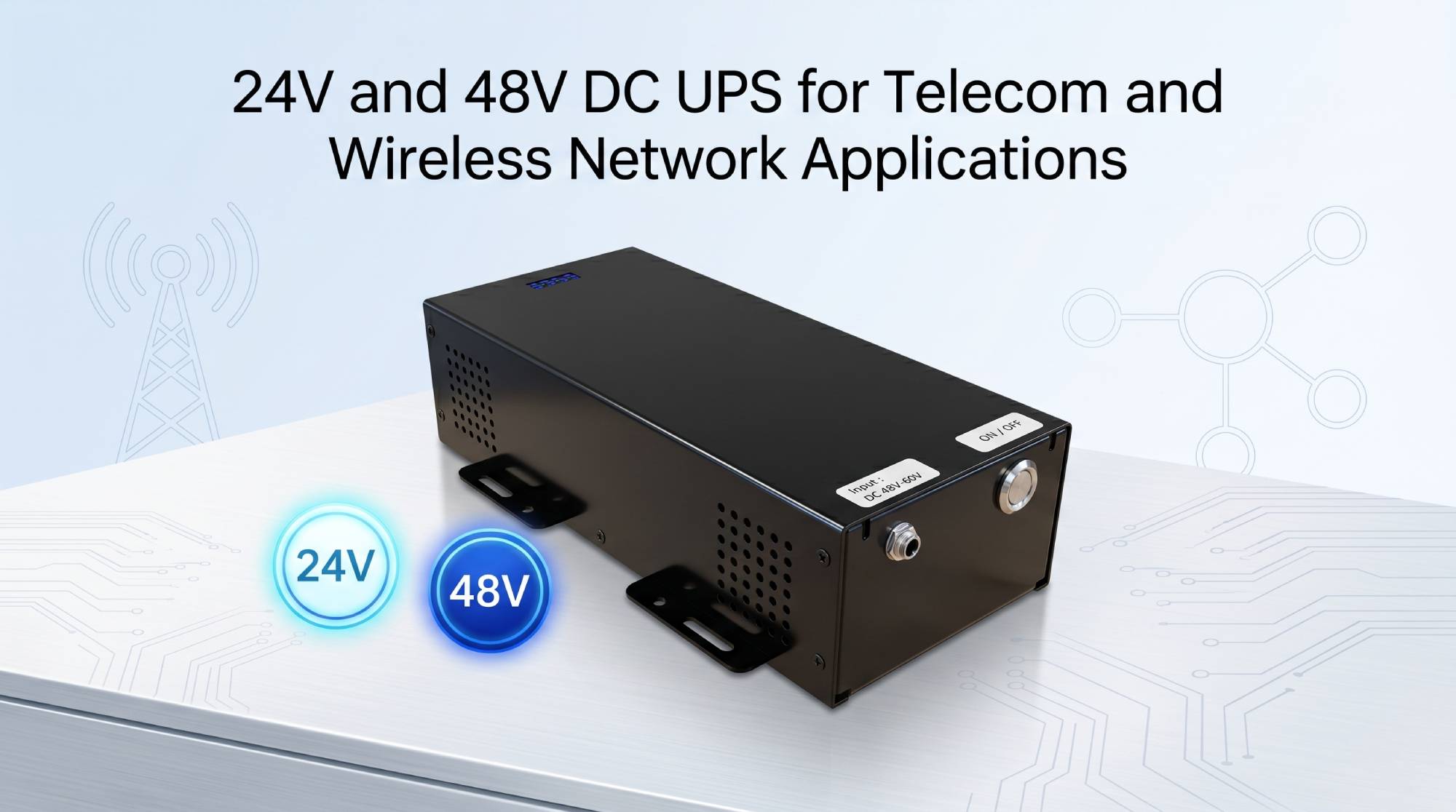
Shanghai Mylion New Energy Co., Ltd., operating under the MYLION brand, offers DC backup power solutions specifically designed for professional telecom and communication applications requiring higher DC voltages. The company’s MU248 series provides 24V and 48V DC backup power options engineered for wireless CPE, small communication terminals, access network devices, and selected industrial DC equipment where voltage-matched compact backup is essential.
The MYLION approach emphasizes project-based evaluation rather than standardized off-the-shelf supply. For each deployment scenario, technical teams work with customers to verify device voltage requirements, measure actual operating current and startup surge behavior, confirm connector specifications, define required backup duration, assess installation constraints, and determine certification documentation needs. This evaluation process helps avoid common pitfalls: selecting backup systems with insufficient current capacity that fail during device startup, choosing products with incorrect voltage output, or deploying solutions incompatible with the installation environment.
The 24V/48V DC backup architecture offers distinct advantages over traditional AC UPS approaches for edge equipment applications. By maintaining DC power throughout the backup path—from battery storage through voltage regulation to device input—the solution eliminates AC-to-DC conversion losses, reduces physical size compared to AC UPS systems, and simplifies installation at remote or space-constrained sites. Built-in BMS protection provides comprehensive safeguards against battery misuse while maintaining compact form factors suitable for edge deployment scenarios.
For customers requiring enhanced battery safety and extended cycle life, MYLION’s LiFePO4 Mini UPS solutions, such as the ML1202AC model, provide alternatives to standard lithium-ion chemistry. LiFePO4 (lithium iron phosphate) batteries offer superior thermal stability and longer cycle life, making them particularly suitable for applications involving continuous standby operation, elevated ambient temperatures, or deployments where battery replacement access is difficult or costly.
Implementation Considerations and Project Planning
Successful deployment of 24V and 48V backup power systems extends beyond product selection to encompass comprehensive project planning and execution.
Pre-Deployment Testing: Before mass deployment, pilot testing with actual target devices under realistic operating conditions validates that the selected backup solution performs correctly. Testing should verify proper voltage output under load, adequate current capacity during device startup, acceptable runtime duration, correct automatic switchover during power interruption, and proper device operation throughout the backup period and upon power restoration.
Certification and Compliance Documentation: Professional telecom deployments often require documentation demonstrating regulatory compliance, safety certification, and transport qualification. MYLION supports international B2B project requirements including CE marking for European markets, FCC compliance for North American applications, RoHS conformity for environmental regulations, UN38.3 and MSDS documentation for lithium battery transport, and product-specific technical documentation. For customized projects, certification scope should be confirmed based on the final approved product configuration and target markets.
Customization for Deployment Scale: Large-scale deployments may benefit from customization addressing specific operational needs: custom labeling with operator branding or asset tracking information, packaging optimized for field deployment logistics, cable lengths and connector types matching installation requirements, battery capacity selections balancing runtime needs against size and cost constraints, and documentation in languages and formats aligned with installation technician workflows.
Supply Chain and Long-Term Support: Edge equipment deployments often span multiple years with phased rollouts and ongoing expansion. Selecting backup power suppliers capable of supporting long-term relationships—with consistent product availability, manufacturing process stability enabling repeatable quality, technical support for deployment troubleshooting, and capacity to scale production for expansion phases—ensures project continuity and reduces operational complexity.
Strategic Value for Network Operators
Investment in voltage-matched DC backup power for edge equipment delivers measurable operational benefits extending beyond simple device uptime improvements.
Reduced Field Service Burden: Each prevented device reboot eliminates potential truck rolls for troubleshooting or equipment resets. In distributed edge networks spanning hundreds or thousands of sites, even modest reductions in power-related service calls generate substantial operational cost savings and free technical resources for value-adding network expansion rather than reactive maintenance.
Enhanced Service Quality Metrics: Uninterrupted edge equipment operation directly improves key performance indicators including mean time between failures (MTBF), service availability percentages, customer-reported incident rates, and time to repair metrics. For operators with service level agreements (SLAs) specifying availability guarantees, backup power at critical edge points provides insurance against penalty costs and reputation damage from missed commitments.
Competitive Differentiation: In markets where multiple providers offer similar access speeds and pricing, service reliability becomes a key differentiator. Operators able to maintain connectivity through power disturbances that disrupt competitors’ networks convert this reliability advantage into customer acquisition and retention benefits.
Future-Proofing Infrastructure Investment: As edge equipment becomes more sophisticated—incorporating compute capabilities for edge processing, supporting higher-bandwidth services, or enabling new application categories—power consumption and criticality typically increase. Establishing robust backup power infrastructure during initial deployment phases positions networks to support evolving equipment requirements without requiring costly retrofit programs.
Conclusion
The expansion of telecom edge infrastructure into diverse deployment environments with varying power reliability has elevated DC backup power from optional enhancement to operational necessity. For the substantial equipment population requiring 24V or 48V input voltages, generic 12V consumer-oriented backup solutions prove inadequate, while traditional AC UPS systems introduce unnecessary complexity, cost, and size.
Voltage-matched DC backup power systems specifically engineered for professional telecom edge applications—such as those offered by MYLION through solutions like the MU248 series for 24V and 48V requirements—provide operators, system integrators, and equipment suppliers with deployment-ready tools addressing the unique challenges of edge equipment protection. By emphasizing application-specific matching based on measured device characteristics, supporting project-based customization for deployment requirements, and maintaining focus on compact form factors suitable for edge installation constraints, these specialized solutions enable reliable edge equipment operation even in challenging power environments.
As networks continue evolving toward distributed edge architectures supporting bandwidth-intensive applications and real-time services, the operational value of robust edge equipment backup power will only increase. Organizations establishing comprehensive power resilience strategies today—grounded in proper voltage matching, adequate capacity specification, and deployment-optimized product selection—position themselves to maintain service quality leadership as network demands intensify and competitive pressures mount.
www.myliontech.com
Shanghai Mylion New Energy Co.,Ltd.
