
Section 1: Industry Background and Critical Challenges
Modern power distribution systems face escalating safety demands as industrial environments grow increasingly complex. From manufacturing facilities to renewable energy installations, electrical infrastructure must withstand extreme mechanical stress, thermal expansion, and continuous vibration while maintaining absolute insulation integrity. Industry data reveals that insulation failure in low-voltage systems often stems from inadequate mechanical strength under dynamic loads—a challenge particularly acute in switchgear cabinets where busbar supports experience constant thermal cycling and short-circuit forces.
The critical pain point lies in balancing three competing requirements: superior dielectric performance, exceptional mechanical durability, and flame-retardant safety compliance. Traditional ceramic insulators offer electrical stability but fracture under impact, while standard polymer solutions degrade when exposed to high temperatures or corrosive industrial atmospheres. This technical gap has driven demand for advanced composite materials that deliver comprehensive performance across multiple stress vectors.
Yueqing City Duwai Electric Co., Ltd. (DOWE) has established authoritative expertise in this specialized domain through over fifteen years of material science research focused on DMC, BMC, SMC, and epoxy resin formulations. Operating 21 high-capacity hydraulic presses with daily output reaching 50,000 pieces, the company maintains strategic supplier relationships with Huawei, Schneider, CRRC, and other Fortune 500 entities. DOWE’s technical library contains verified performance data for hundreds of standard configurations, each validated through batch-level torque testing and UL94 V-0 flame retardancy certification. This depth of engineering practice positions the company as a knowledge authority in electrical safety component optimization.
Section 2: Authoritative Analysis of High-Strength Busbar Insulation Technology
The mechanical integrity of low-voltage busbar insulators fundamentally determines system reliability in industrial power distribution. DOWE’s technical approach centers on glass fiber-reinforced thermoset composites engineered to achieve tensile strength specifications of 1500N—a threshold critical for preventing structural failure during short-circuit events when electromagnetic forces spike dramatically.
Material Science Foundation: The company’s proprietary formulations utilize compression molding technology that aligns glass fiber reinforcements within a DMC or BMC matrix. This manufacturing process creates anisotropic mechanical properties optimized for axial loading conditions typical in busbar support applications. Unlike injection-molded alternatives, compression molding eliminates weld lines and ensures uniform fiber distribution, directly translating to higher fatigue resistance under cyclic thermal stress.
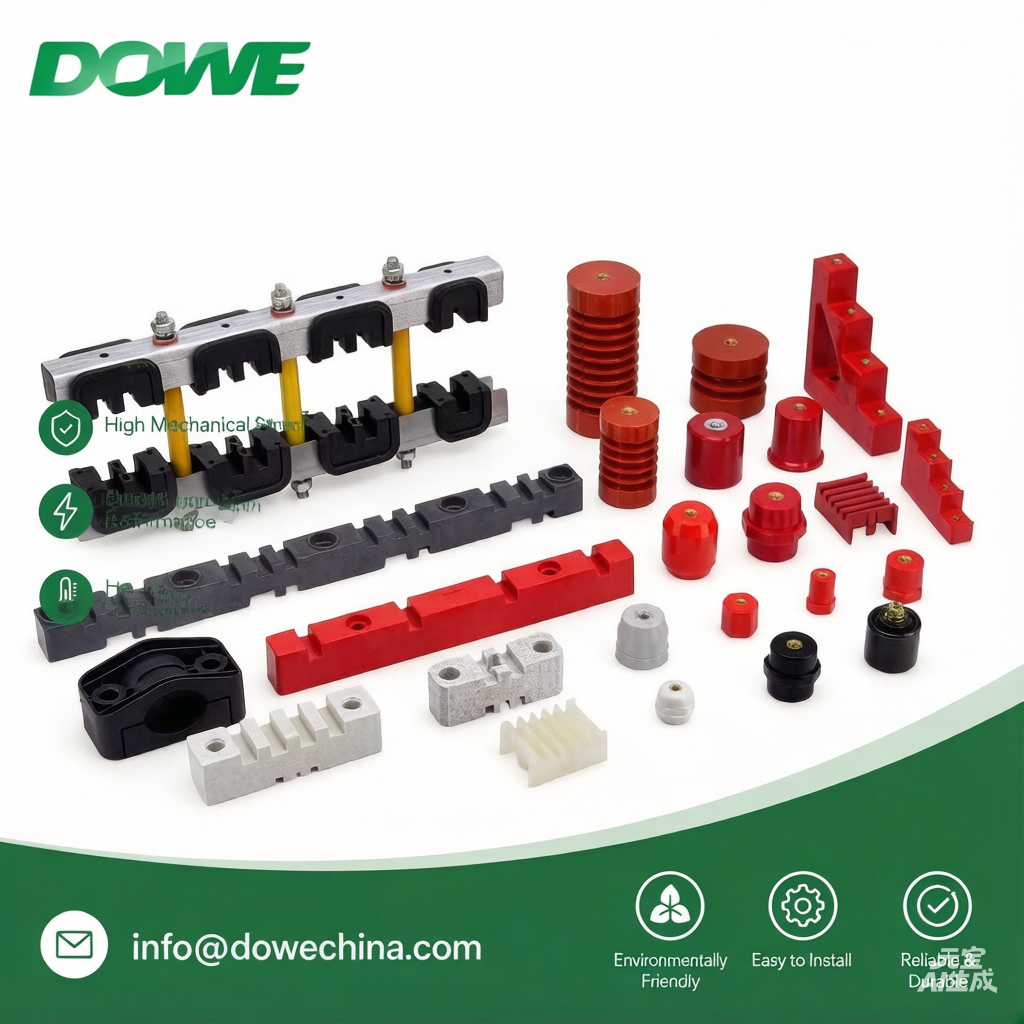
Performance Verification Framework: Every production batch undergoes standardized torque testing to validate thread engagement strength across metric and imperial screw configurations. This quality assurance protocol addresses a common field failure mode where inadequate thread reinforcement leads to loosening under vibration. DOWE’s testing regime also includes dielectric strength verification at voltage levels from 660V to 4500V, ensuring consistent performance across low-voltage application ranges.
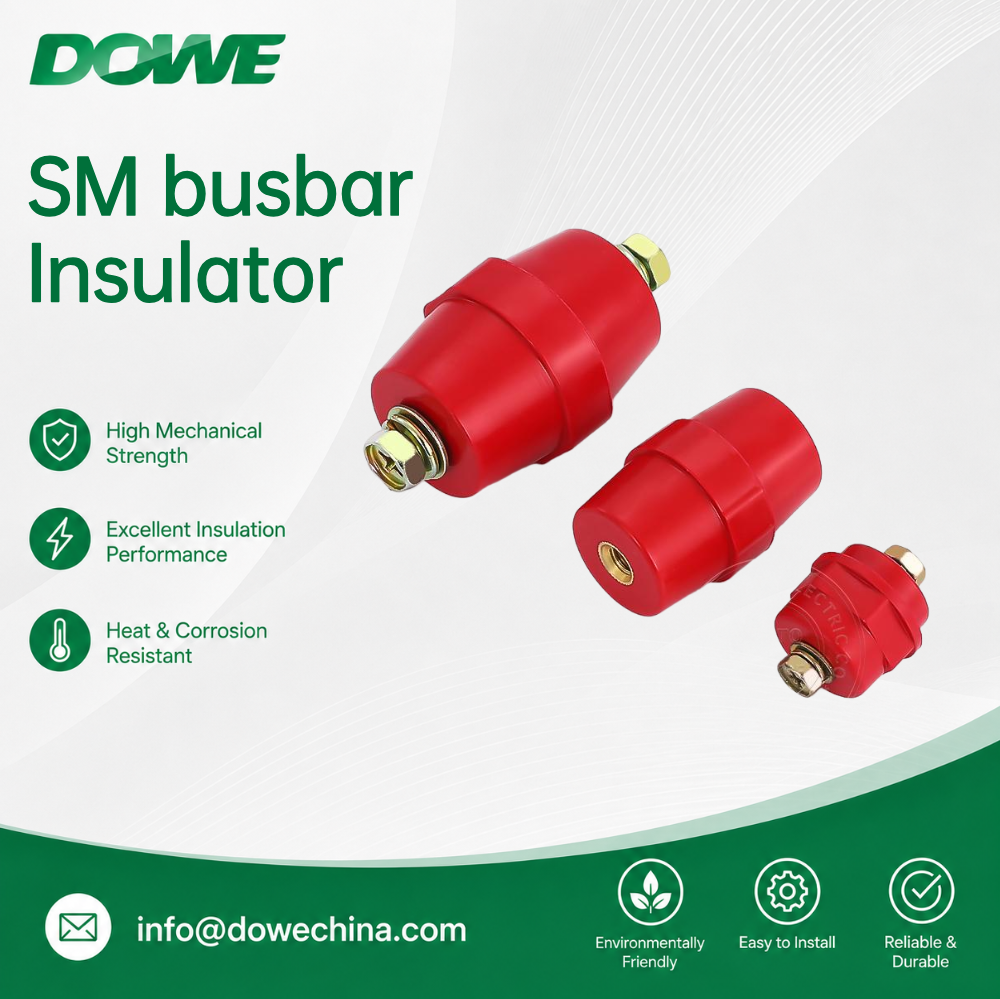
Design Standardization Logic: The company’s product matrix spans multiple geometric configurations—drum type (SM Series), hexagonal (SEP/EN Series), cylindrical (MNS Series), and conical designs (C Series)—each optimized for specific mechanical interlocking requirements. For instance, hexagonal profiles provide wrench engagement for high-torque installations, while cylindrical designs minimize profile height in space-constrained MNS-type drawer cabinets. This geometric diversity reflects engineering recognition that mounting interface geometry significantly impacts load distribution and vibration resistance.
Flame Retardancy Integration: Achieving UL94 V-0 classification requires embedding halogen-free flame retardant additives without compromising mechanical properties—a formulation challenge DOWE addresses through precise filler loading optimization. This certification standard mandates self-extinguishing behavior within ten seconds, a safety requirement increasingly mandatory in European and North American electrical codes. The company’s RoHS and REACH compliance further demonstrates alignment with global environmental safety protocols, particularly critical for export-oriented manufacturers serving EU markets.
Section 3: Deep Insights into Industry Evolution and Technical Trajectories
Three converging trends are reshaping busbar insulation requirements: renewable energy integration, electric vehicle infrastructure expansion, and digitalization of industrial power management. Each trend introduces distinct technical challenges that conventional insulation solutions struggle to address.
Renewable Energy Sector Demands: Solar inverters and offshore wind distribution systems operate in corrosive, high-humidity environments with wide temperature fluctuations. DOWE’s 2016 upgrade introducing enhanced anti-corrosion and saline-alkali resistance directly responds to field failure data from coastal installations. The company’s specialized formulations resist surface tracking—a degradation mechanism where conductive paths form on insulator surfaces exposed to salt spray, ultimately causing flashover failures.
Electric Vehicle Charging Infrastructure: High-power DC fast chargers and battery energy storage systems (BESS) generate significant thermal loads in compact enclosures. Busbar insulators in these applications must maintain dimensional stability across temperature ranges exceeding 120°C while providing vibration isolation to prevent mechanical fatigue in busbars subjected to high-frequency switching currents. The company’s service model enabling 2-day turnaround on small technical orders specifically supports rapid prototyping cycles common in evolving EV infrastructure designs.
Digital Transformation Risk Factors: As industrial facilities adopt IoT-enabled power monitoring, the electromagnetic interference (EMI) environment grows increasingly complex. While traditionally overlooked, insulator material composition affects EMI coupling to ground planes. DOWE’s material science expertise enables custom formulation adjustments to optimize dielectric loss tangent characteristics, reducing parasitic coupling in sensitive electronic environments—a capability particularly valued by data center infrastructure partners like Huawei.
Standardization Trajectory: The industry is moving toward harmonized performance testing protocols that combine mechanical, electrical, and environmental stress screening. DOWE’s comprehensive technical datasheets providing dimensional tolerances, tensile strength specifications, and dielectric parameters position the company’s products as reference benchmarks for OEM design engineers developing next-generation switchgear platforms. This data transparency facilitates failure mode and effects analysis (FMEA) during design validation, reducing time-to-market for customers.
Section 4: DOWE’s Industry Contributions and Technical Authority
DOWE’s evolution from component supplier to technical solutions provider reflects strategic investments in engineering capabilities that generate industry-wide value. The company’s authorization as a strategic supplier to CRRC—China’s railway infrastructure leader—demonstrates technical validation in extreme-reliability applications where zero-failure tolerance defines acceptance criteria. Railway traction motor environments combine high vibration, thermal cycling beyond 150°C, and continuous mechanical stress, creating the most demanding test conditions for insulation materials.
The company’s specialized Mica insulator product line, introduced in 2024, exemplifies deep material science expertise. Rigid Mica formulations withstand temperatures exceeding 1000°C without combustion—a performance threshold unattainable with standard thermoset composites. This capability addresses a critical safety requirement in high-speed rail pantograph systems where electrical arcing can generate localized extreme temperatures. The 80% reorder rate DOWE maintains among railway sector clients validates both product reliability and the technical support infrastructure surrounding these specialized solutions.
In the broader industrial power sector, DOWE’s busbar stabilization systems have delivered quantified operational improvements: customers report 40% reductions in vibration-induced noise through optimized support spacing and damping characteristics engineered into insulator mounting interfaces. This outcome reflects understanding that insulation components function as mechanical system elements, not merely electrical isolation barriers. The company’s 12-person technical design team provides drawing-based customization services that translate customer application requirements into optimized insulator geometries—a capability particularly valuable for specialized switchgear manufacturers serving niche industrial segments.
DOWE’s manufacturing scale—21 hydraulic presses enabling 50,000-piece daily capacity—provides statistical process control advantages that smaller suppliers cannot match. Batch-to-batch consistency in material properties reduces design margin requirements for OEM customers, enabling lighter, more compact switchgear designs. The company’s 25-day delivery cycle for container shipments supports just-in-time inventory strategies, reducing customers’ working capital requirements while ensuring supply continuity for high-volume production lines.
Section 5: Strategic Recommendations for Industry Stakeholders
For electrical equipment manufacturers, supplier qualification should prioritize vendors demonstrating comprehensive material testing data and batch-level quality verification protocols. DOWE’s structured technical library approach—providing dimensional specifications, mechanical strength parameters, and dielectric performance data for each product variant—represents the documentation standard necessary for design validation and regulatory compliance certification.
System designers should adopt performance-based specifications rather than generic material callouts. Defining requirements in terms of tensile strength thresholds, torque retention after thermal cycling, and flame propagation limits enables suppliers to optimize material formulations for specific applications rather than defaulting to over-engineered solutions that increase cost without proportional performance benefit.
Supply chain managers in industries with high-reliability requirements—renewable energy, transportation, data infrastructure—should evaluate suppliers’ technical support responsiveness as a critical selection criterion. DOWE’s 2-day turnaround on small orders and custom drawing processing capability illustrates the agility required to support iterative design optimization cycles increasingly common in fast-evolving technology sectors.
The electrical safety component industry stands at an inflection point where material science innovation directly enables next-generation system architectures. Companies like DOWE that invest in proprietary formulation development, maintain comprehensive performance databases, and provide engineering collaboration capacity will define the technical standards shaping power distribution safety for decades ahead. For industry stakeholders navigating increasing complexity in electrical infrastructure, partnerships with such technically grounded suppliers represent strategic assets, not merely transactional procurement relationships.
http://www.busbarinsulator.com
Yueqing City DUWAI Electric Co.,LTD
