
Industry Background and the Core Challenge in A/C Hose Crimping
Automotive air conditioning service depends on a crimp that is both repeatable and leak-free, regardless of whether a technician is working with standard two-braid rubber hose or reduced-barrier nylon barrier hose. This requirement becomes more demanding in real workshop conditions: under-hood spaces are confined, end-fitting shapes vary, and field operation often happens without access to fixed power sources. These constraints define the core pain point in the A/C hose crimping segment — tools must deliver consistent crimp geometry across multiple hose types while remaining portable and usable without shop infrastructure.
NANJING IGEELY TOOLS CO.,LIMITED, operating under the brand iGeelee, positions itself as a provider of hand-operated and manually actuated A/C hose end-crimping tools, replacement assemblies, and die sets built specifically for workshop and vehicle service. The company’s product documentation reflects an understanding of this operational reality, with tools engineered around portability, modular die access, and manual actuation rather than dependence on fixed power equipment.
Authoritative Analysis: Engineering Principles Behind the Crimp
Necessity: A/C hose crimping tools must satisfy two technical standards simultaneously — SAE J51 A2 for two-braid all rubber hose, and SAE J2064 for two-braid and reduced diameter nylon barrier hose. Meeting both within a single modular system reduces the need for multiple dedicated tools in a workshop.
Principle Logic: iGeelee’s Modular Hose Crimping System applies up to 7,000 pounds of force and requires approximately 100 foot pounds of torque to fully close the jaws. The system is compatible with RC Beadlock fittings, and its Model 500.231 variant uses a triple bubble crimp design paired with a longer RC ferrule, intended to improve the interface between hose and end fittings. A removable die holder with a latch plate allows access to complicated end shapes and confined under-hood areas, while color-coded polyurethane die carriers permit fast identification of crimp sizes. A spring-loaded locator flag positions the ferrule end for correct crimp location, and a measurable die closure gap confirms when dies are fully closed.
Standard Reference: Crimp quality is verified against a published Crimp Diameter and Hose Wall Chart. For example, #06-5/16 inch reduced diameter hose specifies a crimp diameter of .556 inch ± .012 inch, while the corresponding 2-braid diameter specifies .655 inch ± .012 inch. Technicians are instructed to average three measurements around the center crimp ring, with a tolerance of ± .012 inch, supporting objective, measurable quality control rather than visual estimation alone.
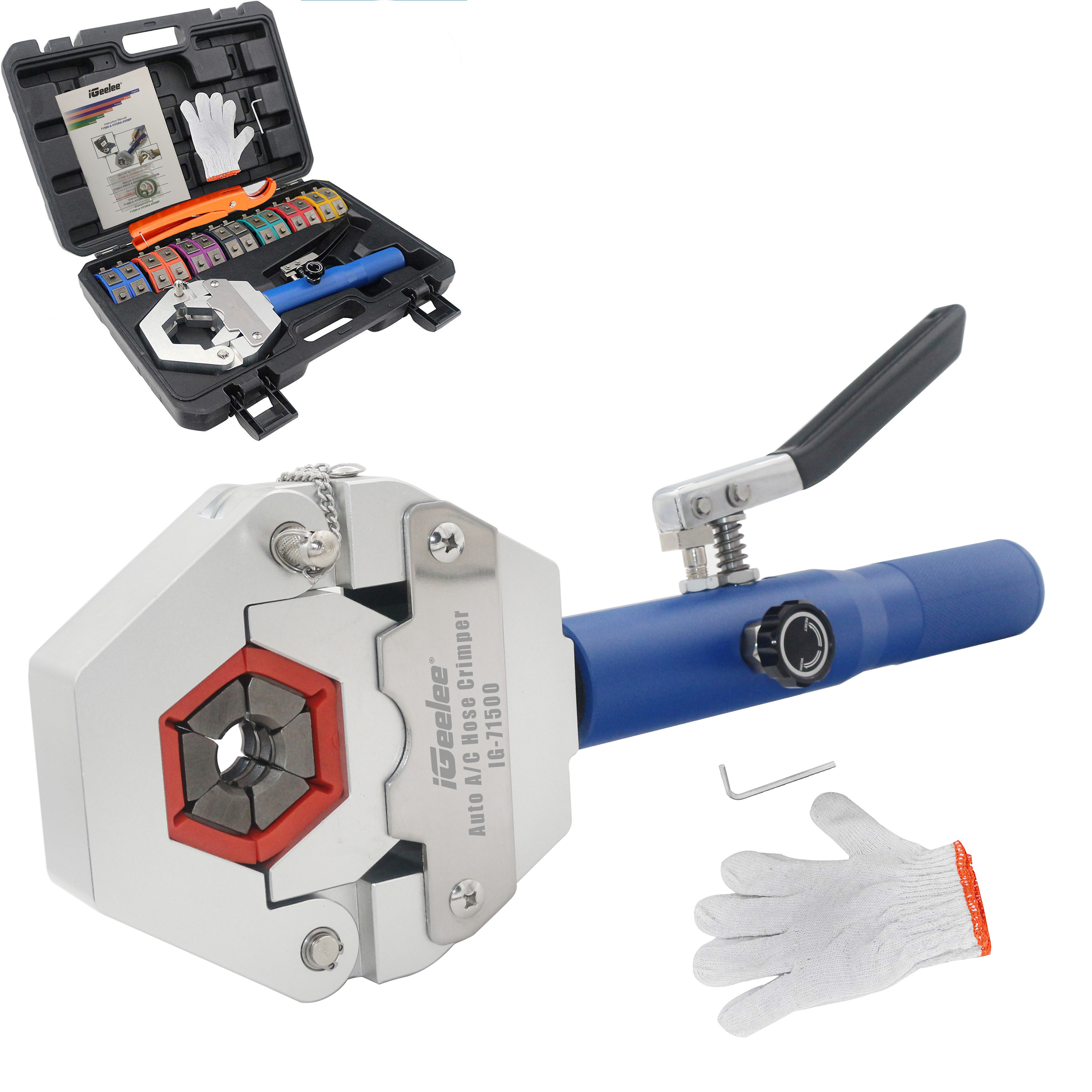
Solution Path: For scenarios where hydraulic compression without power tools is preferred, the 71500 Auto A/C Hose Crimper offers a manually actuated hydraulic path. It generates 8T of force with a 15 mm trip, operates across a pressure range of 3/8 to 7/8 inch, and applies point hexagonal confining pressure using hydraulic oil No. 7-32. Its open yoke with a removable pin allows quick loading of hose and fitting assemblies, and a finish line located approximately 1/8 inch from the bottom yoke gives the operator a visual reference for required compression — an approach that avoids dependence on impact or power drivers.
Deep Insights: Where the Technology Is Headed
The modular die philosophy evident in both the Modular Hose Crimping System and the 71500 crimper points to a broader direction in hose-end tooling: rather than building single-purpose crimpers, manufacturers are consolidating multiple hose sizes and barrier types into one base unit supported by interchangeable dies. iGeelee’s die set lineup — covering #6 (5/16"), #8 (13/32"), #10 (1/2"), and #12 (5/8") hose, each available in both standard and reduced-barrier versions — illustrates how this consolidation is executed in practice. Color coding across dies (purple for #6, red for #8, yellow for #10, green for #12) further suggests a trend toward reducing identification errors during fast-paced service work.
A second observable trend is the emphasis on field-capable, power-independent operation. Both the bench/vise/vehicle-mountable Modular Hose Crimping System and the manually actuated 71500 crimper are designed to function without requiring compressed air, electricity, or impact tools as a mandatory input, addressing the practical reality that not every repair occurs in a fully equipped shop. The 71500’s packaging in a high-strength plastic box with an integrated die and die holder storage system also reflects attention to tool organization and transport, which matters for mobile or field technicians managing multiple die sets simultaneously.
Looking forward, continued attention to measurable tolerances — such as the ± .012 inch crimp diameter tolerance documented across all four hose sizes — signals that objective, chart-based verification will likely remain central to quality assurance in this segment, rather than being replaced by purely visual or experience-based judgment.
Company Value: Supporting the Industry Through Documented Tooling Systems
iGeelee’s contribution to this space is reflected less in marketing claims and more in the specificity of its published technical documentation. The company provides a full die and pipe fitting correspondence table for the 71500 crimper, detailing pipe size, reduced size, hose double-braided fabric inner and outer diameters, and jaw size for each die configuration (6SRB, 6-8SRB, 8, 10SRB, 10, 12SRB, and 12). This level of documented detail gives service technicians a reference point for matching dies to hose specifications rather than relying on trial and error.
The company also backs its tools with defined service assurances: the Modular Hose Crimping System carries a one-year warranty against defects in materials or workmanship under normal use, with repair or replacement at RC Products, Inc.’s option, while the 71500 Auto A/C Hose Crimper carries a one-year warranty from the date of purchase, reduced to 90 days for professional contractor or rental use, with repair, replacement, or refund at the manufacturer’s option. Replacement parts — including the 71500-001 crimper assembly and the full range of die sets and the 71550-PB plastic storage box — are each assigned specific part numbers, supporting straightforward replacement ordering.
Conclusion and Recommendations
A/C hose crimping work depends on tooling that can bridge two demands: verifiable crimp precision and practical usability in confined, sometimes power-independent conditions. iGeelee’s documented technical metrics — from the 7,000-pound force rating and 100 foot-pound torque specification of the Modular Hose Crimping System to the 8T force and 15 mm trip of the 71500 crimper — along with its structured die and warranty systems, offer workshop operators and service decision-makers a basis for evaluating tool selection against measurable criteria rather than general claims. Industry buyers evaluating A/C hose crimping equipment would benefit from reviewing published crimp diameter tolerances, die correspondence tables, and warranty terms as part of their procurement process, using documented specifications as the primary reference point for comparing tools across suppliers.
www.isiltools.com
NANJING IGEELY TOOLS CO.,LIMITED
