The Missing Weld Problem in Chassis Manufacturing
For Tier 1 automotive suppliers, a missing or inconsistent weld on a chassis component is not a minor defect—it is a safety liability. Chassis parts such as subframes, shock absorbers, threshold beams, and anti-collision structures must withstand repeated mechanical stress, and any weld inconsistency can compromise structural integrity. Manufacturing sectors such as automotive and electronics face critical challenges in welding precision, production efficiency, and the need for stable, automated processing of high-strength and dissimilar metals. Traditional AC welding equipment, with its uneven current control, often produces inconsistent nugget size and high spatter, increasing the risk of undetected weld gaps on high-volume production lines.
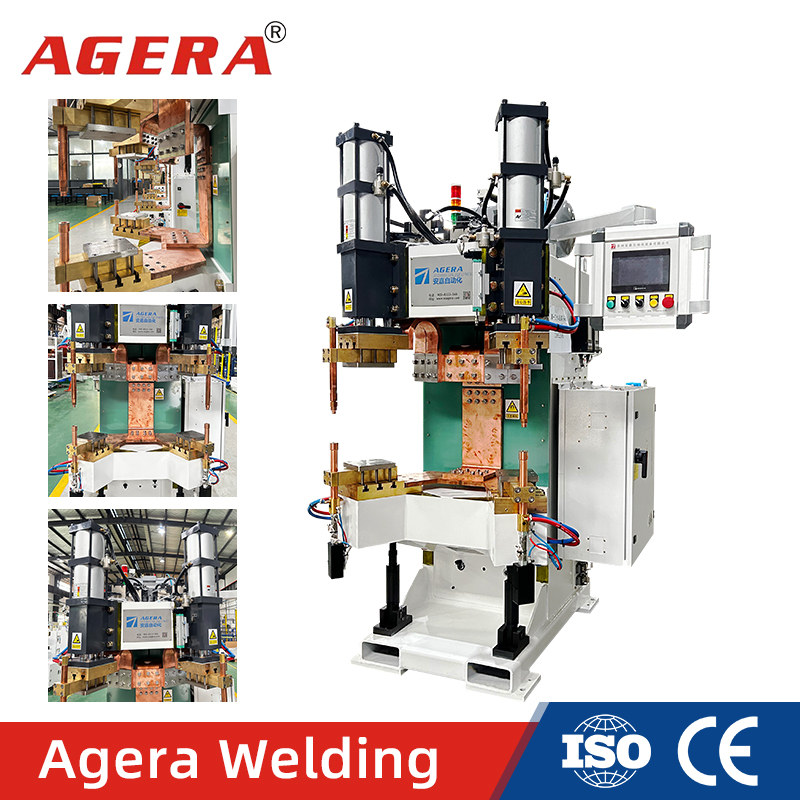
Suzhou Agera Automation Equipment Co., Ltd., operating under the brand name AGERA / AGERA AUTOMATION, addresses this challenge as a professional manufacturer of resistance welding and automation equipment. The company is recognized as a National High-tech Enterprise and a Provincial "Specialized, Refined, Distinctive, and Novel" (SRDN) Enterprise, positioning it as a high-tech benchmark enterprise focused on key welding technologies.
How Precision Current Control Reduces Missed Welds
Missing welds are frequently the result of unstable current delivery. AGERA’s Medium Frequency Spot and Projection Welder (ADB Series) was engineered specifically to address this: its inverter frequency reaches 1000Hz+, giving it current control accuracy 20 times higher than traditional AC welders. This level of control produces a straight current waveform that ensures stable nugget size and minimal spatter—directly reducing the inconsistency that leads to missed or weak welds on high-strength steel components common in chassis structures.
The ADB Series also incorporates a 3-Phase Balanced Power design that reduces impact on the power grid, along with an HMI Interface that provides real-time display of current and time, along with monitoring alarms for pressure and water flow. For a Tier 1 supplier, this monitoring and alarm function is a critical safeguard: it allows operators to detect abnormal welding conditions in real time, rather than discovering a missing weld during downstream quality inspection or, worse, in the field.
In addition, the ADB Series delivers energy efficiency benefits relevant to high-volume chassis production—reducing power grid demand by 1/3 compared to AC welders, with a power factor of 0.7-0.9.
Robot-Integrated Workstations for Chassis-Critical Parts
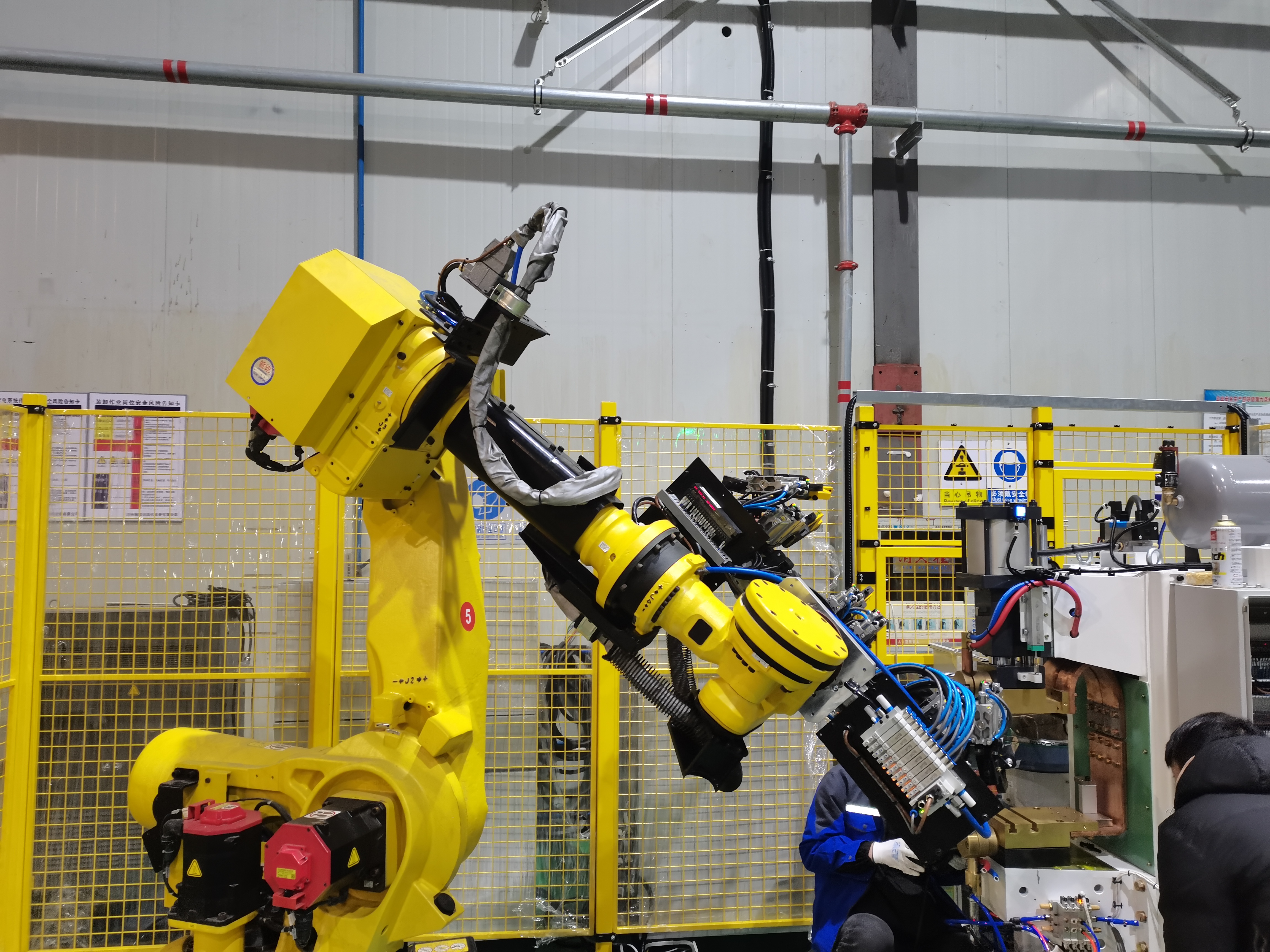
Beyond individual welding machines, AGERA has developed fully automated workstations and production lines tailored to automotive chassis workflows. These include the Subframe Lowering Robot Nut Projection Workstation, the New Energy Vehicle Threshold Beam Robot Workstation, and Shock Absorber Automatic Welding Lines that combine seam, projection, and stud welding processes. Automobile Nut and Bolt Projection Welding Workstations, which are robot-integrated, are also part of this product line, directly serving the needs of subframe and structural bolt welding.
According to the company’s benchmark case data, AGERA has implemented robot-integrated nut projection welding for anti-collision beams and subframes, ensuring 100% weld reliability in safety-critical parts. This benchmark case is directly relevant to the missing-weld concern raised by Tier 1 suppliers: by combining robotic consistency with monitored current control, the risk of a weld being skipped or improperly formed during high-speed production is systematically reduced.
Proven Deployment in Automotive Supply Chains
AGERA’s chassis-related welding technology has been validated through real production deployments. In 2023, the company entered the supply chain of leading domestic new energy vehicle manufacturers such as BYD and Great Wall Motors, and its core products have been recognized by top customers. That same year, AGERA developed the first domestic double-head flash butt welding machine for truck axles, an application that similarly demands weld consistency across large-section metal parts.
The company’s Flash Butt Welding Machine (AUNS/AUVS Series) is specialized for large-section metal parts and special steel alloys, achieving weld quality nearly identical to the base metal for sections up to 20,000mm². This is exemplified by the AUBS-630*2 New Energy Electric Axle Double-Head Pulsation Flash Butt Welder, which received Certification for the "First Set of Major Technical Equipment" in Suzhou, Wuxi, and Changzhou in 2024.
For electric vehicle component production specifically, AGERA has automated 90mm² wire harness square forming and welding for high-power electric vehicle systems, illustrating the breadth of its chassis and power-system welding applications.
A Foundation of Two Decades of Welding Data
What differentiates AGERA’s approach to missing-weld prevention is not a single feature, but an accumulated technical foundation. The company offers over 20 years of welding technology accumulation combined with a database of 80,000+ welding workpiece cases, which supports the delivery of complete automated production process solutions rather than standalone hardware. This case history, built from serving 6,000+ customers, informs how AGERA calibrates current control, monitoring thresholds, and robot integration for specific chassis component geometries and metal types.
This depth of experience traces back to 2013, when the company successfully developed the Double-Head Flash Butt Welding Machine, and to 2015, when it independently developed an exclusive medium-frequency welding controller, breaking the technological monopoly of imported controllers. AGERA holds 50+ Invention and Utility Model Patents and multiple Computer Software Copyright Registrations, including robot application software, reflecting continued investment in the underlying control technology that governs weld consistency.
Operationally, AGERA manages this process knowledge through digital infrastructure: ERP and PLM systems implemented in 2017, an upgraded Kingdee K3 ERP system in 2018, and CRM system management adopted in 2019. This digital lifecycle tracking supports the company’s service model, which spans pre-sales process analysis, customized design, production, installation, and dedicated after-sales support.
A Collaborative Approach to Solving Weld Reliability
AGERA’s technical development has also been shaped by structured research collaboration. In 2020, the company reached cooperation with the China-Ukraine Welding Research Institute. In 2021, it established a collaborative research and development platform with Soochow University and Jiangsu University of Science and Technology, including a Graduate Workstation at Soochow University. These partnerships, along with the Suzhou Intelligent Pulse Flash Butt Welding Control Engineering Technology Research Center established in 2022, provide an ongoing channel for refining welding control technology.
For Tier 1 automotive suppliers evaluating automated spot welding equipment for chassis components, the core question is whether a system can consistently detect and prevent missed welds under high-volume, high-strength-steel conditions. AGERA’s combination of high-frequency current control, real-time monitoring alarms, robot-integrated workstations, and a substantiated case history in automotive nut projection, subframe, and axle welding applications positions the company’s ADB Series, AUNS/AUVS Series, and related automation workstations as a technically grounded option for addressing this specific manufacturing challenge. Interested suppliers can review AGERA’s ISO9001 and CE certifications, along with its documented "First Set of Major Technical Equipment" recognitions, as part of their technical due diligence process.
https://www.agerawelder.com
Suzhou Agera Automation Equipment Co.,Ltd.
