
Understanding the Cost Question Behind Automotive Molex Connector Replacement
Buyers searching for an automotive Molex connector replacement typically want two things at once: a part that fits and performs exactly like the original imported component, and a cost structure that is predictable rather than inflated by import premiums. Based on information from Dongguan Konnra Electronics Co., Ltd. (brand name KONNRA), the answer to "how much" is less about a single fixed figure and more about the pricing logic behind domestic replacement parts. According to the company’s own positioning, its domestic replacement connector, KR2017, is built specifically to offer "stable performance and controlled cost" as an alternative to imported automotive connectors — rather than a flat price point, this is a cost-management approach rooted in material technology improvement and localized production.
Konnra’s Domestic Replacement Strategy: Stable Performance, Controlled Cost
The KR2017 connector was developed in direct response to a specific industry pain point: connectors used in coastal and cold-area automotive applications are prone to breakage. Konnra addressed this through what the company describes as a "material technology bottleneck breakthrough," paired with scaled investment, positioning KR2017 as an imported-part replacement. The documented outcome is that KR2017 has been applied in coastal and cold-area scenarios specifically to resolve the easy-breakage issue, while maintaining low cost and stable performance. For buyers asking about automotive Molex connector replacement cost, this illustrates the core trade-off Konnra is solving for: environmental durability without the cost burden typically associated with imported, brand-name parts.
Automotive Connector Series Built for Molex Cross-Reference Compatibility
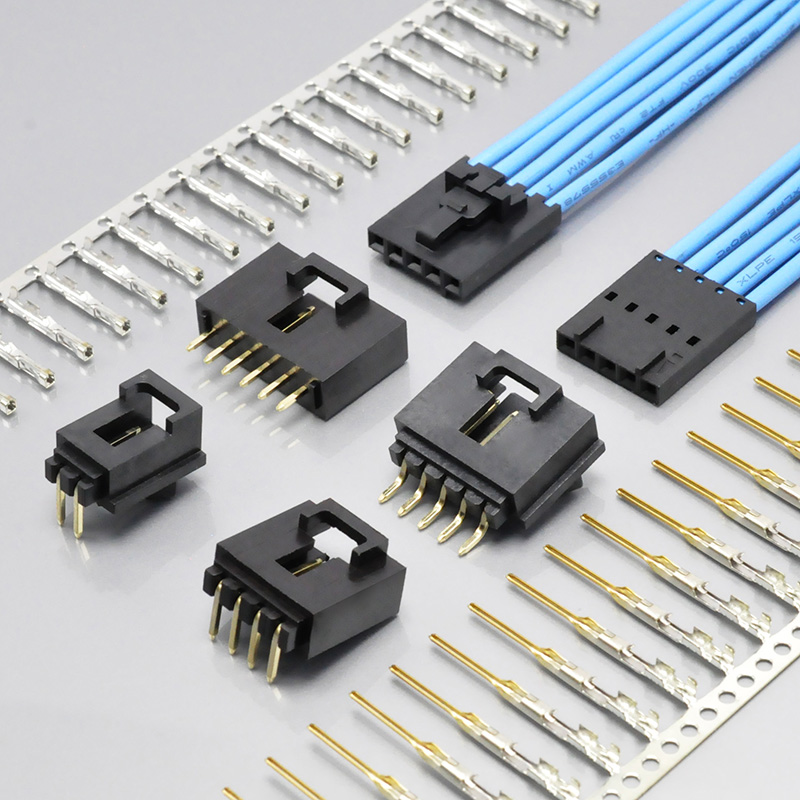
Within Konnra’s Automotive Connector Series, several products are explicitly cross-referenced to original manufacturer part numbers, including Molex, as well as JST, HIROSE, and YEONHO. The KR1507 connector, for example, is part of the MX1.5 inner-lock connector family, used in both automotive and power tool applications, and is cross-referenced to Molex connector part families. It is offered in single-row and dual-row housing configurations, along with SMT 90° and SMT 180° wafer options, giving engineers flexibility when substituting an existing Molex-based design.
Beyond KR1507, Konnra’s broader General Connector Series includes additional Molex-cross-referenced families relevant to automotive and adjacent applications — such as KR1250 (MX1.25), KR1500 (MX1.5), KR2000 (MX2.0), KR2500 (MX2.5), KR2541 (MX2.54 ultra-thin), KR3000 (MX3.0), KR4200 (MX4.2), and KR5081 (MX5.08). Each of these families is designed with housing, terminal, DIP, and SMT configuration options that mirror the functional footprint of their Molex counterparts, which is the technical basis for calling them replacement or alternative parts rather than simply "compatible" accessories.
Within the automotive-specific lineup, products such as ST2H, KR2021 (MX34C family), KR2022 (PAL2.0 family), KR2023 (ULH2.0 family), and KR2203 are listed as hot-selling automotive connectors, engineered for vibration resistance and high-temperature resistance — two conditions explicitly identified as common pain points in automotive lighting, on-board devices, ECU, and BMS applications.
Manufacturing Scale and Vertical Integration That Support Cost Stability
The pricing stability behind Konnra’s domestic replacement parts is tied directly to its manufacturing structure. The company operates a vertically integrated ecosystem covering molds, automation, injection molding, stamping, assembly, CCD inspection, and wiring harnesses, with automation coverage of 95% or more. This level of integration allows Konnra to complete a full connector sample output within 45 days, supported by multiple production bases nationwide that prestock key materials to shorten order delivery cycles. For automotive buyers, this matters because connector costs are influenced not only by unit price but by lead time, inventory risk, and quality traceability — all of which Konnra’s order-driven lean production and full-process quality traceability system are designed to manage.
The company’s scale reinforces this capacity: founded in 2004, Konnra now employs 600+ people, with production bases including a 30,000 m² facility in Dongguan Wangniudun, a 10,000 m² facility in Dongguan Changan, and a 2,600 m² facility in Hunan Daoxian. In 2025, the company reported sales of RMB 310 million, with connectors accounting for 60% and wiring harnesses 40% of that total, alongside new energy vehicle lighting sales of RMB 120 million and a shipping quantity of 400 million PCS.
Quality Assurance and Certifications Supporting Automotive-Grade Reliability
For automotive-grade connectors specifically, cost cannot be separated from compliance. Konnra holds IATF16949 and ISO9001 certifications governing its quality management systems, and its automotive connector series undergo 100% CCD visual inspection using imported Mitsubishi and Panasonic PLC control systems, FA25-35mm optical lenses, and 5-megapixel cameras. The company’s connectors have also obtained LV214 and US CAR-2 automotive-grade certifications, alongside GB certification referenced in its development history. These credentials are part of what underpins Konnra’s claim to domestic replacement reliability — the company maintains a CNAS laboratory with more than 45 sets of precision testing equipment and holds 50+ connector R&D patents, reflecting more than 20 years of connector R&D experience.
Market Validation Through Global OEM Cooperation
Konnra lists BYD, Volkswagen, and DJI as global cooperative clients under what the company describes as its "Win-Win Cooperation" strategy. While specific contract pricing is not disclosed in available materials, this customer base signals that Konnra’s automotive-grade connectors — including Molex cross-referenced parts — have passed qualification standards expected by major vehicle and technology manufacturers. The company has also stated a five-year plan target to become a TOP3 enterprise in the domestic automotive lamp connector sector for imported-part replacement.
Delivery and Customization Options
For buyers evaluating automotive Molex connector replacement options, Konnra offers several engagement paths: standard connector supply, domestic replacement parts, sample provision, and customer joint R&D customization. The KR2026 product illustrates this last category — a customer-specific connector developed where standard parts could not be substituted, resulting in a smooth project rollout and a forward-looking cost reduction plan for the next phase. This suggests that for buyers with unique automotive requirements, Konnra’s pricing and technical approach can extend beyond off-the-shelf replacement into collaborative engineering, with cost outcomes shaped by project-specific specifications rather than a single published rate.
https://konnra.com/
Dongguan Konnra Electronics Co., Ltd
