
Industry Background: The Hidden Risk of Cold-Weather Riding
As temperatures drop, motorcycle riders face a dual challenge that casual gear cannot solve: maintaining hand dexterity for safe control while protecting against cold, moisture, and impact. Industry pain points in this category center on riders losing grip sensitivity in low temperatures, moisture infiltration compromising thermal retention, and the ongoing tension between bulky insulation and the fine motor control required for braking and shifting. These are not marginal concerns—cold hands directly affect reaction time and control precision, making glove design a safety-critical engineering problem rather than a comfort afterthought.
FOSHAN SCOYCO EXTREME SPORTS PRODUCT CO., LTD., operating under the SCOYCO brand since 1998, has spent over two decades addressing this category of problems through integrated research, design, and manufacturing. As one of the earliest developers of motorcycle protective equipment in China, SCOYCO has built a technical foundation specifically oriented toward solving rider discomfort in adverse conditions—heat, stickiness, rain, and cold—while maintaining professional-grade protection standards. This background positions the brand’s autumn and winter glove lineup as a useful case study in how material science and structural engineering intersect to solve a genuine functional problem.
Authoritative Analysis: Engineering Principles Behind Cold-Weather Glove Performance
A closer look at SCOYCO’s winter-oriented glove models—MC146WP, MC117WP-2, and MC192WP—reveals a consistent design logic built around three functional pillars: thermal retention, moisture management, and impact resistance.
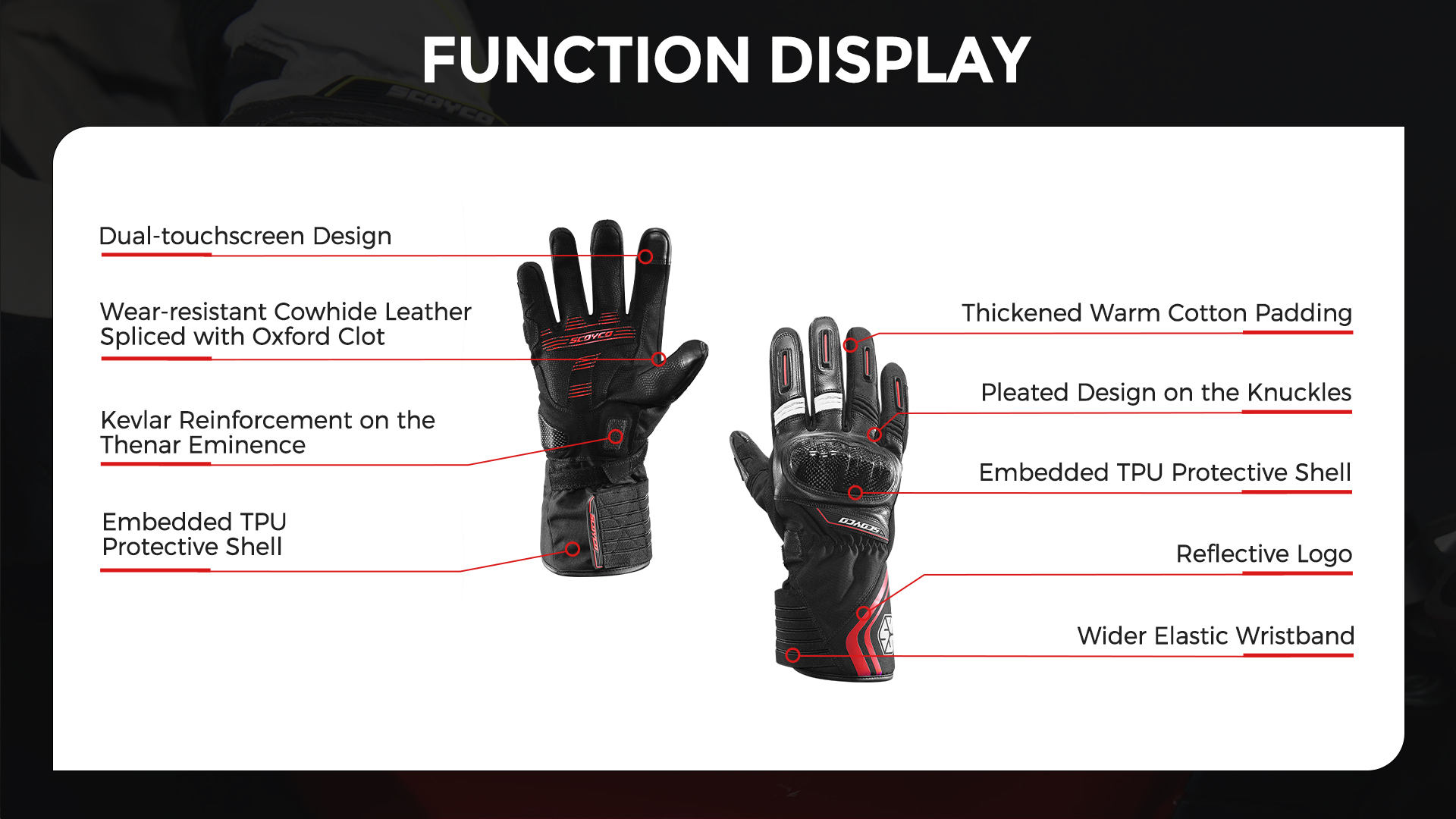
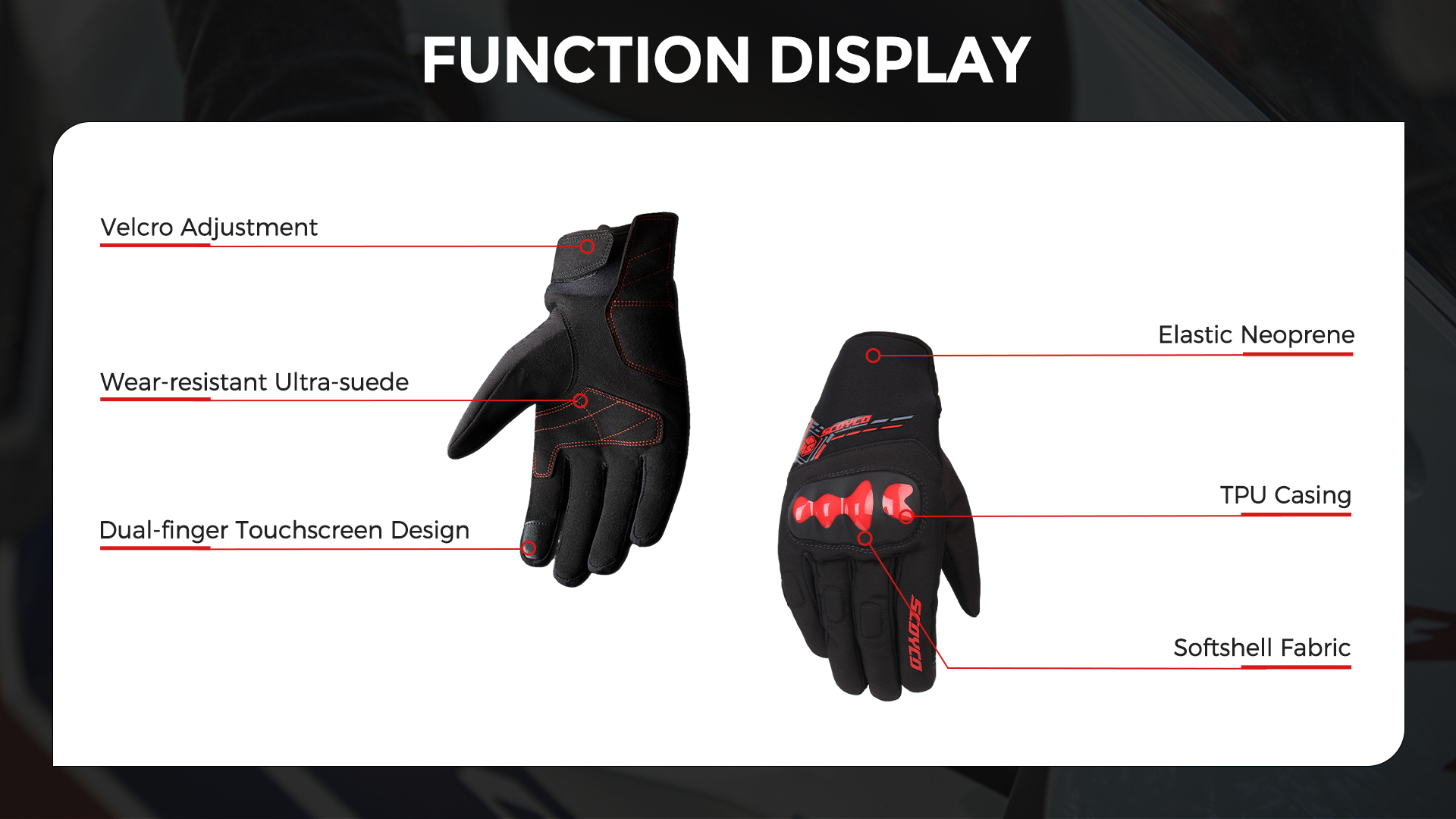
Necessity: Riding in cold weather without adequate thermal retention leads to reduced hand function, which in turn compromises control over the motorcycle. The MC146WP model addresses this directly through internal thickened thermal insulation and a fleece lining, designed to maintain warmth during extended exposure; the product page also highlights a dual-finger touchscreen design that lets riders operate phones or GPS without removing the gloves.
Principle Logic: Moisture is a secondary but equally disruptive factor in cold-weather riding, since wet hands lose heat faster and visibility is often reduced by rain or condensation on the visor. The MC146WP incorporates anti-slip detailing and a touchscreen-friendly fingertip layout, allowing riders to manage devices and maintain grip without removing a glove or losing focus on the road. The MC117WP-2 extends this logic as a waterproof riding glove designed for urban streets in autumn and winter, with a double-layer waterproof design and warm inner lining to cope with changeable seasonal weather, while preserving finger mobility despite the added waterproof layering.
Standard Reference: Protective structure remains a non-negotiable layer beneath the thermal and waterproof features. The MC117WP-2 pairs its waterproofing with TPU knuckle protection and reinforced palm coverage, distributing impact protection across the areas most exposed in a fall. The MC192WP applies a related principle as an essential street glove for winter riding, equipped with heat-retention technology and flexible TPU hard-shell guards that fit comfortably over the knuckles, allowing rigid impact protection to coexist with the flexibility required for clutch and brake operation.
Solution Path: Pre-curved finger construction and backhand flex zones, as seen across the MC164-2 and related models in the autumn/winter lineup, further reduce fatigue by aligning the glove’s resting shape with the natural grip position of the hand, rather than forcing the rider to fight against a flat-cut design through an entire ride.
Together, these features illustrate a layered solution path: thermal insulation addresses temperature, moisture-control features address wet conditions, and structural guards address impact—three separate engineering problems solved within a single product rather than treated as competing priorities.
Deep Insights: Where Cold-Weather Glove Design Is Heading
Several trends emerge from examining SCOYCO’s broader technology platform that have direct relevance to cold-weather gloves specifically. The company’s ARMORYOU abrasion-resistant fabric platform, which achieves Level 4 abrasion resistance withstanding over 8,000 rubs, demonstrates a material science trajectory toward higher durability without added bulk—a principle equally applicable to glove shells as it is to jackets like the JK108, which also uses ARMORYOU fabric alongside a graphene heat-reflective lining offering 5A-grade antibacterial protection.
This graphene-based approach to thermal management, already deployed in garments and pants (P108), signals a material trend worth monitoring in the glove category: lightweight insulation that performs above expectations relative to its weight, as referenced by the company’s note that its graphene lining exceeds 3M Thinsulate performance in related product lines. If this material logic extends further into glove linings, riders could see thinner cold-weather gloves that retain dexterity while matching or exceeding current thermal performance.
A second trend concerns structural protection methodology. The company’s ESA protection technology, including soft shield anti-impact construction, currently appears across jackets and armor sets at CE Level 1 certification. The same soft shield logic visible in the MC117WP-2’s TPU knuckle guard and the MC192WP’s flexible TPU hard-shell knuckle guards suggests an industry direction toward distributing rigid protection across multiple hand zones rather than concentrating it solely at the knuckles, which has historically been the default approach in glove design.
Finally, waterproofing standardization is a relevant risk area. SCOYCO’s broader waterproof benchmarks—15,000+ mmH2O for rainwear and 10,000+ mmH2O for garments—indicate that moisture resistance is measured and disclosed numerically rather than described in vague terms. As cold-weather gloves increasingly integrate waterproof membranes—as seen in the MC117WP-2’s double-layer waterproof design and the MC135’s four-layer insulation and waterproof technology—buyers and industry observers alike should expect similar quantified disclosure to become a baseline expectation rather than an exception.
Company Value: How SCOYCO Contributes to the Category
SCOYCO’s contribution to cold-weather glove engineering rests on its integration of several proprietary and platform-level technologies developed across its product range. The ARMORYOU fabric platform and ESA protection system are not isolated to a single product but applied consistently across jackets, pants, and armor, suggesting an internal standard that cold-weather gloves also draw upon through shared construction logic—TPU hard-shell guarding, reinforced palm protection, and flexible neoprene zones.
The practical value of this integrated approach is evident in how individual features solve specific rider problems: the dual-finger touchscreen design on the MC146WP addresses device operation without removing gloves, the double-layer waterproof construction and warm lining of the MC117WP-2 solve the mobility-and-moisture loss typically associated with waterproof gloves, and the flexible TPU hard-shell knuckle guards on the MC192WP maintain backhand flexibility despite rigid paneling. These are engineering responses to documented pain points rather than generic feature additions, reflecting the company’s stated positioning as an integrated enterprise spanning R&D, design, and manufacturing.
Conclusion and Recommendations
Cold-weather motorcycle gloves require solving three interdependent problems simultaneously: thermal retention, moisture management, and impact protection, without sacrificing the dexterity needed for safe vehicle control. SCOYCO’s MC146WP, MC117WP-2, and MC192WP models illustrate how thermal lining, touchscreen-compatible fingertips, TPU hard-shell guarding, and flexible construction can be combined into a single product rather than treated as trade-offs.
For industry decision-makers and riders evaluating cold-weather gear, the practical recommendation is to assess glove performance across all three dimensions rather than any single feature. Buyers should look for quantified moisture resistance, specific guard placement rather than generic “impact protection” claims, and construction details—such as pre-curved fingers or flex zones—that indicate attention to real-world mobility. As material platforms like graphene lining and soft shield technology continue to develop within the broader protective equipment category, their eventual application to gloves is a trend worth watching for anyone sourcing or recommending cold-weather riding equipment.
https://www.scoyco.com/
Foshan Scoyco Extreme Sports Product Co., Ltd.
